Click on the image below to download the eBook from AMAZON.COM
You will never have bored students again.
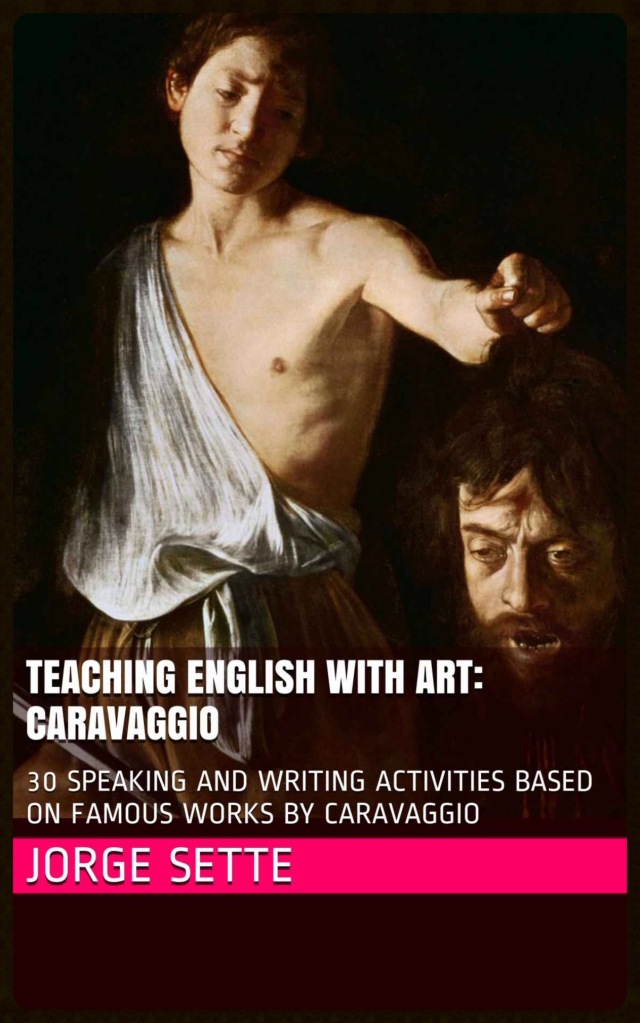
Click on the image to download the eBook
Watch the promo video clip:
Click on the image below to download the eBook from AMAZON.COM
You will never have bored students again.
Click on the image to download the eBook
Watch the promo video clip:
HAPPY NEW YEAR, EVERYONE.
Please find below some official stats sent by wordpress.com on the blog LINGUAGEM. We’ve had a great first year. Thanks for the support and we will back stronger than ever in 2015.

BLOG LINGUAGEM: 2014 official stats


Au revoir
Jorge Sette.

Acrobat on a ball, Picasso
For more info about the series TEACHING ENGLISH WITH ART: Click on the link below to go to AMAZON.COM and get your ebooks: http://wp.me/p4gEKJ-1lS
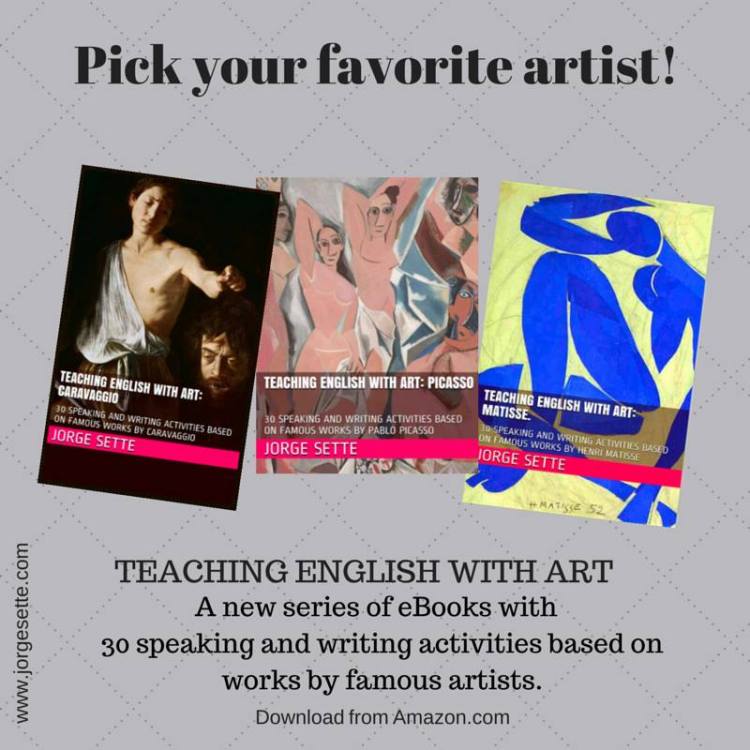
Click on the image above to access the KINDLE STORE. Teaching English with Art: Matisse, Picasso, Caravaggio, Monet, Norman Rockwell
Au revoir Jorge Sette
Teaching English with Art: the ENGLISH LANGUAGE LEARNING materials you have been waiting for:
TEACHING ENGLISH WITH ART: MATISSE. Click here for more info: http://wp.me/p4gEKJ-1kP
TEACHING ENGLISH WITH ART: PICASSO. Click here for more info: http://wp.me/p4gEKJ-1lA
#matisse #picasso #fauvism #cubism #moma #tate #teachingenglish #language #learningenglish
Click on the image below to download your book FROM AMAZON.COM
You will never have bored students again.

Teaching English with Art: Picasso
For other eBooks of the series TEACHING ENGLISH WITH ART, please click here:
Check out the video clip on our eBooks below:
Au revoir
Jorge Sette
Pioneered by Pablo Picasso and Georges Braque, Cubism is one of the most revolutionary and seminal art movements of the 20th century. It has its origins in the post-impressionist paintings of Paul Cezanne, and aims at depicting reality in a non-naturalistic way, being considered the seed of the abstract paintings developed later on. Cubism in its more innovative and radical form lasted from 1907 to 1914, when the First World War broke out.
The end of the 19th century and the early decades of the 20th century were marked by great technological innovations that cried for an art form that could express these fast changes and new times. Traditional art, based on realistic works, which had been perfecting the use of perspective since the Renaissance, could not compete with the innovations of photography and film. They would be a mere replication of these more accurate methods of showing reality.

Portrait of Fernande by Picasso, Pablo, 1909
In an attempt to grasp the essence of the times, Picasso started to move towards more simplified depictions of objects and the human form, trying to represent simultaneously the different angles from which they could be seen, not only from a unique perspective. He started to flatten his images, making use of geometric shapes (such as cubes, hence the name of the movement) and deconstructing reality by slashing the image into different planes, producing, thus, an effect which had a more intellectual than sensorial impact on the viewer.
The iconic painting Les Demoiselles d’Avignon is considered the first Cubist work of art. Primitive art, such as African masks and Iberian sculptures, played an influential role in the development of Cubism. This first phase of the movement is usually known as analytic cubism, characterized by the use of dark, almost monochromatic color hues, and growing to a point where the deconstruction of reality became so radical that the viewer could hardly identify the object or person depicted. The second phase, synthetic cubism, was a lot more energetic and colorful, including the technique of collage, where real-life two-dimensional materials, such as colored paper, newspapers or even hair ribbons, were glued to the painting.

Bottle, Guitar, and Pipe by Picasso, Pablo. 1912
It’s hard to pinpoint when Cubism really finished, although we usually place it in the historical period between 1907-1914. It actually did not end, but transformed itself and evolved into other styles in the following decades.
Even today we can identify strong influences of Cubism in architecture, design and, of course, the arts in general.
NOTE: If you teach languages, you might want to check out our series of eBooks TEACHING ENGLISH WITH ENGLISH available from AMAZON.COM: http://wp.me/p4gEKJ-1lS

Teaching English with art
Au revoir
Jorge Sette
Click on the image below to buy the product from AMAZON.COM
You will never have bored students again.
Click on the image to access the AMAZON.COM page.
Writing is today more fashionable than it has been in a long time. Perhaps it’s at the peak of its importance ever, with all the blogs, messages, emails and tweets swamping our computer, tablet and smart phone screens every second of the day. Of course, most of the time it’s bad or unclear writing. But everyone is doing it one way or another, and job opportunities are opening up for those who do it well.
Content is the key word in the workplace today. Especially if you are in sales & marketing. The buyer has all the power today and they control when, how and where they will make their next purchase. In this context, writing can be a great asset in educating and persuading prospects, making them see you as the expert, or thought leader in your field. Writing great content and making it available will help you develop a relationship with your potential customers, who will definitely lean towards your offer when the time is right.
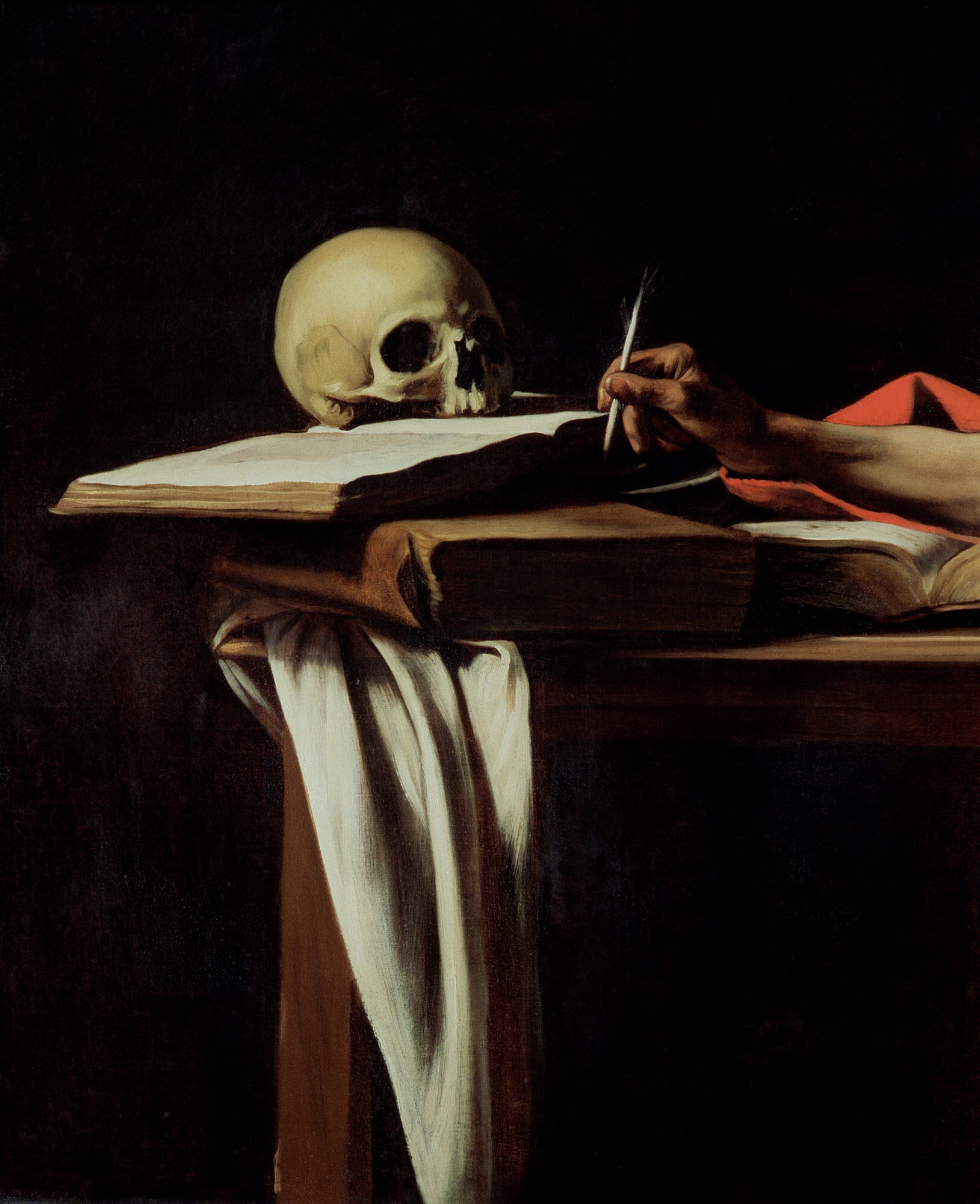
Saint Jerome Writing (detail) by Caravaggio
As a consequence of its importance, the Internet is full of advice about effective writing, how to put blogs together, the dos and don’ts and best practices of publishing anything. By all means, read all you can, as there is a lot of useful information online. Beware, however, of some of the most common misconceptions about writing: in general most of them were acquired or developed at school and academic settings rather than on the Internet. Here are five of the most common:
1. Writing is about inspiration and waiting for the muse to come down and sit on your keyboard. Well, I’m afraid there’s not enough room for the muse to relax and spread out on such a small space. Also, deadlines have a weird way of not accommodating the muse’s busy schedule, so do not wait to get started. Writing is not necessarily what Hemingway warned us against in his famous quote: “There is nothing to writing. All you do is sit down at a typewriter and bleed.” Make it more active: brainstorm ideas, do some research, check out what is trending online, use automatic topic generators on the Internet, and do not delay. Start the process as soon as you can,
2. Writing comes out as the masterpiece you usually read in the printed copy of good magazines, newspapers and books. Well, the final draft is not easy to get to. That’s what you see published. But anyone can get the process started and refine it until you achieve a satisfactory result. The saying writing is rewriting, or writing is more about transpiration than inspiration are indeed true. Once you spill out your first ideas and get them more or less outlined on the page, you will start the process of polishing them. And that is the hard part. This will take time, effort and immense patience.
3. You cannot self-edit. If we are not talking about your PhD thesis or your fiction masterpiece, do not believe you need a team of copyeditors, researchers and proofreaders ready to work for you. They are expensive and hardly available in enough numbers even for big publishing companies nowadays. So, unless you can count on close friends to help you out with it (remember you can always return the favor), you must learn tactics for self-editing. Do not hesitate to count on every piece of technology available to help you with the task: spell checkers, grammar checkers, dropdown thesaurus, online dictionaries, you name it. There are a lot of very useful tools out there. Read your drafts as many times as you can and carry on refining them. There will be a moment when you’ll get so fed up with reading your piece you will want to throw up. That’s when you take a serious break. I’m not talking about the proverbial coffee time (you have probably been drinking coffee nonstop throughout the whole process anyway). Just abandon your text for a couple of days (I hope you can afford to do that. Factor in those necessary breaks when you plan your timetable to meet the deadline). Next time you get back to the text, you will see it with fresh eyes, and give it the final touches as a Steven Pinker would.
4. Sophisticated writing is good writing. Write as you speak. Content that will help you sell is content that’s simple enough for the majority of readers to understand. So drop the long words and complex sentences. The golden rule of elegance is less is more. Apply this to your writing: precision and simplicity of vocabulary, clarity of ideas, avoidance of overuse of the passive voice, and keeping to what is essential are the tactics that will make you win the reader over. As you read and reread your text, try to leave out everything that is superfluous or redundant. Cut, cut, cut.
5. Not everyone can write. You are write (sorry: right) to think so, if you are using Oscar Wilde or Hemingway as your standard. Artistic and creative writing are not for everyone. It does not need to be for you. But most people can learn to develop and communicate clear, authoritative and persuasive ideas in writing. It takes practice, though. All the content marketing gurus agree on this single point: you need to write everyday if you are in the business. The blog post you will write as soon as you finish reading this text will sound a hundred times better than the one you wrote around the same time last year. They will be both there on the Internet: just read and compare them. You will have improved. So keep working at it and surprise yourself month after month at how much better you are becoming. Good luck!
Would you like to share with us any advice on writing? Please do not hesitate to do so on the comments section of this blog. You might as well rate us so we can improve.
Au revoir
Jorge Sette

Click on the picture to access the SlideShare presentation.
Note: you might want to check out our new book TEACHING ENGLISH WITH ART: MATISSE available from AMAZON.COM as an ebook. Click here for more info:

Speaking activities based on famous paintings, fully correlated to the Common European Framework of Reference. Expose your students to language and art. CLICK ON THE IMAGE TO ACCESS THE SLIDESHARE PRESENTATION.
 Jorge Sette "Linguagem"