Michelangelo Merise was born in Milan in 1571 and grew up in a town nearby called Caravaggio, hence his artistic name.
He grew up in times of severe religiosity, brought about by the Counter-Reformation, whose objective was to stop the advance of Protestantism, having Catholics return to a more austere and simpler form of Christianity, based on the cult of Jesus, Mary, the saints and martyrs of earlier times. They tried to accomplish these objectives through repression (the Inquisition) and propaganda (buildings and works of art). The austere values of the Counter-Reformation deeply impregnated and influenced Caravaggio’s paintings.
Caravaggio
After a couple of years as an apprentice in Milan, Caravaggio moved to Rome in his early 20s, where, alone, hungry and penniless, he had to compete with a great number of other artists who flocked to what was considered the center of the world to make it as a famous painter. His career really took off when he fell under the protection of a very well-connected patron, Cardinal del Monte, who changed his life.
It didn’t take long for Caravaggio to acquire fame. Boosted by his patron’s connections, his network grew steadily. Endowed with a very original and unique artistic style, he was soon considered the best painter in Italy. He became famous mainly for his dramatic use of light and shadows, in a style known as tenebrism (chiaroscuro), in which he painted biblical, mythological and everyday scenes in a very naturalistic way. The mission of a painter, according to Caravaggio, was to represent real life with all its flaws, ugliness, and occasional beauty.
Conversion of Saint Paul on the Road to Damascus, 1601.
Caravaggio, however, had a very difficult personality. Short-tempered and with a violent streak, he was wild. Roaming the mean streets of Rome after nightfall, he would very often get into fights and brawls. He frequented taverns and brothels, always carrying his sword, which was illegal, and he did not hesitate to use it whenever provoked. Those were hard times and he was the object of much jealousy and envy.
Extremely volatile and abrasive, Caravaggio was eventually involved in murder. He got into a fight over a tennis match and ended up killing his opponent. This probably makes him the only great artist ever to commit murder. Banished from Rome, he fled to Naples, where he started a new life and was soon given commissions by important people to paint again.
From there, he moved to Malta, hoping to become one of the famous Knights of Malta, a combination of military and religious order which was formed to defend Christianity against its enemies. Difficult as it was for most people to enter the order, his powerful connections were at work again here and he managed to be accepted. This was meant to be the first step to get him a papal pardon, which would allow him to return to Rome.
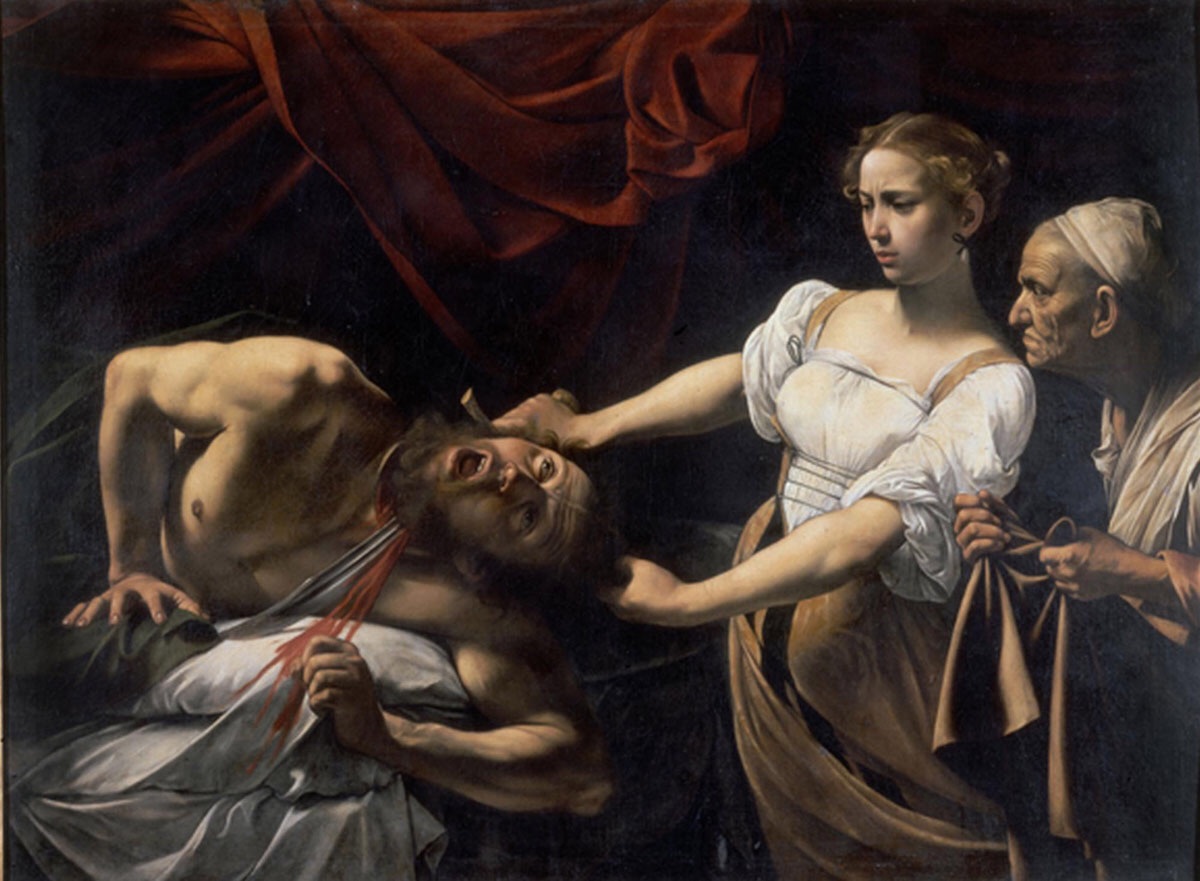
Judith beheading Holofernes, 1598/99
However, the circumstances and his harsh personality again hindered his plans. He got in trouble in Malta, and from then on, lived in the run for over 2 years, moving constantly to places such as Syracuse and Palermo in Sicily, and again back to Naples, where more trouble awaited. Finally he seems to have been stricken by a fever and died alone on a beach in Porto Ercole, supposedly on his way back to Rome. His body was never found.
If you are interested in Caravaggio, please check out our eBook series TEACHING ENGLISH WITH ART: http://wp.me/p4gEKJ-1lS
The quintessential Impressionist, Claude Monet was born in Paris in 1840 but grew up on a beach town in Normandy, Le Havre. His father was a grocer and his mother was a singer.
From an early age he was bored with regular school and spent more time drawing sketches on the blue pages on his notebooks than dedicating himself to his lessons. These sketches were caricatures of teachers and famous people, and he was able to sell them easily for a fair price.
Claude Monet
In 1858, Monet met the seascape painter Eugène Boudin, who would have a huge influence on Monet’s style of painting. Monet began to appreciate nature and wish to paint the effects of light and shadows on water, trees, and flowers. He learned that the ideal way of painting was in the “open air”.
He decided to move to Paris and join the Académie Suisse in 1859. The atmosphere of the Académie was very relaxed, the hours were flexible, and the painters were free to develop their own experiments. Later, Monet joined the studio of Charles Gleyre, where he made friends with the artists Bazille, Renoir and Sisley.
The most important achievement for an artist in those days was to have his paintings accepted and shown at the famous Salón, an official annual exhibition in Paris, sponsored by the government. Despite the fact that Monet had some works accepted there, he soon realized that the kind of painting he was interested in would never be popular in that traditional environment.
The paintings in the Salón were usually idealized works, representing historical or mythological subjects. They were usually perfectly finished with extra coats of paint added to them. Monet, however, had realized very early on that what he enjoyed painting was the real world: landscapes, seascapes and contemporary Paris, applying vibrant colors, representing the way light was reflected on trees, grass, water, flowers and regular people. He was one of the first painters to paint outdoors from the start to the end of a painting. He thought it was essential to capture real light and the way it changed along the day and in different seasons of the year.
In 1874, his group of friends, who also had difficulty having their artworks accepted by the Salón, decided to have an exhibition dedicated to their own works. Of course, it was hard to compete with the Salón, and their exhibition only attracted a fraction of the public who would go to the traditional event, but that was a start, anyway. Their alternative exhibition was repeated every year for the next eight years.
In 1874 exhibition, Monet presented a painting called Impression: Sunrise (see image below). All we saw in it was a solitary boat on the sea in Le Havre with a red sunset reflecting on the water, painted in fast, diffused brushstrokes. An art critic, Louis Leroy, from the magazine Charivari, mocking the title and the style of the picture, wrote that the artists that painted like Monet were mere impressionists. His paintings looked more like sketches rather than finished works of art. Despite the derogatory use of the word, Monet and his friends boldly appropriated the name and started to use it officially to define their revolutionary new style. Impressionism had been born.
Impression, Sunrise, 1876.
Claude Monet had financial problems for most of the first part of his life, but he started to make real money after he turned forty. By then, Impressionism had already become a recognized and important artistic style, admired and sought after by many art dealers.
He married twice. He had two sons by his first wife Camille, and 6 stepchildren from his second wife, Alice. He spent forty years living in a beautiful house with his whole family, painting views from his wonderful garden and artificial pond, carefully put together by himself with the help of 6 gardeners. This house was in Giverny and can still be visited by tourists today.
When he moved to Giverny in 1883, Monet started to paint what is usually known as the series paintings: he would paint the same subject on many canvas at a time, working on each one according to the right time of the day, giving continuation to each of them on the following day. So, as the light changed, he moved to the next painting matching the right time of the day, in a sequence. He started with haystacks, and then moved on to poplar trees, the Rouen Cathedral and, finally, the famous water lilies. He has more than 200 paintings on lilies, including the huge curved panels kept at the Musée de l’Orangerie, near the Louvre.
Blue Water Lilies: 1916-1919
It is important to say that, although Monet was the official founder of Impressionism, he had been strongly influenced by the works of Manet and Courbet, who came before him, and, at a later stage, by the works of Turner and Constable, which he was able to get to know when he lived in London with his family, during the Franco-Prussian war. The group of Impressionists consisted of many artists, such as Renoir, Bazille, Sisley, Degas, Cézanne and others, who strengthened the movement with their powerful contributions. Cézanne was the one who took the movement forward, showing the way to the future, heavily influencing iconic artists such as Matisse and Picasso.
A chain smoker, Monet died of lung cancer in 1926, having worked hard on his paintings and his garden to the very end. Claude Monet is one of most famous and loved artists in history, and his paintings sell for millions of dollars today.
If you are interested in Monet, please check out our eBook series TEACHING ENGLISH WITH ART: http://wp.me/p4gEKJ-1lS
Take que quiz and find out how much you know about Claude Monet:
Poppies at Argenteuil. 1873
1. Where was he born? a. Le Havre, b. Naples, c. Paris
2. What was he like? a. Quick-tempered, b. Calm and peaceful, c. Cold and calculating
3. What kind of painting style is he famous for? a. Romantic, b. Impressionist, c. Baroque
4. What was the most original trait of his paintings? a. Bright colors and open-air painting; b. Idealization of reality and the use of myths c. Emulation of the classical models
5. How did he die? a. Of lung cancer, b. Killed in a battle, c. Of old age
6. Was he famous while he was alive? a. Not at all, b. Pretty much c. In the second half of his life
7. Was he ever married? a. Twice, b. Never c. Once
8. What didn’t he paint? a. Landscapes, b. Boats and water, c. Mythology
9. What’s the historical context he lived in? a. The Counter-Reformation, b. The Second Industrial Revolution, c. The Renaissance
10. Which one is not a Monet painting: a. Puppies in Argenteuil b. Blue Nude IV, c. Saint Lazare Station
Claude Monet
You may wish to take a look at our video clip: TEACHING ENGLISH WITH ART: MONET (the eBook)
For further info on the titles of the series TEACHING ENGLISH WITH ART, click here:
Teaching English with Art! This eBook is a wonderful supplement to any coursebook or extra materials your students may already be using in the English class. It contains 30 speaking and writing activities for classroom use, based on some of the most striking works by French artist CLAUDE MONET, the founder of Impressionismo. The objective of the eBook is to expose the students to high art while teaching English, fulfilling therefore one of the tenets of effective language acquisition: providing a realistic context for the language to be learned and practiced as a means to an end. Your students will love to exercise their English discussing the works of Monet. This is a proven way to make language acquisition fun and effective by creating in the classroom an atmosphere of interest and motivation. Each activity is clearly correlated to the COMMON EUROPEAN FRAMEWORK OF REFERENCE (CEFR), and the level is stated next to it.
CLICK ON THE IMAGE BELOW TO DOWNLOAD THE EBOOK.
Click on the image to download the eBook.
Take a moment to watch the video clip of TEACHING ENGLISH WITH ART: MONET
When you read a piece of good writing in The Economist, Folha de São Paulo or The New Yorker, you will probably wonder about the special powers of the writer. How is it possible to sit in front of a laptop and, in one go, come up with such a refined and polished text. The writer must have counted on a potent muse sitting by his side, you conclude. But, for anybody who has attempted the hard task of putting a piece of writing together, the recognition that the path is a little harder will soon dawn on him. Hemingway defined the process in the most dramatic way: “There is nothing to writing. All you do is sit down at a typewriter and bleed.
Of course, the Hemingway process would not be very popular in most of our schools and online courses today. As we are concerned mainly about writing in the language class in this post, we need to draw a line. After all, chances are teachers and coordinators would be charged with abuse and put in jail if they expected or encouraged the students to follow anything like the method proposed by the great author of THE OLD MAN AND THE SEA.
Luckily, there is a third way: fire the muse and follow a step-by-step process to your writing activities. Writing is a skill students must master. We have never written so much as in today’s world. Most of our communication on the Internet occurs in the form of writing, one way or another.
Following the 5-step process we’ll be outlining below is probably the most effective way to come up with a good text. Of course, if you have the privilege of counting on good professional editors, the process becomes a lot easier, but not many people – least of all language students – can afford this luxury on a day-to-day basis, so we must rely on ourselves, and, if we are lucky, on some of our friends and classmates for aid.
Process Writing
Therefore, what we are advocating here is that writing should not be a solitary activity: pairs or groups of students should take part in it, although, ideally, each one should be working on his own individual piece. There are very clear steps to follow in what is generally know as process writing. This is, in our opinion, the best approach to teach and practice this productive skill in the language classroom. Let’s cover each of the phases in the sections below.
1. Brainstorming (generating ideas). When you are given a writing assignment, get together with a colleague and think of all the ideas the topic might generate. Don’t censor yourself at this stage, anything goes. If there’s no given topic, your freedom is even greater, and you will have fun imagining all possible topics, points-of-view, arguments or characters that may go into your piece. This is more fun when done with another person or in a small group. Then, each one can follow their own thread of thoughts, after this initial kicking off of ideas, and get down to writing their first draft.
2. Drafting. Now it’s time to prioritize all the wonderful ideas you generated in the step above. Consider the physical space you need for the text: is it a blog post, a story, an essay, an infographics design, a tweet? How many words are you supposed to use in your assignment? Don’t even consider using all your ideas. Pre-select, choose, discard, adjust, change. Cut, cut, cut. Establish what should go into each paragraph, which sentence you will pick as the topic one. Draft and redraft as many times as you feel you should. The more, the better. Change sentences to a different part of the text for stronger impact or more consistency. Decide what should be the beginning, the middle and the end of the piece. It’s always easier to start with the end. Remember the clever words of the Cheshire Cat to Alice, in Alice in Wonderland, by Lewis Carroll:
“Would you tell me, please, which way I ought to go from here?”
“That depends a good deal on where you want to get to,” said the Cat.
“I don’t much care where” said Alice.
“Then it doesn’t matter which way you go,” said the Cat.
3. Revising. Now, possibly with the help of a friend, you are going to begin refining and polishing your text. Your colleague will read the text, ask questions whose answers he would expect to find in it, but does not. He will probably make suggestions. There’s no need to take everything he says into consideration. Your are the writer after all, so the final decision is yours, but try and incorporate some of his feedback. Apply your own critical thinking skills to decide if the text is coherent, well thought out, convincing, logical.
4. Editing. This next step involves going deeper in the process started in the previous step. Time to check for grammar, vocabulary and syntax mistakes. Make sure collocations and register (formal and informal) are adequate. Have the spellcheck on your computer on. Consult a thesaurus, dictionaries, and grammar guides. Read aloud to make sure your text sounds good, to make sure it sounds English. Enter phrases and idioms you wish to use into Google to see if they appear in other texts and really mean what you wish to say. Again, get help from your friends.
5. Publishing. This is the last phase of your work. You will be deciding on the images to use, the layout, the kind of font you find appropriate. This part is a lot of fun, in general. Reread it one more time. Any more changes? If you are using a digital device, be brave and push the button PUBLISH. Next time you write something it will be even easier.
The Steps of Process Writing
Sometimes these steps may occur in a different order. Writing is messy. Moreover, the number of drafts cannot be stipulated: the more the better. But we all know there are time constraints to be taken into account, and the final product needs to be presented at some point. So let’s use common sense, and work on your piece within a time frame that suits your teacher’s expectations. In a language lesson, of course, it is the drafting that counts: the more you focus on polishing and making your piece more impactful and error-free, by adding ideas, deciding on the best location of sentences, breaking paragraphs in more consistent ways, and finally asking your friends for help to identify grammar and vocabulary problems, the more you will be learning. That’s when learning is really taking place. The final product is only the logical consequence of the hardest possible work you put into the project.
And remember, the final product does not need to be a masterpiece. The secret to fine writing has been repeated countless times by the experts – although both students and teachers seem to resist it: good writing is rewriting. Besides, writing improves over time, and the more you practice, the better results you will get. Good luck.
NOTE: If you are interested in process writing, you may consider checking out our eBook series TEACHING ENGLISH WITH ART. Click here for further info on the series: http://wp.me/p4gEKJ-1lS
Check out this fun video clip on our CARAVAGGIO eBook:
One of the most famous versions of the myth of Salome is the play written by Oscar Wilde, originally in French, in 1891. In this version, Salome is the daughter of Herodias, wife of Herod Antipas, the tetrarch of Galilee and Peraea.
The prophet John the Baptist has been imprisoned by Herod for criticizing his marriage to Herodias, who had previously been Herod’s brother’s wife. John the Baptist claims the consortium is incestuous.
In Wilde’s play, the action takes place during a party thrown by Herod probably in celebration of his own birthday.
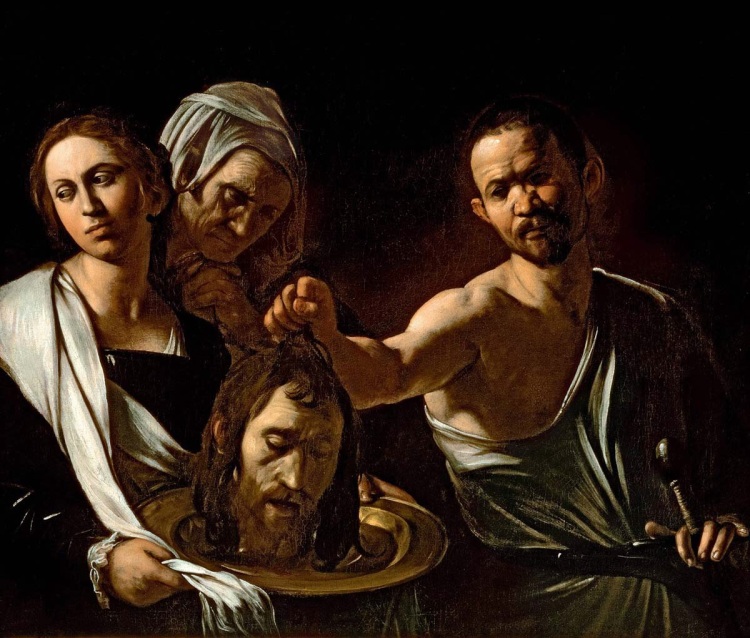
Caravaggio’s Salome and the Head of John the Baptist, 1607
During the party, Salome tries to seduce the prisoner John the Baptist but does not succeed in her intent. A number of signs indicate that tragedy looms ahead: the moon looks strange and ominous; a soldier/servant has just committed suicide; Herod, coming out of the party, slips in a pool of the blood shed by the victim, and hears a sound like the one made by the flapping of giant wings…These are all bad omens. What is going to happen?
Soon afterwards, Herod, drunk on wine, and somewhat infatuated by his stepdaughter Salome, begs her to dance for him. Herodias, her mother, does not think this is appropriate and tries to forbid her, but Salome acquiesces when Herod promises she can have anything she wishes in return.
Salome then dances the famous “dance of the seven veils”, which mesmerizes Herod. Time has come now for her to ask for her reward: she wants it to come on a silver platter. Herod laughs: “sure, she can have it on a silver platter…but what is it that she wants?” Salome demands: “The head of the Baptist”, catching Herod completely off guard. He is horrified by the request.
Her demand is fully appreciated by Herodias, who hates the prophet. She insists that her daughter should get what she wants. Herod tries to make Salome change her mind by offering her lots of alternative gifts, such as jewels and beautiful birds, but she is adamant: all she wants is the prophet’s head on a silver platter.
Her wish is granted: John the Baptist is decapitated. Caravaggio painted in gory detail a gruesome scene based on the myth, almost 300 years before the play was written.
Note: the text above is from the ebook: TEACHING ENGLISH WITH ART: CARAVAGGIO. For further info on the series please CLICK HERE: http://wp.me/p4gEKJ-1lS
Please find below some official stats sent by wordpress.com on the blog LINGUAGEM. We’ve had a great first year. Thanks for the support and we will back stronger than ever in 2015.
You must have heard about Alex from Target, if you have accessed any social media in the past few days. This is the story of a 16-year-old boy from Dallas, with Justin Bieber kind of looks, who became an overnight celebrity after a teenage customer – a girl called Abbie – fell in love with him at first sight and posted his photo bagging groceries at a Target – the second-largest retailer in the US – where he works as a cashier. The good-looking boy saw his account on Twitter surge from a little more than a 100 followers to more than half a million in less than 48 hours! Messages of eternal love, passion and admiration, with the hashtag #alexfromtarget, came from all corners. Some girls offered to mother his kids.
Alex from Target
Next thing, Alex Laboeuf is invited to take part in the Ellen Degeneres’s talk show, becoming even more popular. When asked by Ellen how he planned to tap into this sudden exposure, and if he could dance or sing, he simply answered he was good at bagging groceries. Poor thing. The story has been reported by serious and important media outlets such as CNN and the New York Times.
A marketing agency rushed to take credit for the viral phenomenon, claiming they had orchestrated it, but Target and the boy denied they had anything to do with the agency and were as surprised as everyone else. The boy knew about his sudden wave of popularity through his manager, and, at first, thought he was kidding.
I find this both extraordinary and scary. If it’s really true that this was an organic and grassroots viral hysteria, it’s worrying that you can have your life instantly disrupted by a photo taken and posted without your consent by someone you don’t know or care about, while you are at work, and then getting retweeted thousands of times by pubescent girls who became your instant fans. Downright weird!
Also, these things tend to die out as fast as they start – remember the ice bucket thing?- which makes me wonder about the sense of frustration and emptiness the boy will feel when all this buzz comes to nothing in a couple of weeks, which is what probably will happen, if he does not show any special artistic talent soon enough.
As for the marketing implications of the story, we marketers know it’s very hard, if not impossible, to produce a viral campaign. The elements that make a video or a photo go viral are really intangible and unpredictable, and there’s always the danger that the campaign will backfire, if customers feel cheated. I wouldn’t recommend it as a promotional strategy to any company. A systematic approach to content marketing will yield a lot more results. Educating your customers on a regular basis by providing useful and interesting info is way more productive.
Obviously there will be an enormous boost of awareness for Target during the next few days. But did they need that? Who doesn’t know them in the US already anyway? Besides, customers may feel manipulated and could avoid patronizing the company for some time. Danger.
However, with the power of the Internet to amplify everything and the hormones of the youth running awry, you can’t prevent these oddities to happen. I wish Alex all the luck in the future.
When you are at the stage of brainstorming for a nonfiction blog post or a piece of creative writing, it’s inevitable to remember a couple of articles, books and novels related to the topic you read at some point and enjoyed. They will be a source of inspiration and influence in your writing, making you somehow even slightly jealous, wishing you had thought of that first. But, of course, you would also have needed the right language to encapsulate it. After all, more important than the plot itself is how you say things.
Take the book Life of Pi by Yann Martel, for example, whose original idea some people claim was stolen from our Brazilian writer Moacyr Scliar. Well, plagiarism is hard to establish, there are a lot of gray areas, but one thing I’m sure of: Martel did not write the same story nor, most definitely, used the same language as Scliar. Jorge Luis Borges, in his marvelous piece Pierre Menard, Autor del Quixote, from the book Ficciones takes this idea even further, asserting that a book written with the exact same words by a different author at a different time would be read in a new way, due to the dissimilar historic contexts, and therefore would not be the same book at all. I agree.
After reading a comment on Facebook by a friend saying that she is full of ideas for blog posts but do not find the time to write them (yes, we all know how teachers are busy!), I made a joke saying that all my good ideas had already been stolen by the likes of Shakespeare, Tolstoy or Philip Roth.
Then I though for a moment, and decided to give serious consideration as to which novels I really wished I had written and why. This is my humble list:
Books I wish I had written
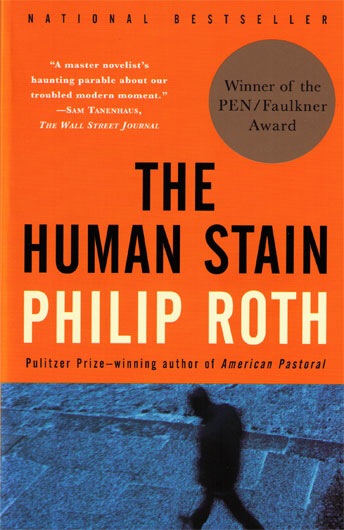
1.The Human Stain, by Philp Roth: it’s hard to discuss this book without giving a bit too much away, so apologies for the spoilers. The story of a light-skinned black boy who grabs the opportunity to pass for a Jew in 1950’s America and later becomes a Classics Professor at a small college is a complex account of the choices you make in life and the responsibilities and consequences that come with them. The need to make concessions and compromise basic values to achieve a bigger goal is the central theme of the book. The deep moral dilemma you face when you take such a radical decision, including the necessity to abandon and cut relations with your family and community to start a new life somewhere else as a completely different person, is evaluated by the author from unusual and unexpected angles in this impressive book. As irony is the hallmark of Roth, the book starts with the most paradoxal of incidents: the professor, noticing that two of the students enlisted in his class never seem to be present, asks the class the question which brings about his doom: “do they exist or are they spooks?” The latter being an old loaded word, a racist epithet for blacks. It turns out that the Professor, never having seen those students before, meant spooks in the most common sense of the word, that is, ghosts, and, after all the pressure and hassle he goes through, without support from any of his colleagues and students – for a number of political reasons – he decides to resign and end his career. I would love to have written this story for its universality: any minority can identify with what Coleman, the Jewish/Black professor, goes through, and can easily put themselves in his shoes. Given the opportunity would you do the same? Would you change your race, color, nationality, sexual orientation or gender? Or would you just give up all of your chances of fully growth and spend the rest of your life as a second class citizen in a society that will only offer you the fulfillment of your whole potential if you are the right color?
The Human Stain
2. Dom Casmurro, by Machado de Assis: this must be the book I reread most often in my entire life. I know it almost by heart. What attracts me is the way the characters are so well-rounded and fully developed, leaping out of the page as if you could go for a walk and talk to them. This does not mean, however, that you will know them any better. This is the whole point of the story. The dissimulation, the fact that we never know anyone completely. The impossibility of dealing with only one version of the reality. I can’t get enough of the artistry of the author, who, narrating the story in the first person, never lets the reader be sure about what really happened: was the main character’s wife an adulterer? Is the boy she gives birth to his son or his best friend’s? The doubt will corrupt his marriage and ultimately destroy all the love in his life. He becomes empty and isolated, having chosen the version of reality which will cause him the most pain and damage. Don’t we all choose the latter?
Dom Casmurro
3. We need to talk about Kevin, by Lionel Shriver: a professional woman is in love with her work and her husband. She writes and publishes travel guides, having the chance to go places, tour interesting and remote regions, avoiding getting stuck in a housewife’s rut, being independent most of the time. Yet, she can count on a loving husband to comfort and look after her when she comes back home after a long trip: this is a dream life. She has the best of both worlds. Then, what else is it that society claims will make every woman even happier and more complete: to have a baby. From the birth of Kevin, her firstborn, to the dantesque crime scene at the end of the book, We need to talk about Kevin reads like a nightmare. You can’t put it down. A thriller in every sense of the word. But one that goes way beyond the limitations of the genre. Shriver’s ambitions are a lot more encompassing. She discusses the nature of evil. Is it caused by nurture or nature? How is it created? Has Kevin always been the monster she feared he was or was his low self-esteem caused by his mother’s lack of love and care that turned him into a criminal? Was the mother’s resentment for having to give up all the pleasure and independence of her former life, her pre-baby life, toxic enough to corrupt and undo the little creature? The sense of guilt of a mother for not conforming to the patterns of a society that takes motherly love for granted only contributes to the character’s anguish and mental confusion. Of course, the book will show different perspectives of the scenarios we painted, but the conclusion will be up to the reader.
We need to talk about Kevin
These are all great themes and I don’t need to tell you how masterfully these concepts and ideas are exploited by those wonderful writers. The angles they illuminate, the perspectives they reveal would hardly have occurred to the average reader. That’s why they are geniuses and we are blog writers. But we can always try to get closer to their art in our writing. According to Malcolm Gladwell, another writer whose books I wish I could have written (although they are nonfictional), all it takes is a dedication of 10,000 hours of work to become a world class master at your craft.
Which books would you like to have written yourself? Let us know.