Teaching English with Art: the ENGLISH LANGUAGE LEARNING materials you have been waiting for:
Click on the image below to know more about TEACHING ENGLISH WTH ART and buy your eBooks:

Teaching English with Art
Teaching English with Art: the ENGLISH LANGUAGE LEARNING materials you have been waiting for:
Click on the image below to know more about TEACHING ENGLISH WTH ART and buy your eBooks:
Teaching English with Art
HAPPY NEW YEAR, EVERYONE.
Please find below some official stats sent by wordpress.com on the blog LINGUAGEM. We’ve had a great first year. Thanks for the support and we will back stronger than ever in 2015.

BLOG LINGUAGEM: 2014 official stats


Au revoir
Jorge Sette.

Acrobat on a ball, Picasso
For more info about the series TEACHING ENGLISH WITH ART: Click on the link below to go to AMAZON.COM and get your ebooks: http://wp.me/p4gEKJ-1lS

Click on the image above to access the KINDLE STORE. Teaching English with Art: Matisse, Picasso, Caravaggio, Monet, Norman Rockwell
Au revoir Jorge Sette
Teaching English with Art: the ENGLISH LANGUAGE LEARNING materials you have been waiting for:
TEACHING ENGLISH WITH ART: MATISSE. Click here for more info: http://wp.me/p4gEKJ-1kP
TEACHING ENGLISH WITH ART: PICASSO. Click here for more info: http://wp.me/p4gEKJ-1lA
#matisse #picasso #fauvism #cubism #moma #tate #teachingenglish #language #learningenglish
Pioneered by Pablo Picasso and Georges Braque, Cubism is one of the most revolutionary and seminal art movements of the 20th century. It has its origins in the post-impressionist paintings of Paul Cezanne, and aims at depicting reality in a non-naturalistic way, being considered the seed of the abstract paintings developed later on. Cubism in its more innovative and radical form lasted from 1907 to 1914, when the First World War broke out.
The end of the 19th century and the early decades of the 20th century were marked by great technological innovations that cried for an art form that could express these fast changes and new times. Traditional art, based on realistic works, which had been perfecting the use of perspective since the Renaissance, could not compete with the innovations of photography and film. They would be a mere replication of these more accurate methods of showing reality.

Portrait of Fernande by Picasso, Pablo, 1909
In an attempt to grasp the essence of the times, Picasso started to move towards more simplified depictions of objects and the human form, trying to represent simultaneously the different angles from which they could be seen, not only from a unique perspective. He started to flatten his images, making use of geometric shapes (such as cubes, hence the name of the movement) and deconstructing reality by slashing the image into different planes, producing, thus, an effect which had a more intellectual than sensorial impact on the viewer.
The iconic painting Les Demoiselles d’Avignon is considered the first Cubist work of art. Primitive art, such as African masks and Iberian sculptures, played an influential role in the development of Cubism. This first phase of the movement is usually known as analytic cubism, characterized by the use of dark, almost monochromatic color hues, and growing to a point where the deconstruction of reality became so radical that the viewer could hardly identify the object or person depicted. The second phase, synthetic cubism, was a lot more energetic and colorful, including the technique of collage, where real-life two-dimensional materials, such as colored paper, newspapers or even hair ribbons, were glued to the painting.

Bottle, Guitar, and Pipe by Picasso, Pablo. 1912
It’s hard to pinpoint when Cubism really finished, although we usually place it in the historical period between 1907-1914. It actually did not end, but transformed itself and evolved into other styles in the following decades.
Even today we can identify strong influences of Cubism in architecture, design and, of course, the arts in general.
NOTE: If you teach languages, you might want to check out our series of eBooks TEACHING ENGLISH WITH ENGLISH available from AMAZON.COM: http://wp.me/p4gEKJ-1lS

Teaching English with art
Au revoir
Jorge Sette
Click on the image below to buy the product from AMAZON.COM
You will never have bored students again.

Click on the image to access the AMAZON.COM page.
Today I read in the paper that the killer of John Lennon, Mark David Chapman, appealed to be released from prison for the third time now. It has been denied. Now he can try again in two years’ time. I don’t think he will be able to lead a normal like outside of prison. There is always the danger of his being lynched. Besides, it looks like Yoko Ono is against the measure too. She must be really afraid he will be coming after her. It makes sense. I can only imagine the amount of publicity he is going to get the minute the steps out of jail: book deals, reality shows, record contracts (Chapman sings Lennon) and what not.
Although I started off as a fierce Beatles fan in my childhood and early adolescence, things changed as I came in contact with the Stones’ music through a close friend while we lived in England in the late eighties. We were language students in Bournemouth and borders in the same house. He introduced me to the Stones and I’m very grateful to this day. The roughness and wildness of the Stones’ music were a lot more reflective of my personality in those days. They are still my favorite rock band.
It’s not only the music that fascinates me, but the whole persona of their lead singer, Mick Jagger. I may have read three or four biographies about him (the one I would recommend is Philip Norman’s) and I can’t get enough of his personal and public story. Mick reversed many assumptions that most people have. He turns ugly into sexy and even cute at times. He makes looking old cool. He makes rock and roll professional and businesslike. He will not have his disturbingly wrinkled face and drooping oversized lips be touched by plastic surgery in an age when even 30-year-olds are having their features altered to look like weird Kens and Barbies.
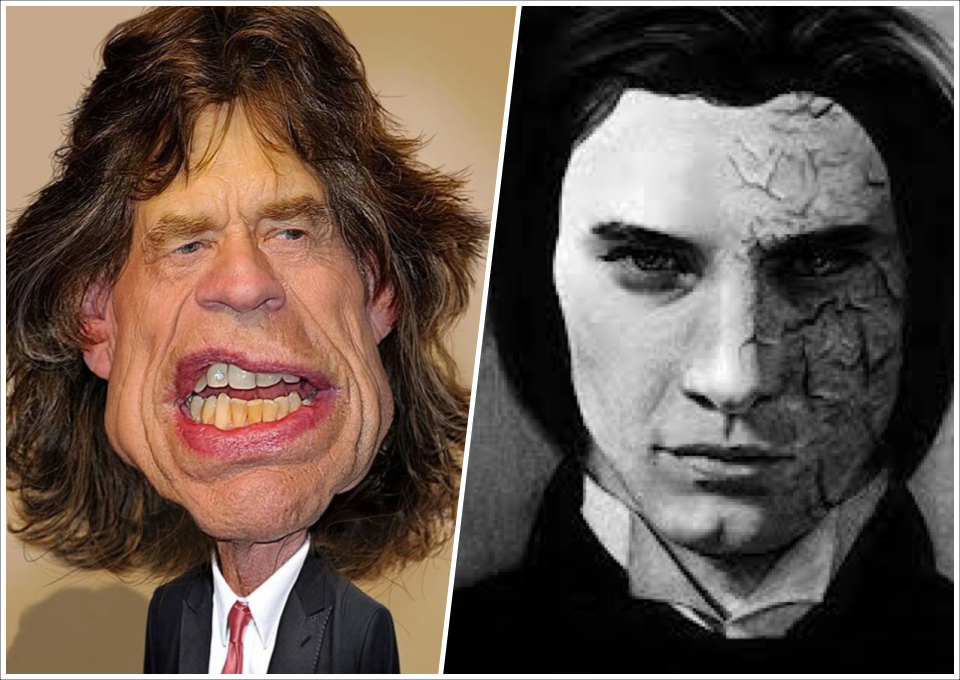
Mick Jagger is Dorian Gray
Mick Jagger did not share the most common prejudices of his era. Legend says all he wished to be, back when he started, was Tina Turner. She opened for his shows a number to times in the sixties. Rumor has it he would imitate Tina’s moves for hours in front of a mirror. She was the coolest person in the world for him. This is one of the funniest things I heard about Mick. There is also gossip that he’s bisexual, but whatever his sexual preferences may be, the fact is he has always treated gays and blacks friendly.
However, it’s undeniable that Mick Jagger has a very dark side to his personality. His whole attitude towards life reminds us a little bit of Oscar Wilde: especially on the occasion when he was put in jail in the sixties for drug consumption at what looked more like an orgy than a party. It’s said prison really broke him for a while, just like it damaged Mr Wilde badly at the end of the XIX century. Even more precisely, he seems to bear an uncanny similarity to one of Oscar Wilde’s most famous characters, Dorian Gray.
Unlike Gray, however, whose aging process and corrupt and criminal lifestyle were all reflected on a portrait of himself he kept hidden in an attic, while he himself remained young with features as angelical and fresh as when he was a teenager, Mick Jagger’s parched and wrinkled canvas of a face certainly bears all the marks of sins and experience of someone who’s been sailing against rough winds for the most part of his life. His 70-year-old body, however, just like Dorian Gray’s tight, flexible and muscular structure, does not seem do be different than a 25-year-old man’s, when you see him on stage. The Stones’ song Time is on My Side seems to say it all about the mythological figure.
Besides, very much in Dorian Gray’s fashion, he is famous for having destroyed and corrupted many lives who dared to get too close to the light and got burned by its brightness. Marianne Faithfull, for example, the troubled young singer of the 60s who dated Jagger, especially reminds me of a modern Sybil Vane, the first woman Dorian Gray destroyed on his path to utter corruption and crime. Some will say that Jagger sold his soul to the Devil in exchange for the success of his career and eternal youth of his body. No wonder he continuously thanks the dark forces through the ultra popular ode Sympathy for the Devil.
Not only until the mid-nineties did I have a chance to actually attend a Stones concert. An unforgettable experience at the Pacaembu Stadium in Sao Paulo, under heavy rain, with some of my closest friends. Also, in the summer of 2012, I visited a great exhibition in London at Somerset House, where they showed rare pictures of the Stones in poster-like sizes. This was part of a celebration of the 50-year anniversary of the band. I had a great time attending the exhibition, being in the heart of London, and looking at this rare collection of Stones pictures. The gift store was a rip-off, however, and the same T-shirt you could buy for 10 pounds in Camden Town would cost close to 50 at the museum. I was rational enough not to give in to the temptation.
Unlike Lennon, we are fortunate Mick Jagger is still among us. I know we will always have his music and his taped shows, but it’s good to know that this force of nature is very much alive and kicking. In the movie SHINE A LIGHT, Martin Scorsese manages to capture much of his energy and charisma. You feel like Mick is not performing for the camera at any moment, he is just doing his thing, being his difficult-self, while Scorsese and his crew are running around trying to capture his best on camera. Good thing the director managed to do so. Now we have this wonderful performance frozen in time on our bookshelf and can watch it whenever we need to infuse more energy and inspiration into our dull and unglamorous lives.
What do you think of Mick Jagger and the Stones? Share your opinion with us as you rate this post.
Au revoir
Jorge Sette.
I’m getting awfully confused with all these BuzzFeed quizzes I’ve been taking: it looks like I’m an Audrey Hepburn version of a unicorn, living in New York, commuting everyday (or should I say galloping) to Barcelona, while honing my Shakesperean skills as a writer to be read as a self-published $ 0.99 e-book on Amazon. I need more from life.

Au revoir
Jorge Sette
Living in São Paulo is an advantage for those who love what is usually called High Art, as we have a fair number of museums in the city. Of course, we lack the spoiling infinite choices of those who live in places like London, Paris and New York, but things could be worse.
However, going to a famous exhibition in Sampa is not without its frustrations and annoyances, as there are usually long lines on the weekend and the facilities are far from excellent. Besides, I’m quite addicted to audio tours, which, unfortunately, are not very common in Brazilian museums. I can’t stand guided tours, so I never join those little groups of people who follow a uniformed museum employee listening in awe whenever the guide decides to stop in front of a painting of her choice to spill out all the memorized knowledge in artificial intonation. I tend to run in the opposite direction.
So it’s not surprising that my best experiences in art viewing will have taken place abroad. The objective of this post is to share and discuss with my audience four of the great masterpieces I’ve already had the chance to see in person. I don’t think there is anything wrong in admiring pieces of art through apps, books or video, but I’m sure we all agree that the experience of standing only a couple of centimeters away from a great sculpture or painting in a beautiful museum can not be beaten.
The pieces I chose to write about here are not necessarily listed in any special order. They represent some of the art I feel most moved by – either because of their sheer beauty, or because they may be related to a special moment in my life. Two of them are based on stories I may have read or heard: I love pictorial representations of mythology. They are among my favorites. Also I did not have to think long and hard before selecting the pieces for the post. They are the ones that first came to my mind:
1. Samson and Delilah, by Peter Paul Rubens: I first saw this painting while roaming through the rooms of the National Gallery in London last time I was there. My eyes were immediately drawn to it for its vibrant colors, strong subject matter and unique distribution of lighting. You can see Samson, of biblical fame, sound asleep on Delilah’s lap while his hair, source of huge strength, is being treacherously cut off. The Philistines are already waiting there on the doorstep to take him away and blind him. The painting by Rubens is highly sensual and yet poignant, and, to me, its relevance can also be traced to my childhood, when I first heard the story and was deeply impressed by it.

Samson and Delilhah, 1609, by Peter Paul Rubens. National Gallery
2. The Lady of Shallot, by Waterhouse: I have a funny personal anecdote about this painting. I had discovered it on an app about art and fallen in love with its bright colors and hippie-like atmosphere (although it was painted almost 100 years before the “flower power” movement). I have always been a fan of the romantic sixties and its music. Pre-Raphaelites, therefore, with their drama and romance, feature among my favorite painters. Well, a couple of years ago, I was in London for work and had an afternoon off. I decided to invest the time visiting the Tate Gallery, with the sole purpose of seeing this particular painting. My surprise was that, as I entered the museum, for some reason, I marched straight up to the room where the picture was hanging, without ever having been there before. I had passed other rooms on my way into the museum, but somehow this was the first room I got into, after making a left off the main passageway. I could only interpret this, of course, as fate. The Lady of Shallot, just like a magnet, had dragged me to the place. She probably was as eager to meet me as I was. The painting itself is a bit too high on the wall and the colors are somewhat faded in comparison to the copy I had on the app. But still it’s impressive, and remains one of my favorites of all time.
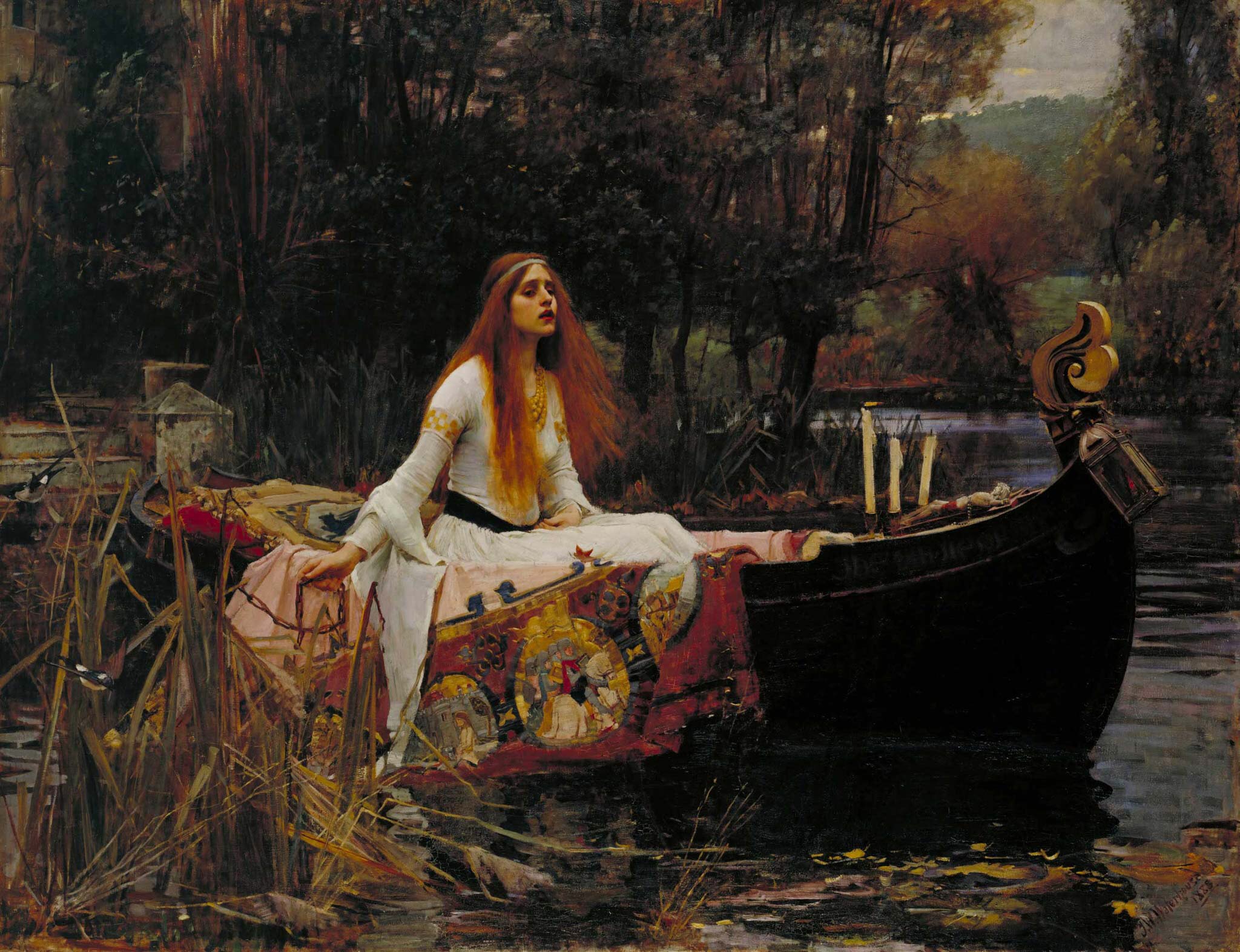
The Lady of Shallot, 1888, by John William Waterhouse, Tate Gallery.
3. The Thinker, by Rodin: In my teenage years in Recife my mother used to introduce me to her friends who came to our house as “the thinker”, the son who would spend hours either reading or staring into the void in front of our backyard garden with his mind going places she could not fathom. When I was still in high school, she gave me a little marble figurine in the shape of Rodin’s The Thinker, which she had acquired as a souvenir in Europe. This little gift is one of my most treasured objects and I keep it in my living room to this day (see picture below). Therefore, years later, I teared up with emotion when I first laid eyes on one of the versions of The Thinker, brought to the Pinacoteca in Sao Paulo as part of a huge Rodin exhibition in the mid-nineties (we had to stand in line for hours, and, once inside, needed to rush through the pieces as if in a car race, so many people attended the event everyday). A couple of years later, however, I could indulge in as much Rodin as I wanted too, roaming freely around the rooms and gardens of his Museum during a sunny summer day in Paris.

My little version of THE THINKER by Rodin. My living room.
4. Mars, the God of War, by Velázquez: The pressures against growing old – or really, the prejudice one confronts after reaching 30 – are mounting in today’s infantilized society, and it’s hard not to feel progressively inadequate and afraid. Obviously one keeps postponing – for himself – the cutting off date after which you should be considered old: it’s usually at least 10 years ahead of your current age. Therefore it was with a warm feeling of relief and reassurance that I came across this riveting Velázquez’s painting at Museo del Prado in Madrid: it dares to show the god of war, Mars, as an emaciated and tired middle-aged man, with his stunning shield lying on his feet. My conclusion was that, if even the gods need to confront the aging process, it should be OK for the rest of us.

Mars, God of War, 1640, by Velázquez. Museo del Prado.
There are many more pieces I’d love to write about. I promise my loyal readers to get back to the subject in future posts. For now, I believe this will give you a preview of my taste in Art.
What about you? What are your favorite pieces of art? Share them with us.
NOTE: You might want to check out our language and art eBooks available from AMAZON.COM. Click here for further info: http://wp.me/p4gEKJ-1lS
Teaching English with Art
Au revoir
Jorge Sette.
Maleficent, the new Disney movie that tells the story of Sleeping Beauty from the point-of-view of its original Nemesis – the evil fairy godmother – had all the potential to awe audiences, going way beyond its stunning visuals, if they had decided to work on more complex and original levels, paying closer attention to how mythology and its archetypes (typical characters) sustain great storytelling.
One can’t help but think of Wicked, that, first as novel, and then as a successful Broadway musical, also narrated the backstory of an evil character, the Wicked Witch of the West, of The Wizard of Oz fame, from the difficulties she had as a (literally) green child all the way to her adulthood, when she gets to meet Dorothy and her shoes. Although both Maleficent and Wicked chose to tell the story from the point of view of the alleged villain, the latter accomplished a lot more artistically.
Maleficent as a character is carefully construed to represent a strong role model for girls. Angelina Jolie looks stunning in the role, and will visually fascinate girls and boys alike. Boys, however, will surely be more entertained by the great number of superhero-like action scenes and predictable visual effects. It’s unfortunate, however, that the story is too weak to replace the original in children’s imagination, as it’s a lot less dark and scary in its connotations. Fairy tales are not supposed to be watered-down versions of their originals, and it’s a shame that Disney progressively goes in this direction with every new version they produce.
These are some of the problems that weaken Maleficent (Spoiler alert: you may want to watch the movie before reading the following):

Angelina Jolie as Maleficent
1. The hero/heroine archetype of the story keeps shifting (is it Prince Phillip? Aurora? Or Maleficent herself?) Stories need a well-defined hero with a clear objective. The hero can and should be flawed (so there’s nothing wrong with Maleficent’s rage and wish for revenge from a dramatic stance). However, the whole story should be about her journey, and the transformation she goes through along what is commonly called the dramatic arc. Maleficent the movie does not really have any of its characters growing or changing through experience in its almost two hours of storyline. In this version, Maleficent has always been a strong and benevolent fairy, protective or the moor and its creatures. Then she makes one mistake led my revenge or jealousy, and spends the rest of the movie trying to fix it. This does not a good story maketh.
2. I’m sure that, for young moviegoers, the three little “good fairy-godmothers” are visually enchanting and can even be funny at times (especially the one played by Imelda Staunton), and they dutifully fill the role of tricksters, an important kind of archetype, providing the comic relief every story needs. However, adults will miss the irony and wit usually delivered by such characters in more sophisticated versions of kids’ movies.
3. Diaval, the raven, is too weak as a mentor, another essential archetype in effective stories. Maleficent, both as a movie and as a character, would have benefited a lot more if she had a more intriguing, wiser, and possibly older tutor to rely on. It would have given the movie a much stronger structure.
4. King Stefan, who starts off as Maleficent’s first love, does not have a clear archetypal role in the story. He’s too lame as a shadow/nemesis, and not very convincing as a shapeshifter (archetype usually filled by the heroine’s romantic interest). Similarly, young prince Phillip fails to awaken the sleeping princess with his cold teenage kiss: I don’t think we need to say anything more about his role in the story after this flop. Therefore, the movie really relegates male figures to totally secondary and pathetic roles.
5. Aurora’s role also does not fit in within the mythological structure of effective storytelling, being neither a hero nor a shadow, or any other essential archetype. She roams around the moors, beautiful and wide-eyed, without any specific dramatic function. The couple of scenes in which both Aurora and Prince Phillip, at different moments, unconsciously float in the air in the wake of Maleficent clearly indicate that these characters lack what is fundamental in archetypes of more importance: agency. Frankly, these levitation scenes boarder the ridicule.
6. The movie climax, packed with action and pyrotechnics, does not look any different from the last superhero movie you may have watched. The grand finale depicts lots of deus-ex machina solutions ( “Into a dragon”, orders Maleficent, before her loyal raven becomes a fire-spitting monster. Well, that is an easy way out, right? Worse: he fails! Maleficent will need to get her creepy dead wings back to succeed.
Speaking of those wings: at first, the scene in which they are cut off looked like this was going to be one of darkest and best moments of the movie, and could easily stand for all the feminist and environmentalist metaphors the movie repeatedly uses. However, the fact that they fly back and reattach themselves to their owner in a climactic scene at the end spoils all the dark beauty and menacing effect of the former scene. Now the wings are just another deus ex-machina-kind of solution employed by poorly-creative scritpwriters. Besides, one wonders why the wings did not decide to do this years before.
Now it’s your turn. Share with us your opinion on Maleficent.
For more on storytelling I would suggest you read two other posts in this blog: “The Power of Storytelling – The Mythological Structure ” (http://wp.me/p4gEKJ-F2) and “More Storytelling Tips for Marketers” (http://wp.me/p4gEKJ-UK).
Au revoir
Jorge Sette.
 Jorge Sette "Linguagem"