Click on the image below to download the eBook from AMAZON.COM
You will never have bored students again.
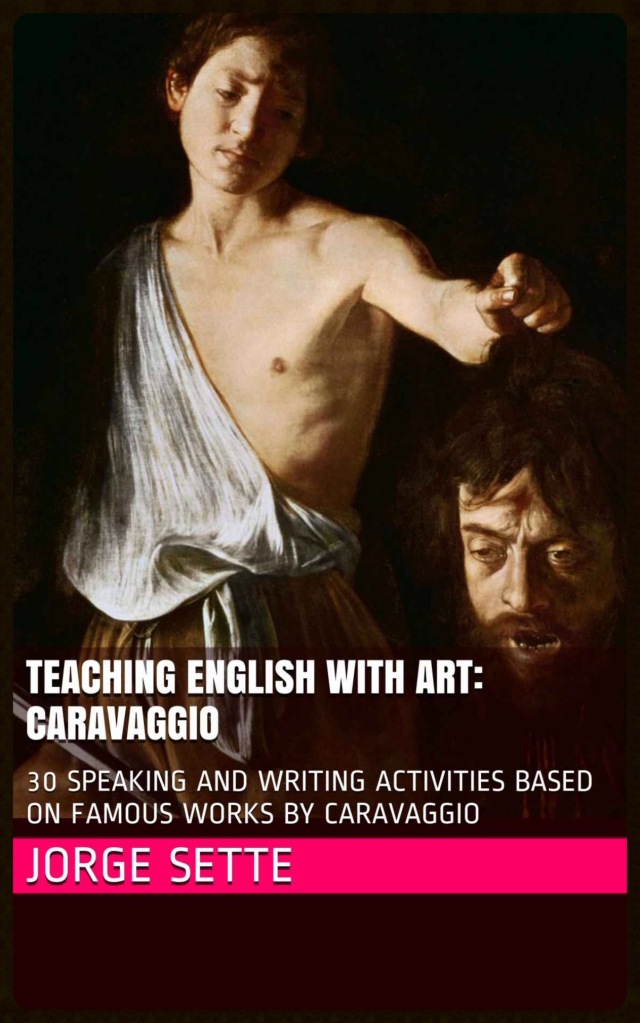
Click on the image to download the eBook
Watch the promo video clip:
Click on the image below to download the eBook from AMAZON.COM
You will never have bored students again.
Click on the image to download the eBook
Watch the promo video clip:
Teaching English with Art: the ENGLISH LANGUAGE LEARNING materials you have been waiting for:
Click on the image below to know more about TEACHING ENGLISH WTH ART and buy your eBooks:

Teaching English with Art
HAPPY NEW YEAR, EVERYONE.
Please find below some official stats sent by wordpress.com on the blog LINGUAGEM. We’ve had a great first year. Thanks for the support and we will back stronger than ever in 2015.

BLOG LINGUAGEM: 2014 official stats


Au revoir
Jorge Sette.
Click on the image below to buy the product from AMAZON.COM
You will never have bored students again.
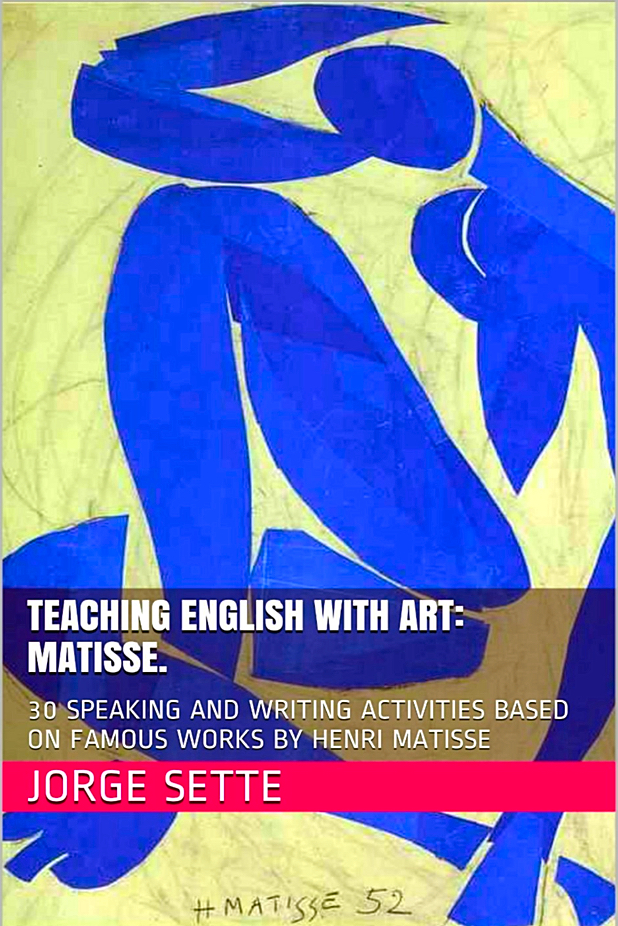
Click on the image to access the AMAZON.COM page.
The summer of 2014 held an unforgettable event for the lovers of Matisse, one of the masters of 20th century visual arts. The Tate Modern in London offered an unprecedented exhibition of Matisse’s cut-outs, the art form he created and developed in the last decade of his life, after undergoing a very invasive and traumatic operation for intestinal cancer in the early 1940s. This exhibition, Matisse: the Cut-Outs, showed nothing less than 130 pieces of Matisse’s works, a unique feat that some claim won’t be repeated in the foreseeable future.
Matisse’s cut-outs are deceptively simple compositions made of shapes cut out from sheets of paper painted in vibrant gouache colors and assembled together as a collage in somewhat abstract forms. After his surgery, Matisse found it difficult to stand at the easel and paint for long hours, so he decided to start experimenting with this radically novel art form. Sitting on his bed or in a wheelchair, he would dexterously cut shapes directly from the sheets of paper with huge tailor scissors, and then ask his assistants to pin them together in a variety of patterns. He changed the arrangements many times before he was fully satisfied with the overall look and effect of the piece.
Matisse’s cut-outs are revolutionary in the sense that they broke the barriers between drawing and painting fusing them in enchanting colorful shapes. Each cut-out was directly sliced from the colorful sheet without a previous penciled outline to help define the form. They are basically a celebration of color and an affirmation of life. Many considered this new artistic phase of Matisse his second life. A rebirth in every sense.
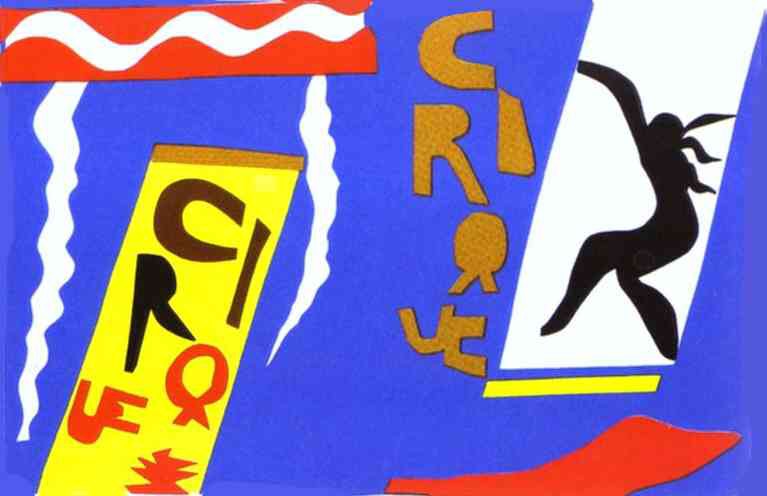
The Circus, 1947. Illustration for the book Jazz.
The first cut-outs appeared in a limited edition book called Jazz, which, in addition to the 20 screen printed cutouts, featured Matisse’s handwritten notes about the images, painted in black.The contrast between his beautiful monochromatic handwriting against the white paper and the fierce colors of the screen printed cut-outs creates a striking effect. In this book, a copy of which is kept at the Victoria and Albert Museum in London, the cut-cuts are mainly representations of circus performers, such as high wire walkers, trapeze artists, acrobats, clowns, knife-throwers and magicians.
Despite its vibrant colors, some identify a darker side to this book, though. Produced at the end of the Second World War, it’s not difficult to read metaphors of these violent and disruptive times into it. Take the iconic Icarus below, for example. You might see it as a representation of the mythological figure of the son of Daedalus plunging across the sky to his death, having flown too close to the sun, which caused his wax wings to melt down. Or you can see a corpse in the middle of exploding shells with a bloody spot right over his heart, as a clear reference to the war.

Icarus. 1947. Illustration for the book Jazz.
Matisse did not stop painting altogether as he started creating the cut-outs. Some of his most amazing paintings date from this period as well. However, after 1948, maybe because of his progressive frailty and growing infirmity, he practically gave up on painting. His creative force, therefore, was channeled to the cut-outs, which began growing in size, becoming murals, and totally capturing the artist’s imagination, becoming almost an obsession.
At first sight, some people may be taken aback by the simplicity of this art form, and some even dare to say this is something even a kid could do. Well, we defy them to try it. Only an artist of the scope of Matisse would be able to combine those kinds of colors and variety of shapes to produce such an impactful and pleasurable effect on the viewer. Besides, the best ideas, as we know, are usually the simplest ones: only nobody thought about them before. Copy cats abound afterwards in all areas of life.

The Snail. 1952/53.
No discussion about Matisse’s cut-outs would be complete without mentioning his final masterpiece: the design of the Chapel of the Rosary in Vence, built just down the road from the bucolic house – Villa Le Rêve – where Matisse lived in the last years of his life. It took Matisse four years to complete the project, which included stained-glass windows, three ceramic murals, the interior decorations and even the priest’s robes.
The chapel is famous for the atmosphere of serenity it infuses in its visitors. His maquettes for the stained-glass windows were assemblages of cut-outs, in soothing hues of green, blue and yellow. As the sunlight filters through them, reflecting on the marble floor, one notices the three ceramic murals opposite them, bearing monochromatic drawings representing in utter simplicity and some audacity (such as emphasizing the breasts of the Virgin Mary), the Virgin Mary with Baby Jesus, the Stations of the Cross, and the founder of the order of the Dominicans, Saint Dominic.
Matisse was known for his atheism, which makes many wonder what prompted him to design this chapel and to consider it himself his greatest achievement as an artist. One reason might be he did it after becoming close friends with a Dominican nun, Sister Jacques-Marie, who nursed him during his period of convalescence after the surgery. Her convent did not have a chapel at the time, forcing the nuns to use an old garage for their rituals. Matisse used to say that he felt God only when he was working. Therefore, the chapel is more likely to be an expression of his devotion to the God of Art, using motifs of the Christian religion only as metaphors.

Interior of the Chapel of the Rosary in Vince. 1950.
NOTE: You might want to check out our series of eBooks available from AMAZON.COM TEACHING ENGLISH WITH ART. Please click here: http://wp.me/p4gEKJ-1lS

Teaching English with Art
Au revoir
Jorge Sette.
You may have heard the term ANDRAGOGY. No, it’s not something you need to treat and there’s no need to be scary if you find out your husband is into it. It’s simply the word we use for “pedagogy” when the learners are not children.
Although there are many overlaps between the processes of teaching adults and children – they both love learning through playing, for example – there are some differences too. And those differences must be taken into consideration, if you are designing a course or training session for your employees, or other adult participants.
Some of the differences, established by Malcolm Knowles, an American Adult Educator of the XX century, are, for example, adults need to know why they are learning; adults wish to take responsibility for their learning, so they should contribute and take active part in the process; they have already a wealth of experience to build on and the new items to be learned (knowledge, skills, or attitude) will add to their baggage; the purpose of learning must be objective and perceived as relevant, which is, to help them with their lives or give them pleasure; they are more willing to learn things that meet a specific need or desire; they are more likely to be moved by intrinsic motivation (self-steem, for example) than extrinsic (rise in salary, promotion, relocation, etc).
Having established these basic differences, we must also add that both kids and adults have, individually, different learning styles (visual, auditory, kinesthetic), and some are more likely to use either the more analytical (left) or the more creative (right) side of the brain. These individual differences must also be taken into account when you design and develop a training course. I know, you must be thinking by now that, unless you are a teaching on a one-to-one basis, you can’t possibly cater for all these needs and idiosyncrasies. The good news is yes, you can. Let’s list here the basic steps you should take in putting together an effective training course for a group of adults. I will be using examples from a very successful course I created while I ran a consultancy service called Tutor in the mid-nineties, The course Pronunciation for Brazilian Teachers of English attracted hundreds of teachers every time it was offered at different venues and times all over the country. Sometimes these were open events, for which any teacher could sign up. Other times, these were tailor-made or adapted modules for specific schools as a service for their teachers.

Training adults effectively
Obviously, it’s not possible to cover all the details of a well-designed and implemented training course in the space of a blog post. This is not my intention. But I promise to come back to the topic periodically as you ask questions and comments on this overview of the mains steps I give you below:
1. Needs analysis: being a Brazilian teacher myself, I identified very early on that most teachers in the country had a huge gap in the knowledge and practice of pronunciation. They spoke English – some better than others – but very few had actually learned or knew explicitly about the different phonemes of the language or the mechanics of pronunciation. Many were not familiar with concepts such as stress and intonation either. Therefore, most of them, in their classes, tended to skip teaching the coursebook sections that dealt with these areas of the language. The famous English phonemic chart you can find on a number of websites, DVDs, or apps today was not so easy to access back then. So this was a big opportunity for me to start a business and help the teachers. On the other hand, when I gave tailor-made courses at specific schools, I had to unearth the real needs of the teachers and how much they already knew about the subject, so I could adapt the off-the-shelf course I’d already put together. In these cases, you do your research through oral interviews with prospective participants and supervisors, through written questionnaires, through focus groups or by watching some of the teachers at work.
2. Design: now that you know the participants’ needs, you must define how the course is going to be delivered: is it going to be presential, done via a webinar or blended? In addition to that, you need to determine and write down the learning objectives of the course. What is expected from the participants in terms of performance as they finish the training session? What is going to change? Of course, the clearer you state these objectives, the more effectively you will create and apply the materials you are planning for the course. A typical objective would be, for example, by the time the teachers finish this first module of the course they should be able to recognize and reproduce (orally and in writing) all the individual symbols that represent the phonemes of the English language and use them in clear contexts (as in specific words). You will notice that the objective follows the popular formula S.M.A.R.T (specific, measurable, achievable, relevant and time-bound).
3. Development: this is the hands-on phase of the process, when you are going to create all the different materials that will compose the course and help you impart the content of the sessions (deductive approach: lectures), or lead the students to discover parts of it by themselves (inductive approach, discovery), and finally practice and discuss the learning points. Remember you are creating a course for a number of individuals with different types of learning styles, tastes and ways to use the brain. So variety is the key. Always start with a relevant icebreaker or energizer to create an atmosphere conducive to learning and give the participants a chance to get to know each other from the beginning. Believe me: these warm-ups will make your job a lot easier later on. Especially if they are thematically linked to the topic of the course. Keep the pace fast (that’s the rhythm most participants are used to in today’s hectic world and keep alternating and using diversified activities: short lectures with the help of visuals such as slides (note: even during these lectures, make the process learner-centered by getting them to participate actively, through questions, for example, or comments); games; guided note-taking (students fill in the gaps of sentences previously written in the handouts; physical activities (involving movement), pair work, group work, debates, etc. I know, it can sound a bit overwhelming. But it’s doable. Remember: the longer the course the more variety it requires and you will have more time to apply different activities to suit as many different learning styles as possible. If the course is short, or broken down into modules, you will have to prioritize.
4. Implementation: this is the great moment you and your trainees have been expecting. You are putting all your preparation in practice. if you have the chance to run a small pilot with a group of volunteers before that, fine, but most trainers cannot afford the time to do that. Try and include during the ice-breaker, or before that, a moment when the participants will be able to express their expectations regarding the training. Of course if you did the needs analysis well, there will be no surprises here. But maybe you’ll have to make small adjustments to fit their unexpected hopes. Flexibility is an important characteristic of good trainers. Try to exercise it. As the session progresses and you get more comfortable with he group, allow for more participation, become more of a facilitator to the process, call them by their names (name tags or desk tents with their names written on them are a must), and carry on making adjustments whenever needed, especially regarding the time each activity lasts. You may have to shorten an upcoming task if the current one drags for too long. Create a detailed schedule for yourself so you can keep track of how much time each activity should take. In long courses, things may get out of hand if you don’t stick to this timetable. Do not forget to have breaks throughout the course. Most people are fueled by caffeine these days or they need to stretch their legs and walk around after long hours sitting down.
5. Closing: at the end, allow time for feedback and final questions. You can devise interesting activities for that too. Ask questions about what they think should be done as a follow-up to the session. Or explain the follow-up plan you have already designed: job aids, individual couching, accompanied visits to clients, lesson-monitoring for feedback, etc.
You will not have to start from scratch every time you design a course. I used some of the materials and activities I created for my initial course for years, with small adaptations now and then, to suit different contexts or to update them. But it’s good to understand and go through the whole creation process a few times to make it fresh.
Training is a field that is growing and more professionals will be needed. If you are interested in it, start educating yourself: read as much as you can on the topic, follow blogs, enroll in training sessions as a learner, and participate in conferences. It’s a very hard and demanding job, yet very exciting and varied. Good luck.
Au revoir
Jorge Sette.
If you are a regular reader of this blog you probably love the TED talks as much as I do. I make a point of watching at least one a day. There is always something to learn from them. Even if you don’t find the content that interesting, you can always profit from the speakers’s way of getting her points across, and copy some of the techniques to hone your own presentation skills.
This weekend I needed a break from binge watching Netflix’s THE KILLING – which I did last weekend – and, as consequence, must have put on a couple of kilos, having raised my consumption level of popcorn and ice-cream considerably, while following detective Linden (Mireille Enos) drive relentlessly in the rain along the streets of Seattle. So I chose, instead, to raise my usual share of TEDs’ intake, which was very sensible of me, since they feed the mind and soul rather than the body: I usually take notes while watching them, which stops me from grabbing the popcorn or digging into the ice-cream.
This is a list of 5 interesting takeaways I collected from some talks I’ve recently watched. They are all on education. The summaries are not quotes but my own interpretation and wording of the ideas. I strongly recommend you watch the clips as a way to contextualize my comments better.
Here is the list:

TED Talks
1. From “A 30-year History of the Future” (by MIT Media Lab founder Nicholas Negromonte).
In 30 year’s time you will be learning English by taking a pill. It will travel though your blood stream and reach you brain, formatting your neural connections accordingly. Well, based on Negromonte’s strong track record of predictions that were eventually realized, I would not discard the possibility.
2. From “Let’s Teach Kids to Code” (by Mitch Resnick, Director of the Lifelong Kindergarten group at MIT Media Lab).
There’s not much difference between the so-called digital natives and the rest of us. They are very fluent in gaming and using apps, but not in creating them. Their attitude to technology is overall very passive. They need to learn how to code to really be able to fully express themselves through technology and make use of all that is available. He compares technology to a natural foreign language: kids at this point are fluent at reading it but not at writing. He proposes we start teaching kids to code immediately to make a difference. Besides, coding will teach them not only this new “language” but a whole lot of content that can be expressed through it: just like the Content and Language Integrate Learning (CLIL) approach some of us use to teach English.
3. From: ‘Want to Innovate? Become a ‘now-ist’ “ (by Joi Ito, Director of the MIT Media Lab)
According to the speaker, learning is not education. The former is discovering things for yourself actively, the latter is about passing on knowledge to someone else who’s passively at the receiving end of the channel. Learning is what really matters today, if you want to become an innovator. To engage in learning you have to be connected, pro-active and very rooted in the moment (a now-ist). You must be alert and strive to be aware of everything that is going on around you. It’s necessary to seek collaboration from peers online, developing skills on how to get useful people together on your network to make your ideas happen as soon as possible. Not much planning is required to put out your innovative ideas. Don’t waste time overthinking what the outcome will be like. Adjust and learn as you move along. “Demo or die” (quote from Nicholas Negroponte he uses in his talk): ship your concept as fast as you can.
4. From “How the worst moments of our lives make us who we are” (by writer Andrew Solomon).
This is about education in its broader sense. The speaker, in a beautiful and moving talk, much in the vein of Oscar Wilde’s De Profundis and Philip Roth’s Nemesis, claims that the key to happiness is to “forge meaning and build an identity” for yoursef out of the worst adversities that may have struck you in life: be it imprisonment and ostracism in the case of Wilde at the end of the 19th century; contamination by polio in the early 1940s for the characters of Nemesis; or, as in Solomon’s personal account, exposure to cruel bullying at school and prejudice at large in today’s American society for being a homosexual. Meaning is not out there to be found, it’s a narrative you have to build from within and then invite others into. Just like Wilde and Roth, Solomon proposes you take full ownership and responsibility for your failures and falls and, maybe through love and art, re-create yourself to grow and be complete. Don’t miss this one!
I guess this is it for now. Enjoy you TED talks and please suggest some as you rate and comment on this post.
NOTE: You might want to check out our my series of eBooks TEACHING ENGLISH WITH ART, available from AMAZON.COM
Click here for more info: http://wp.me/p4gEKJ-1lS
Au revoir
Jorge Sette.
This is going to be an unusual post. We won’t be giving you any solutions, only problems and issues to consider. All of us who work in the field of education, either as teachers, school owners, publishers or booksellers are worried about the future of our business, or should I say, our mission. From the get-go, I would like to state my position regarding education, so it’s clear and can inform the vocabulary I might use throughout this post. I think of education as a business. Not just like any other business, but a very special and interesting one, as it is the source of human development and betterment. However, in a capitalist society, education is regulated by the same principles of supply and demand of all other businesses.
My objective in this post is simply to raise five of the questions I’m sure most of you share with me. I propose we start searching possible answers, reading up on the topics, and begin a debate on each of these issues. You are more than welcome to use this space (my blog LINGUAGEM) to share your views and ideas on the points listed below. My questions concern these following points:
The School of Athens (detail) by Raphael, 1509
1. Teachers. My first question is, of course, will we have a job in the future? As teachers, and other professionals of the education business – publishers, school owners and booksellers – I anticipate the answer will be yes (fortunately), but our jobs will change a lot. More and more the ball will be on our clients’ court (students and parents) and, as a consequence, we will have to adapt and try to reach them directly and on their own terms if we want to survive as professionals. They will have a strong say on everything regarding education: the kind of teacher they prefer, the methodology, the learning materials they will use, and how they wish to purchase them.
2. Methodology. What will be the most popular and preferred way of learning? We have always known learners have different leaning styles and are stronger and weaker at different forms of intelligence. One solution fits all will not do. Therefore, I suspect, we will see a lot of blended learning, with great variation on the percentage of online learning versus classroom lessons. Also, how much of this online learning will be self-learning or involve a tutor or teacher helping them out outside the classroom? In what situations will inductive/deductive approaches work best? The importance of learning pace is also another point to be considered: will these students require more individual lessons or profit more from a group learning environment? How much of the class will need to be flipped, when students deal with the theoretical points at home on their own and then come to class to solve practical problems, discuss doubts or simply apply what they learned in a more controlled environment.
3. Learning Materials. I’m pretty sure print materials are on the way out, as ebooks can offer all the advantages of print ones, and a lot more. If we already prefer to read novels on the Kindle, what to say of the possibilities inbuilt in a multimedia biology or history educational kit, which will allow them to watch a living cell divide itself or a dramatized episode taken place during the Renaissance played out as a video clip at the click of a mouse. Gaming, in addition, will make learning a lot more active and interesting, stimulating parts of the brain a lecture could never achieve to do. However, there is plenty of room for variation within online learning. We need to consider, for example, the best length of video clips to make retention more effective; should each 5-min footage be stopped and followed by a short quiz? What works best: animations or reals actors? Could a simple replication online of an old-fashioned blackboard with a teacher writing on it and explaining the teaching point work? The latter is exactly what Khan Academy does: except that the teacher is exceptionally good and the classes work like magic! Have you ever had trouble with algebra or trig? Try the modules on Khan and you will enjoy the beauty and magic of concepts that seemed arid and boring when you were in high school.
4. Schools/Colleges. What kind of changes will brick-and-mortar schools have to go through to compete with online learning? Blending is the first thing that comes to mind. But if teachers won’t be lecturing and classes are really going to be flipped, what other kinds of special services could schools and colleges provide to attract and retain clients? It’s really exciting to think about this. The moment we understand better how our brains absorb and/or create knowledge, we may need to hire psychologists, speech therapists and neurologists as part of our regular staff to help our learners out and differentiate our schools from the competition.
5. Metrics. Adaptive learning. How are we going to measure and adapt our teaching to the specific needs of students? What international scales, tests and certifications can be created to align consistently the different approaches across different institutions and regions?
These are all very big questions and require a lot of studying and research before we can come up with the right answers. Besides, the process is really dynamic and won’t stop. It will continue evolving and throwing new lights on education and the learning process. These are really exciting times we live in if we are in the field of education.
My recommendation is start reading up and updating yourself as much as you can on what is going on in the field and start experimenting with new forms of teaching, writing, reading, producing and selling learning materials right now. We don’t want you to have to struggle to catch up.The future of education has already started.
I guess this is all for today. Don’t forget to share your views and make your comments about those topics as you leave this page. We’ll be delighted to read them.
Note: you might want to check out our new book TEACHING ENGLISH WITH ART: MATISSE available from AMAZON.COM as an ebook. Click here for more info:
Au revoir
Jorge Sette.
Living in São Paulo is an advantage for those who love what is usually called High Art, as we have a fair number of museums in the city. Of course, we lack the spoiling infinite choices of those who live in places like London, Paris and New York, but things could be worse.
However, going to a famous exhibition in Sampa is not without its frustrations and annoyances, as there are usually long lines on the weekend and the facilities are far from excellent. Besides, I’m quite addicted to audio tours, which, unfortunately, are not very common in Brazilian museums. I can’t stand guided tours, so I never join those little groups of people who follow a uniformed museum employee listening in awe whenever the guide decides to stop in front of a painting of her choice to spill out all the memorized knowledge in artificial intonation. I tend to run in the opposite direction.
So it’s not surprising that my best experiences in art viewing will have taken place abroad. The objective of this post is to share and discuss with my audience four of the great masterpieces I’ve already had the chance to see in person. I don’t think there is anything wrong in admiring pieces of art through apps, books or video, but I’m sure we all agree that the experience of standing only a couple of centimeters away from a great sculpture or painting in a beautiful museum can not be beaten.
The pieces I chose to write about here are not necessarily listed in any special order. They represent some of the art I feel most moved by – either because of their sheer beauty, or because they may be related to a special moment in my life. Two of them are based on stories I may have read or heard: I love pictorial representations of mythology. They are among my favorites. Also I did not have to think long and hard before selecting the pieces for the post. They are the ones that first came to my mind:
1. Samson and Delilah, by Peter Paul Rubens: I first saw this painting while roaming through the rooms of the National Gallery in London last time I was there. My eyes were immediately drawn to it for its vibrant colors, strong subject matter and unique distribution of lighting. You can see Samson, of biblical fame, sound asleep on Delilah’s lap while his hair, source of huge strength, is being treacherously cut off. The Philistines are already waiting there on the doorstep to take him away and blind him. The painting by Rubens is highly sensual and yet poignant, and, to me, its relevance can also be traced to my childhood, when I first heard the story and was deeply impressed by it.

Samson and Delilhah, 1609, by Peter Paul Rubens. National Gallery
2. The Lady of Shallot, by Waterhouse: I have a funny personal anecdote about this painting. I had discovered it on an app about art and fallen in love with its bright colors and hippie-like atmosphere (although it was painted almost 100 years before the “flower power” movement). I have always been a fan of the romantic sixties and its music. Pre-Raphaelites, therefore, with their drama and romance, feature among my favorite painters. Well, a couple of years ago, I was in London for work and had an afternoon off. I decided to invest the time visiting the Tate Gallery, with the sole purpose of seeing this particular painting. My surprise was that, as I entered the museum, for some reason, I marched straight up to the room where the picture was hanging, without ever having been there before. I had passed other rooms on my way into the museum, but somehow this was the first room I got into, after making a left off the main passageway. I could only interpret this, of course, as fate. The Lady of Shallot, just like a magnet, had dragged me to the place. She probably was as eager to meet me as I was. The painting itself is a bit too high on the wall and the colors are somewhat faded in comparison to the copy I had on the app. But still it’s impressive, and remains one of my favorites of all time.
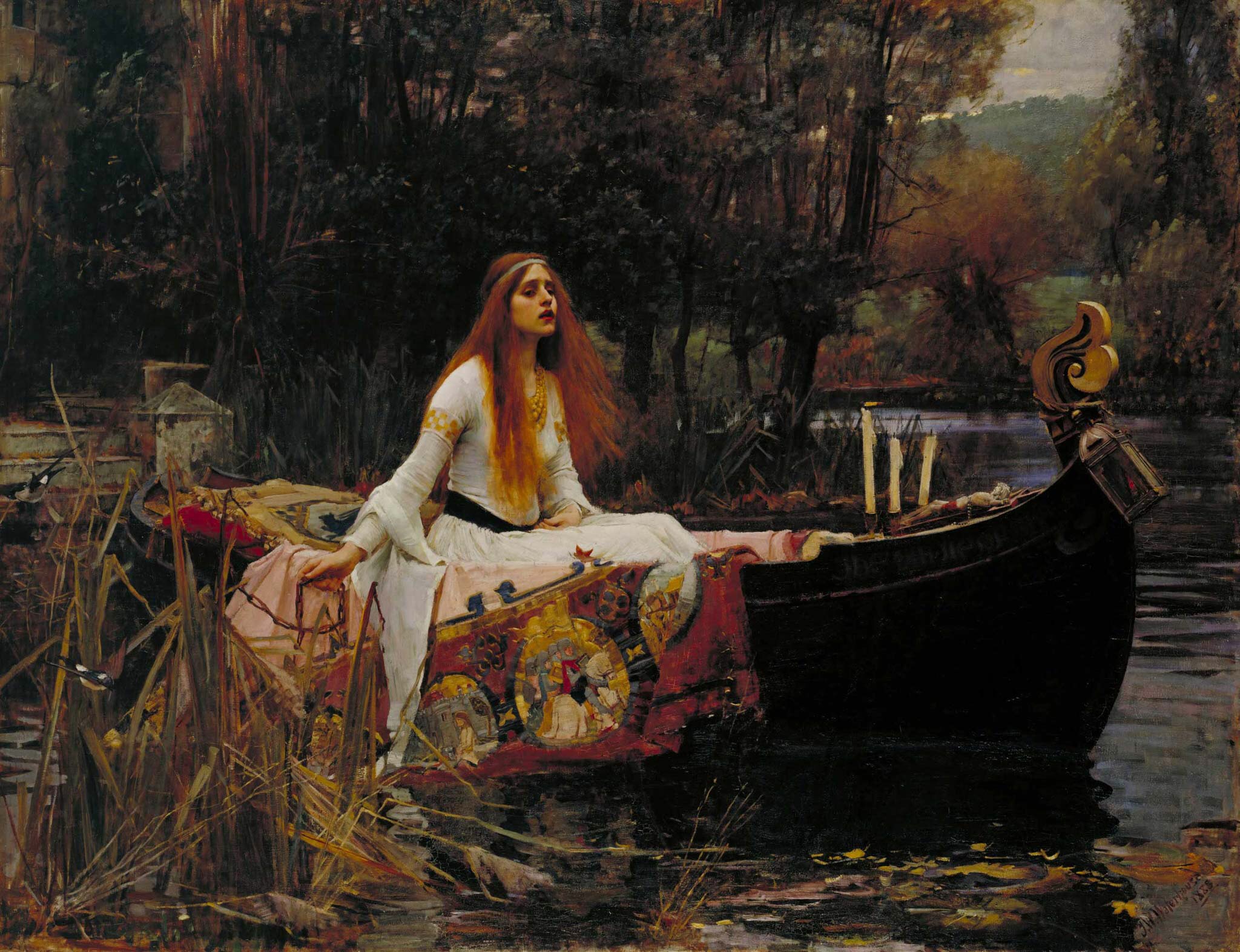
The Lady of Shallot, 1888, by John William Waterhouse, Tate Gallery.
3. The Thinker, by Rodin: In my teenage years in Recife my mother used to introduce me to her friends who came to our house as “the thinker”, the son who would spend hours either reading or staring into the void in front of our backyard garden with his mind going places she could not fathom. When I was still in high school, she gave me a little marble figurine in the shape of Rodin’s The Thinker, which she had acquired as a souvenir in Europe. This little gift is one of my most treasured objects and I keep it in my living room to this day (see picture below). Therefore, years later, I teared up with emotion when I first laid eyes on one of the versions of The Thinker, brought to the Pinacoteca in Sao Paulo as part of a huge Rodin exhibition in the mid-nineties (we had to stand in line for hours, and, once inside, needed to rush through the pieces as if in a car race, so many people attended the event everyday). A couple of years later, however, I could indulge in as much Rodin as I wanted too, roaming freely around the rooms and gardens of his Museum during a sunny summer day in Paris.

My little version of THE THINKER by Rodin. My living room.
4. Mars, the God of War, by Velázquez: The pressures against growing old – or really, the prejudice one confronts after reaching 30 – are mounting in today’s infantilized society, and it’s hard not to feel progressively inadequate and afraid. Obviously one keeps postponing – for himself – the cutting off date after which you should be considered old: it’s usually at least 10 years ahead of your current age. Therefore it was with a warm feeling of relief and reassurance that I came across this riveting Velázquez’s painting at Museo del Prado in Madrid: it dares to show the god of war, Mars, as an emaciated and tired middle-aged man, with his stunning shield lying on his feet. My conclusion was that, if even the gods need to confront the aging process, it should be OK for the rest of us.

Mars, God of War, 1640, by Velázquez. Museo del Prado.
There are many more pieces I’d love to write about. I promise my loyal readers to get back to the subject in future posts. For now, I believe this will give you a preview of my taste in Art.
What about you? What are your favorite pieces of art? Share them with us.
NOTE: You might want to check out our language and art eBooks available from AMAZON.COM. Click here for further info: http://wp.me/p4gEKJ-1lS
Teaching English with Art
Au revoir
Jorge Sette.

Click on the picture to access the SlideShare presentation.
Note: you might want to check out our new book TEACHING ENGLISH WITH ART: MATISSE available from AMAZON.COM as an ebook. Click here for more info:
 Jorge Sette "Linguagem"