How to work with the eBooks of the series TEACHING ENGLISH WITH ART


Teaching English with art has many advantages: it provides an exciting context; it exposes the students to beautiful and powerful images, making the lesson more memorable; it can easily be linked to other subjects in the school curriculum: history, geography, science, philosophy etc; and, as the response of human beings to different artworks is always unique, teachers can tap into that by personalizing speaking and writing activities. Personalization and freer practice are the most important stages in the language acquisition process.

Our eBooks bring photos of paintings of famous artists such as Matisse, Picasso, Caravaggio, Monet, Norman Rockwell,  Vincent van Gogh and Winslow Homer. Based on these paintings, each book brings a series of vocabulary, speaking and writing activities, composing a set of 30 items altogether, each divided in a number of exercises. The students are encouraged to work on both topic-based and task-based types of speaking activities, and explore the steps of process writing. Teachers are free to decide how much time their students should spend on each writing activity. Notice that, while the speaking activities should take place in class, some of the steps of the process writing activities, such as drafting and publishing, can be assigned as homework. For further information on these approaches, please refer to the following articles previously posted on the blog LINGUAGEM:  Topic-Based versus Task-Based Speaking Activities (http://wp.me/p4gEKJ-1nJ) and Writing: Focus on the Process not on the Product (http://wp.me/p4gEKJ-1ot)

Click on the picture above for further info

Click on the picture above for further info

The activities in each book cater for different linguistic levels, ranging from beginner (A1) to  advanced (C2). They are correlated to the COMMON EUROPEAN FRAMEWORK OF REFERENCE, which makes it easy for the teacher to match the eBook exercises to whatever other teaching materials they are already using, providing, therefore, effective and interesting supplementary work on productive skills. These extra activities can be used as a warm-up; whenever the teacher feels the class needs a boost in their motivation during the lesson, through an energizing task; as a filler for a lesson which finished earlier; or as complement or extension to topics already covered in the main coursebook.

Our materials are not meant for self-study. It takes a teacher to monitor and lead the students through the activities, but the eBooks can be used both in traditional classrooms or on online courses. Ideally both teachers and students should have their own practice books – downloaded to the Kindle app on their desktops,  laptops, tablets or smartphones. Whenever the teacher wishes to provide heads-up exercises or have the students focus their attention more effectively, they can project the pages of the eBooks onto a blank wall, and ask the students to switch off their electronic devices.

Most of the speaking activities can be done in pairs or groups. Alternatively, the whole class can be involved. We suggest the teacher give the students some preparation time before they are ready to speak in front of the class. Another important technique would be to have the student repeat the same story, role plays or any other speaking activity with more than one partner, in sequence. He will invariably perform better the second or third time around.

As for the writing activities, we advocate the use of process writing techniques. The student should work on drafts that progressively get more sophisticated and accurate until they reach the final product. Students should be trained to self-correct or peer-correct these drafts. Teachers should establish how many drafts they expect for each activity. The final draft can then be corrected by the teacher before being displayed to the class in some form. Please remember that it’s during the drafting phase that students learn how to write. The final product is only a consequence. The longer they spend on the drafting phase, the better their writing is going to get.

In addition to the exercises, the eBooks bring short biographies of each of the artists featured, the historical context he lived in and the main characteristics of the artistic movement he participated in. The teacher should give the students a brief overview of the artist’s biography, his times, where he lived, and his style. Teachers will not need to go beyond what is written in the eBook, although there is a wealth of information freely available on the Internet if teachers or students wish a more in-depth introduction or to know more about the artist.

Some of the eBooks also contain short texts referring to specific artworks of that particular artist, either because they are prominent in his oeuvre or because they are based on historical or mythological events that, if explained in a more comprehensive way, will enhance the student’s understanding of the painting and help them with their English production.

We are certain these eBooks will prove invaluable in making your lessons stand out and help your students develop their English. For further info on the series TEACHING ENGLISH WITH ART, please click here  http://wp.me/p4gEKJ-1lS and purchase the eBook about your favorite artist right now.

Check out this fun video clip on our CARAVAGGIO eBook:

Au revoir

Jorge Sette

Writing: focus on the process and not on the product


When you read a piece of good writing in The Economist, Folha de São Paulo or The New Yorker, you will probably wonder about the special powers of the writer. How is it possible to sit in front of a laptop and, in one go, come up with such a refined and polished text. The writer must have counted on a potent muse sitting by his side, you conclude. But, for anybody who has attempted the hard task of putting a piece of writing together, the recognition that the path is a little harder will soon dawn on him. Hemingway defined the process in the most dramatic way: “There is nothing to writing. All you do is sit down at a typewriter and bleed.

Of course, the Hemingway process would not be very popular in most of our schools and online courses today. As we are concerned mainly about writing in the language class in this post, we need to draw a line. After all, chances are teachers and coordinators would be charged with abuse and put in jail if they expected or encouraged the students to follow anything like the method proposed by the great author of THE OLD MAN AND THE SEA.

Luckily, there is a third way: fire the muse and follow a step-by-step process to your writing activities. Writing is a skill students must master. We have never written so much as in today’s world. Most of our communication on the Internet occurs in the form of writing, one way or another.

Following the 5-step process we’ll be outlining below is probably the most effective way to come up with a good text. Of course, if you have the privilege of counting on good professional editors, the process becomes a lot easier, but not many people – least of all language students – can afford this luxury on a day-to-day basis, so we must rely on ourselves, and, if we are lucky, on some of our friends and classmates for aid.

Process Writing

Process Writing


Therefore, what we are advocating here is that writing should not be a solitary activity: pairs or groups of students should take part in it, although, ideally, each one should be working on his own individual piece. There are very clear steps to follow in what is generally know as process writing. This is, in our opinion, the best approach to teach and practice this productive skill in the language classroom. Let’s cover each of the phases in the sections below.

1. Brainstorming (generating ideas). When you are given a writing assignment, get together with a colleague and think of all the ideas the topic might generate. Don’t censor yourself at this stage, anything goes. If there’s no given topic, your freedom is even greater, and you will have fun imagining all possible topics, points-of-view, arguments or characters that may go into your piece. This is more fun when done with another person or in a small group. Then, each one can follow their own thread of thoughts, after this initial kicking off of ideas, and get down to writing their first draft.

2. Drafting. Now it’s time to prioritize all the wonderful ideas you generated in the step above. Consider the physical space you need for the text: is it a blog post, a story, an essay, an infographics design, a tweet? How many words are you supposed to use in your assignment? Don’t even consider using all your ideas. Pre-select, choose, discard, adjust, change. Cut, cut, cut. Establish what should go into each paragraph, which sentence you will pick as the topic one. Draft and redraft as many times as you feel you should. The more, the better. Change sentences to a different part of the text for stronger impact or more consistency. Decide what should be the beginning, the middle and the end of the piece. It’s always easier to start with the end. Remember the clever words of the Cheshire Cat to Alice, in Alice in Wonderland, by Lewis Carroll:

Would you tell me, please, which way I ought to go from here?”

“That depends a good deal on where you want to get to,” said the Cat.

“I don’t much care where” said Alice.

“Then it doesn’t matter which way you go,” said the Cat.

3Revising. Now, possibly with the help of a friend, you are going to begin refining and polishing your text. Your colleague will read the text, ask questions whose answers he would expect to find in it, but does not. He will probably make suggestions. There’s no need to take everything he says into consideration. Your are the writer after all, so the final decision is yours, but try and incorporate some of his feedback. Apply your own critical thinking skills to decide if the text is coherent, well thought out, convincing, logical.

4. Editing. This next step involves going deeper in the process started in the previous step. Time to check for grammar, vocabulary and syntax mistakes. Make sure collocations and register (formal and informal) are adequate. Have the spellcheck on your computer on. Consult a thesaurus, dictionaries, and grammar guides. Read aloud to make sure your text sounds good, to make sure it sounds English. Enter phrases and idioms you wish to use into Google to see if they appear in other texts and really mean what you wish to say. Again, get help from your friends.

5. Publishing. This is the last phase of your work. You will be deciding on the images to use, the layout, the kind of font you find appropriate. This part is a lot of fun, in general. Reread it one more time. Any more changes? If you are using a digital device, be brave and push the button PUBLISH. Next time you write something it will be even easier.

The Steps of Process Writing

The Steps of Process Writing

Sometimes these steps may occur in a different order. Writing is messy. Moreover, the number of drafts cannot be stipulated: the more the better. But we all know there are time constraints to be taken into account, and the final product needs to be presented at some point. So let’s use common sense, and work on your piece within a time frame that suits your teacher’s expectations. In a language lesson, of course, it is the drafting that counts: the more you focus on polishing and making your piece more impactful and error-free, by adding ideas, deciding on the best location of sentences, breaking paragraphs in more consistent ways, and finally asking your friends for help to identify grammar and vocabulary problems, the more you will be learning. That’s when learning is really taking place. The final product is only the logical consequence of the hardest possible work you put into the project.

And remember, the final product does not need to be a masterpiece. The secret to fine writing has been repeated countless times by the experts – although both students and teachers seem to resist it: good writing is rewriting. Besides, writing improves over time, and the more you practice, the better results you will get. Good luck.

NOTE: If you are interested in process writing, you may consider checking out our eBook series TEACHING ENGLISH WITH ART. Click here for further info on the series: http://wp.me/p4gEKJ-1lS

Check out this fun video clip on our CARAVAGGIO eBook:

Au revoir

Jorge Sette.

Blog Linguagem: 1st Anniversary. Jan 2015: 100% Growth!


We broke all our records in Jan 2015 with a 100% growth.  Join us now: http://www.jorgesette.com

LINGUAGEM, MARKETING, SALES TRAINING, CULTURE, ART

100% GROWTH

100% GROWTH


Our main customers. Where do they come from?

Our main customers. Where do they come from?


Click on the link below to check out our latest stats in PDF format.

Blog LINGUAGEM- First Anniversary


Au revoir


Jorge Sette.

Topic-Based versus Task-Based Speaking Activities


Speaking is one of the most valued skills in learning a foreign language. When you want to find out about the general knowledge of a person in a foreign language you usually ask DO YOU SPEAK (language)? I can’t remember ever hearing from someone if I could listen to English, on the other hand.

Most learners therefore expect to speak the language fast when they join a course or hire a teacher. As teachers, however, we know that, being a productive skill, speaking will have to come after listening in the process of the students’ linguistic development. The same goes for writing: it needs to follow reading. Receptive skills (listening and reading) precede productive skills (speaking and writing). This is an absolute law that emulates the acquisition of the native language.

Ideally, students would have to spend sometime quietly listening to as much English as possible, at the right level, which, according to the linguist Stephen Krashen, would be roughly tuned to slightly above their current level in the language (i + 1), before they are asked to produce utterances. This quiet period of listening comprehension is called by the experts The Silent Period. This is when input is internalized (becoming intake).

In general, language schools and teachers cannot afford to apply this methodology exactly as it’s prescribed, as, for marketing reasons and to keep their businesses, they need to satisfy the strong expectation the students (clients) have about being able to speak the language quickly. Therefore teachers need to, at least, create a few speaking opportunities in the beginner’s class. Fair enough, this will not cause any serious disruption in the learners’ acquisition process.

Task-Based Speaking Activitie

Task-Based Speaking Activities

It would be important, however, to manage these expectations aptly, making it clear to the students that their ability to speak English will grow proportionally to the amount of linguistic input they get exposed to. The more they listen and read, the quicker and more fluently they will be able to speak the target language. Especially in dealing with adult students, I recommend teachers have a candid conversation with their students about what the methodology entails.

Having covered how to deal with the students’ frustration of not being able to produce English as fast as they would like to, let’s move on to how a teacher can create speaking opportunities for their students at any level.

There are basically two kinds of speaking activities: Topic-Based activities and Task-Based activities. The first refers to the kind of activities that usually involve giving the students a topic and expecting them to talk about it or discuss it. The latter involves a task: students use the language as a means to an end, trying to solve a problem or complete a task. Both kinds of activities are valid and enjoyed to a greater or lesser extent by different kinds of students. I would say that, as a general rule, task-based activities work better for lower levels while topic-based ones for intermediate to upper levels of linguistic proficiency. But this is not an absolute law.

An example of a task-based activity would be to have the students list the best places to go on vacation. Individually, each student would draw their own list (with, let’s say, 5 items, numbered in order from the best place) and, then, they would be paired off with the task of coming up with a common list. They would have to discuss the pros and cons of each place and prioritize their recommendations. Then each pair would present the negotiated list to the rest of the class.

An example of a topic-based activity, on the other hand, would be a debate: Gay Marriage: are you for or against? The students would express their own views on the issue. Teacher could guide the discussion by presenting typical and polite phrases to introduce disagreement, explain turn-taking rules, show them how to modalize one’s point of view, etc. Language and conversation skills would be taught together.

The exercises you find in our series TEACHING ENGLISH WITH ART include both topic and task-based speaking activities. The visual input is always a painting from a great master (Matisse, Picasso, Caravaggio). Students look at the painting in their ebooks and do the speaking activity indicated for their level (we use the Common European Framework of Reference to set the level). However, most activities are very open-ended and personalized, so sometimes the teacher can use even more advanced activities with lower-level learners, as the students themselves will adapt the production to their own level of English. An alternative way of dealing with the activities would be to project the image of the painting from a laptop or tablet onto a white wall to make it more of a heads-up type of exercise.

More on speaking and writing activities in the upcoming blog posts. Watch this space. To download a book from the series TEACHING ENGLISH WITH ART, please click here: http://wp.me/p4gEKJ-1lS

Teaching English with Art

Teaching English with Art

Au revoir

Jorge Sette.

Caravaggio Fun Quiz: how much do you know about the artist?


How much do you know about Caravaggio, the painter? Take the quiz and find out:


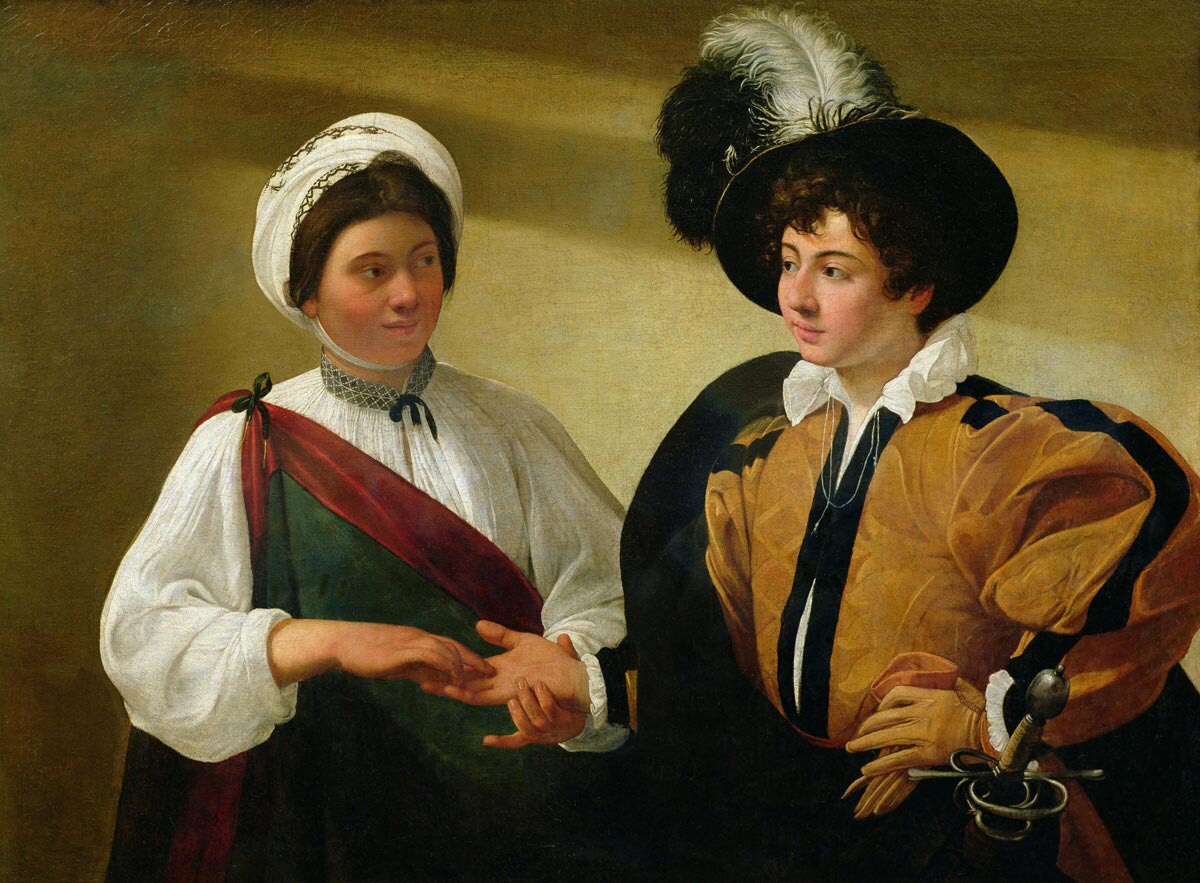
Caravaggio's The Fortune Teller

Caravaggio’s The Fortune Teller


  1. Where was he born? a. Rome, b. Naples, c. Milan


  1. What was he like? a. Volatile and abrasive, b. Calm and peaceful, c. Cold and calculating


  1. What kind of painting style is he famous for? a. Romantic, b. Baroque, c. Impressionist


  1. What was the most original trait of his paintings? a. Tenebrism (chiaroscuro), b. Idealization of reality, c. Emulation of the classical models


  1. How did he die? a. Not clear, b. Hanged in Rome, c. Of old age


  1. Was he famous while he was alive? a. Not at all, b. Only after he turned 70, c. Pretty much


  1. Was he ever married? a. Never, b. Twice,  c. Once, but he became a widower soon


  1. Did he have powerful patrons? a. No,   b. Only near his death,  c. Yes, especially Cardinal del Mondo


  1. What’s the historical context he lived in?  a. The Industrial Revolution, b. The Counter-Reformation,   c. The Renaissance


  1. Which one is not a Caravaggio painting: a. The Death of the Virgin, b. Las Meninas,  c. Young Sick Bacchus


Caravaggio's quiz. Answer key.

Answer key


Note: the quiz above is from the ebook: TEACHING ENGLISH WITH ART: CARAVAGGIO. For further info on the series please CLICK HERE:  http://wp.me/p4gEKJ-1lS

Check out the video:

Au revoir

Jorge Sette

Caravaggio, Oscar Wilde, Salome…and the head of the Baptist!


One of the most famous versions of the myth of Salome is the play written by Oscar Wilde, originally in French, in 1891. In this version, Salome is the daughter of Herodias, wife of Herod Antipas, the tetrarch of Galilee and Peraea.

The prophet John the Baptist has been imprisoned by Herod for criticizing his marriage to Herodias, who had previously been Herod’s brother’s wife. John the Baptist claims the consortium is incestuous.

In Wilde’s play, the action takes place during a party thrown by Herod probably in celebration of his own birthday.

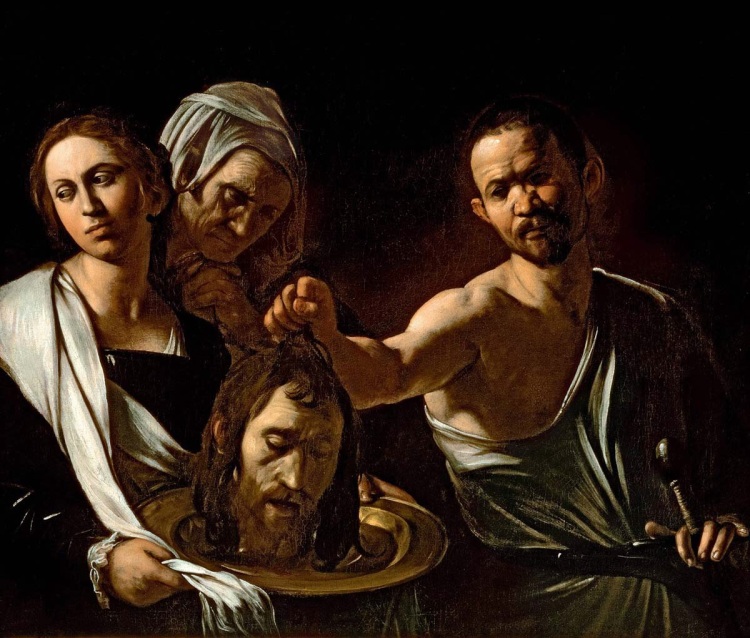
Caravaggio's Salome with the Head of John the Baptist, 1607.

Caravaggio’s Salome and the Head of John the Baptist, 1607

During the party, Salome tries to seduce the prisoner John the Baptist but does not succeed in her intent. A number of signs indicate that tragedy looms ahead: the moon looks strange and ominous; a soldier/servant has just committed suicide; Herod, coming out of the party, slips in a pool of the blood shed by the victim, and hears a sound like the one made by the flapping of giant wings…These are all bad omens. What is going to happen?

Soon afterwards, Herod, drunk on wine, and somewhat infatuated by his stepdaughter Salome, begs her to dance for him. Herodias, her mother, does not think this is appropriate and tries to forbid her, but Salome acquiesces when Herod promises she can have anything she wishes in return.

Salome then dances the famous “dance of the seven veils”, which mesmerizes Herod. Time has come now for her to ask for her reward: she wants it to come on a silver platter. Herod laughs: “sure, she can have it on a silver platter…but what is it that she wants?” Salome demands: “The head of the Baptist”, catching Herod completely off guard. He is horrified by the request.

Her demand is fully appreciated by Herodias, who hates the prophet. She insists that her daughter should get what she wants. Herod tries to make Salome change her mind by offering her lots of alternative gifts, such as jewels and beautiful birds, but she is adamant: all she wants is the prophet’s head on a silver platter.

Her wish is granted: John the Baptist is decapitated. Caravaggio painted in gory detail a gruesome scene based on the myth, almost 300 years before the play was written.

Note: the text above is from the ebook: TEACHING ENGLISH WITH ART: CARAVAGGIO. For further info on the series please CLICK HERE:  http://wp.me/p4gEKJ-1lS

Check out the video:

Au revoir

Jorge Sette

Caravaggio and the Myth of Medusa


Medusa was a beautiful priestess serving at the temple of Athena. Her beauty attracted a number of suitors, but she had to turn them down, as, according to her vows, she was supposed to remain a virgin.

However, Poseidon, God of the Sea, fell in love with Medusa and appeared to her in the shape of a bird. Being a god, it was easy for him to have his way with the poor maid and sleep with her.

As customary in mythological tales, the victim takes the blame for this sort of incident, and Athena, in a fury, turned Medusa into a horrific monster with the skin of a corpse and poisonous snakes for hair. Besides, anyone who dared to look her in the eyes would immediately turn to stone.

Caravaggio's Medusa

Caravaggio’s Medusa

Perseus, son of Jupiter with the mortal Danae, grew up on the Island of Seriphus. For many years he longed to receive a visit from his father, but it did not happen. His mother would tell him to be patient, as time did not work in the same way for gods.

Danae attracted the attention of Polydectes, king of the island, who tried to force her to marry him. She refused, but the King imposed one condition not to marry her: Perseus must bring him the head of Medusa as a gift.

Perseus, although unprepared and young, did not hesitate to accept the challenge. He knew he had first to find the Grey Sisters, horrible old hags who lived in the forest and shared one eye between them. They kept taking turns at using the eye ball. In a moment of distraction, while one of them was passing the eye to another, Perseus snatched it and told them that he would keep the eye unless they told him where the nymphs lived. The nymphs would tell him where to find Medusa and would give him the necessary weapons to fight her. The old hags acquiesced.

Perseus set out to meet the nymphs, who gave him three weapons: the sword of Jupiter, his father; the shield of Athena, the Goddess of Wisdom; and the winged sandals of Hermes, the Messenger of the Olympic Gods. He was also told not to look Medusa in the eye or he’d be turned to stone.

As he approached the lair of the monster, Perseus noticed a number of statues of men scattered in the garden. These were probably men who had tried to get to Medusa before him and were dully petrified. All was rock and desolation around the cave of the monster.

Perseus turned his back to the entrance and walked backwards towards the inner chambers of the cave, looking into the reflection on his polished shield for orientation. This way he would not have to look Medusa in the eyes directly. As he located her, he turned around with his eyes shut and struck her neck with the powerful sword of Jupiter, decapitating the creature.

Using Hermes’ sandals, he flew back to the Island of Seriphus, arriving right at the moment when the wedding between his mother and King Polydectes was about to take place. He shouted: Here’s your gift! And held the head of Medusa in front of the king. The King looked into the eyes of the dead monster and, as a result, was turned immediately to stone. And so Danae was free to go and live with her son again.

Caravaggio’s work, inspired by the myth of Medusa, was painted on an actual shield. It was not meant to be hung, but passed from hand to hand when viewed.

Note: the text above is from the ebook: TEACHING ENGLISH WITH ART: CARAVAGGIO. For further info on the series please CLICK HERE:  http://wp.me/p4gEKJ-1lS

Check out the video:

Au revoir

Jorge Sette


Teaching English with Art: Caravaggio


Click on the image below to download the eBook from AMAZON.COM

You will never have bored students again.

Click on the image to download the eBook

Click on the image to download the eBook

Watch the promo video clip:

http://youtu.be/Evuvs5AouQY

English Teaching Should Go Beyond Language!


Teaching English with Art: the ENGLISH LANGUAGE LEARNING materials you have been waiting for:

Click on the image below to know more about TEACHING ENGLISH WTH ART and buy your eBooks:

Teaching English with Art

Teaching English with Art

OUR BLOG “LINGUAGEM” HAS HAD A GREAT FIRST YEAR!


HAPPY NEW YEAR, EVERYONE.

Please find below some official stats sent by wordpress.com on the blog LINGUAGEM. We’ve had a great first year. Thanks for the support and we will back stronger than ever in 2015.

BLOG LINGUAGEM: 2014 official stats

BLOG LINGUAGEM: 2014 official stats


Screen Shot 2014-12-30 at 8.48.34 PM Screen Shot 2014-12-30 at 8.52.35 PM


Au revoir

Jorge Sette.