The Old Man and the Sea


What’s all the fuss about this little tale of on old Cuban fisherman on the hunt for a huge marlin in the blue seas of the Gulf Stream, and his fight against the sharks that try to steal his spoils of war on the way back home? I needed to find out.

In his deceptively simple writing, Ernest Hemingway expresses all his concepts about life, old age, the meaning of victory, friendship, cooperation and masculinity in the fewer than 130 pages of this unforgettable story.

It’s a book with layers of meanings, and the right one for you will emerge and resonate deeply and fast – depending on your age and the point of life you’re at.

The Old Man and the Sea. Illustration by C.F. Tunnicliffe and Raymond Shepard.

The Old Man and the Sea. Illustration by C.F. Tunnicliffe and Raymond Shepard.


The powerful narrative of Hemingway will make you put yourself in this old man’ shoes (or lack thereof). You will feel the fishing line cutting through your hands and your back while you try to keep the marlin hooked, as the huge fish swims forward fighting for freedom, pulling your skiff along for endless hours out to the deep sea. The old man’s thoughts will be your thoughts – although I suspect his love for baseball will surely be replaced by your passion for soccer if you don’t live in the USA; his endurance and respect for life will sink profoundly into your heart. His recurring dreams of lions walking on a distant African beach will duplicate all your yearning for naturalness, beauty, purity and strength.

The Old Man and the Sea made me realize three great movies I’ve watched recently have strong references to it, without my noticing them at the time: Life of Pi, Captain Phillips and All is Lost, the latter featuring Robert Redford from the height of the dignity of his 77 years of age. The same themes of endurance, self-reliance and the power of dreaming reverberate through all of them, resolved in different and exciting original artistic forms. And, of course, they all go back to Melville’s Moby Dick.

I don’t expect anything else from a work of art: give me something beautiful and simple – throw some ocean into it, if possible – test my hero to the limits of his physical and mental strength, put me in his head as he struggles, and the artist will have managed to take me to places I have never been before, and, as a consequence, made my life richer and a lot more meaningful.

Au revoir

Jorge Sette.

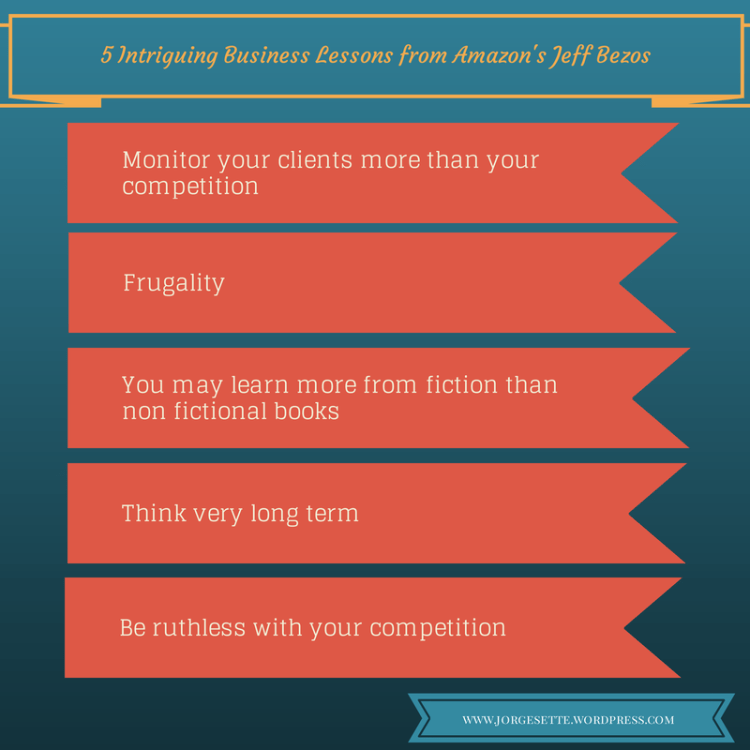
5 INTRIGUING BUSINESS LESSONS FROM AMAZON’S JEFF BEZOS


5 INTRIGUING BUSINESS LESSONS FROM AMAZON'S JEFF BEZOS

Click on the image above to access the full text.

5 Intriguing Business Lessons from Amazon’s Jeff Bezos


If you haven’t had the chance to read Brad Stone’s THE EVERYTHING STORE: JEFF BEZOS AND THE AGE OF AMAZON, reach out for your Kindle and download it right now. It’s an exciting account of the creation and development of Amazon into one of the most unique companies in history and the life of his peculiar founder Jeff Bezos.

IJeff Bezos and the Everything Store

Jeff Bezos and the Everything Store

Amazon.com started as an online book retailer and grew to become a company where you can purchase virtually anything, from apparel, to art to web services. It originated the concept of cloud computing service and was the first company, through the Kindle,  to turn online reading into a reality for thousand of hundreds of people on the planet. In addition, it claims it will be launching rockets into outer space soon.

If Amazon puts the client first – and, as customers,  you and I can certainly attest to that – working for Bezos looks like it’s not a lot of fun. Amazon is supposed to have all the depressing and Orwellian political atmosphere and red tape of huge corporations combined with the lack of resources of a startup. Many of his ex-employees are said to suffer from post-traumatic stress disorder, and the ones who remain there live under constant pressure and fear of getting fired before the end of the day. Bezo’s explosive personality is not very different from that of another difficult boss – Steve Jobs. It is kind of sad to think Nature tends to offset their kind of genius and creativity with a terrifying temperament and underdeveloped interpersonal skills.

Despite these drawbacks, you may find below a number of interesting lessons and facts about Jeff Bezos and his company. They are all based on info I got from the book. You may either try to apply them in your own business or, at least,  enjoy these points as mere trivia:

1. Monitor your clients more than your competition. Of course Amazon has always kept a close eye on Walmart, Apple, Barnes and Noble,  and Google – their main competitors. But he has always been much more likely to create or optimize processes that, rather than simply emulate these companies breakthroughs in terms of profitability, would actually benefit the client. For him, the client experience has always come first. Short term profit has always been an afterthought.

2. Frugality. Bezos is obsessed with simplicity and adept of an ascetic life style (in this he was not very different from Jobs either, by the way). He has always kept his staff on a very tight budget, cutting all kinds of extra costs with the aim of investing in the clients’ experience. His mantra was low prices everyday (just like Walmart’s), and he would go out of his way to make this happen, keeping his margins to a minimum or even giving them up altogether, such was his confidence in a business model that, if trusted by the client, would payoff in the future. Bezos would carefully  consider the need of every extra expense or cost and try to connect it directly to a benefit to the client. Lack of resources, according to him, would spur creativity and imagination from his staff.

3. You may learn more from fiction than non-fictional books. His favorite novel is Kazuo Ishiguro’s  The Remains of the Day. I was very happy to hear about this, as I love reading novels and this is certainly one of my all-time favorites. However, I don’t really think you can learn the hard facts about being an entrepreneur from the likes of Philip Roth or Machado de Assis. Fiction in my opinion will help you deal with the human side of business, and will probably keep you from having to resort to antidepressants when you struggle to work under bosses like Bezos, get sabotaged by coworkers or even fired.  But,  in my humble opinion, only the actual experience and the study of technical reading material will help you grow in your career. The most interesting thing about this aspect of Bezos’s personality  is  that his love for books boosted the launch of the Kindle, whereas Steve Job’s passion for music  – especially Bob Dylan’s and the Beatles’s – was a strong inspiration in his creation of iTunes. Do what you love and you are more likely to succeed.

4. Think very long term. Entrepreneurs need to persist in seeding. The payoff never comes immediately. Especially now, in this fast-paced, ever-changing technological landscape. Appreciate the little victories you achieve every day and fight on. Celebrate every little step towards a moving target you don’t even know if you will ever reach.

5. Be ruthless in the negotiation with your competition. For Jeff Bezos “win-win” was an unamazon way of thinking. You need to score an advantage over your opponents. Think football during these times of World Cup.  A draw is not acceptable. Do not even be afraid of disrupting your own business model in your pursuit to win. Do everything to destroy it and create something new instead. If you don’t do it, others will. Cannibalization is OK.

You may not agree with every tip Bezos has to offer, but remember where he got to by using them. Of course, you should always take successful entrepreneurs’s  and  gurus’ advice with a grain of salt, for, as Malcolm Gladwell explains in his brilliant book OUTLIERS, there is always a lot more to success than meets the eye. A set of special conditions not available to all is always present in the these Cinderella’s stories of ash to riches, so look out for them.

What is your formula for success? Please share it with us (if we are not competing with you).

NOTE: If you are interested in TEACHING ENGLISH WITH ART, you might want to check out our successful series of eBooks available from AMAZON.COM (KINDLE STORE). Just click here: http://wp.me/p4gEKJ-1lS

Teaching English with art

Teaching English with art

Au revoir

Jorge Sette

Gabriela, Clove and Cinnamon: a must-read novel


I’m planning to eat a moqueca today, a typical Brazilian dish consisting of salt water fish stew in coconut milk, onions, garlic, tomatoes, coriander and dendê oil from Bahia. This will be my way of celebrating having finished the delicious novel Gabriela, Clove and Cinnamon by Brazilian writer Jorge Amado.

Despite the fact that our literature is not very well known outside the borders of Brazil, chances are the reader will have heard of Amado and his homeland, Bahia. He is one of our most popular writers of the XX century, and his books have been translated into more than 40 languages throughout the world.

Many of his works have been turned into famous Brazilian soap operas, miniseries and movies, but, of course, the experience of watching Amado either on the big or small screen does not compare to the much deeper pleasure of embarking on the deliciously funny, poetic and encompassing canvas of his writing.

Gabriela – Image generated by ChatGPT.

Jorge Amado treats the reader with a wealth of unforgettable characters from the lowest to the highest echelons of the provincial cities of the northeast of Brazil, who intermingle in a network of politics, friendships, romance and violence.

Gabriela, the novel, is a dream of humor, poetry and cultural information. As a Brazilian, it felt great to be transported to the Ilhéus (a town on the coast of Bahia) of the first decades of last century, when the booming of the cacao exportation was making changes in the town and its customs at a pace never seen before. Progress was threatening the lifestyle and status quo of the families of the first farmers who got hold of huge expanses of land by force, with the help of their armed jagunços, never hesitating to use violence and murder in constant ambushes against their opponents. But now times were changing, with the arrival of technology and progressist businessmen, who came to those backward towns attracted  by the riches generated by the cacao.

Jorge Amado delivers his prose in a light, funny and detached tone, packed with irony, yet showing great warmth and understanding towards his characters. He depicts prostitutes, rich farmers (the so-called “colonels”), their minions (“jagunços”), churchgoing  and gossipy splinters, lonely concubines, small time businessmen and pathetic pseudo-intellectuals, against the backdrop of the geography and culture of the small provincial cities of the early decades of the 20th century. His prose will stay with you for a long time after you close the book (or switch off your Kindle), such is its power and universality.

Moreover, “Gabriela” is a very sensual text, filled with the colors, smells and tastes of Bahia. It’s a book that celebrates life and the liberation of minds, especially women’s, from the colonial chains and obsolete traditions of a male-dominated society. It’s a radical hymn against machismo, opening up doors to the possibility of freedom.

Gabriela, the protagonist, represents the essence of Brazilianness, in her beauty, simplicity, lightheartedness and pleasure for life. Of course, both the main characters of “Gabriela, Clove and Cinnamon” and “Dona Flor and Her Two Husbands”, another famous Amado novel, are deeply associated in our minds with the image of Brazilian actress Sônia Braga, who portrayed them both in famous movies and soap operas during the seventies. Of course, I was too young at the time to fully enjoy them – this, however, does not stop me from putting the face of Ms Braga to the wild Gabriela of the pages of the novel. After all, Sônia Braga was an icon of Brazilian sexuality and beauty in her day.

Jorge Amado is a pleasure to read. His stories will certainly make a profound mark in your life and deepen the awareness you may have of Brazilian culture. I strongly recommend you have a go at it.

Au revoir,

Jorge Sette.

Heart of Darkness: the horror, the horror


After meeting Colonel Kurtz in the powerful portrayal given by Marlon Brando in “Apocalypse Now”, when the movie first launched, I always wanted to get to know the original character he was based on: the mysterious Englishman lost in the jungles of Africa created by Joseph Conrad in his novella “Heart of Darkness”. If you, like me, are into dark themes and water (be it sea or river), this is the book for you.

For many years I hesitated to start the book. The  language on the first page looked obscure, and I was not sure I had the energy to go through it. I even downloaded  it in different versions (I believe they were free). The copies lay on my iPad for a couple of years now. Then I came across it in the beautiful voice of Kenneth Branagh, as an audiobook, but, for some reason, I kept losing my concentration whenever I reached Parque Villa Lobos – a nice recreational area in Sao Paulo – on my bike, and could not follow the story from then on. Well, the audiobook at least showed me that if I got past the first couple of pages, with their detailed description of ships coming and going on the Thames at dusk, things would get more interesting. So I resumed the book. And did not regret it.

Brando_Apocalypse Now

Marlon Brando as Colonel Kurtz in Apocalypse Now.

Although the novella is written in prose, as you embark in the story within the story, which tells of seaman Marlow’s time as a captain of a French steamboat  working in the business of ivory trade somewhere in Central Africa, going up the Congo river, “a mighty big river, that you could see on the map, resembling an immense snake uncoiled, with its head in the sea, its body at rest curving afar over a vast country, and its tail lost in the depths of the land”,  it turns into a somber and gripping poem which becomes hard to put down. Although the book is short, the reader’s experience is very deep and lasting.

Marlow is in search of a tradesman named Kurtz, who seems to have lost contact with the ivory trading company they both work for. He was famous for having been an excellent employee, sending tons and tons of ivory down the river back to the headquarters. But for now, rumor has it something may have happened to him, as all communication seems to have ceased. Is he dead? Could he be ill? After all not many white men remained healthy, physically or mentally, after a couple of months in those desolate and warm latitudes.

Of course, as with all great works of art, the book lends itself to many interpretations and can be read on many levels. I believe that, at some point, Conrad was even accused of racism for the use of  the word nigger many times, and also for treating the natives as an indiscriminate living mass, not considering them as human individuals in the story. For today’s ears, it is certainly uncomfortable to read the word nigger inserted without any qualification or explanation within a passage, but let’s not forget the story is told from the point of view of Marlow, the seaman we don’t know much about. We know, however, that Marlow is aware that even London, “the biggest and greatest town in the world”, started off as a dark and uncivilized place, and that the Romans must have gone through something similar to what he is going through right now, floating on that snake of a river, in the middle of nowhere, surrounded by looming trees and sighing vegetation, under a scorching sun.

The book explores this fascinating encounter of a civilized man with the primitive world, which seems to exert a powerful pull over him, making him reconsider the values White Europe stands for. Therefore, it’s a harsh criticism of the barbaric colonialism in Africa, which, under the guise of a civilizatory mission, invaded and exploited those virgin regions of the world for pure material profit, causing a lot of destruction and pain along the way. The book questions what really is civilization and what terrible energies get unleashed when Paris and London clash with the Congo in the figure of Kurtz: “the horror, the horror”.

Others say that the book is about the battle between good and evil (stay in the boat and be safe or go on land like Kurtz and lose your soul to corruption due to lack of restraint). Whatever interpretation you lend to the story, the fact is that Heart of Darkness is one of the most poetic books I have ever read. Its account of a boat trip along that methaforically muddy river in the primitive jungle that pulsates like an alien heart will stay with me for years. It also made me appreciate the boldness and creativity of director Francis Ford Coppola, who transported the story to a totally different context (the Vietnam war in the late sixties and early seventies),  managing to make the themes and topics of the book even more relevant in a new era of barbarism.

Have you read the book?  What did you think of it? Share your opinion with us.

Au revoir

Jorge Settte.


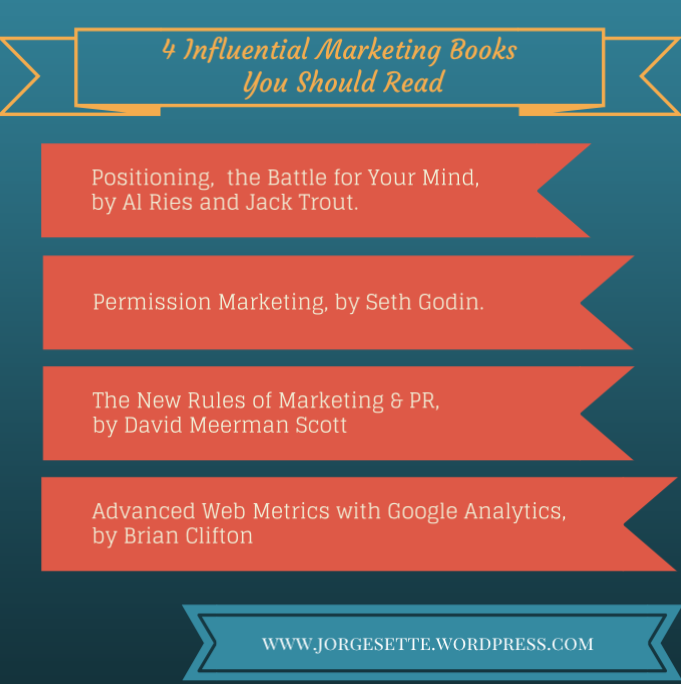
4 Influential Marketing Books You Should Read


4 Influential Marketing Books You Should Read

Click on the the image to access the full text. We suggest another two books in the text.

Why We Love Gabo (Gabriel García Márquez) and You Should too


Of course the first thing I did after “hearing” about the death of Gabriel García Márquez on Facebook (where else?) was to access my Kindle app and download a full collection of his short stories and his biography (Vivir para Contarla). I have the print version of the biography at home, but, as I was away, I felt the need to reread parts of it immediately. The prices were astoundingly low on Amazon.com, and I figured they may not remain so for very long, as the hype brought about by the death of any celebrity is bound to push up prices of anything related to them.

It was very comforting going to bed that night with those two books safely stored on my iPad. It felt like I had somehow beaten and transcended death. I could keep Gabo with me for as long as I wished. And this is something I needed to do.

Gabriel García Márquez

Gabriel García Márquez

When I first read ONE HUNDRED YEARS OF SOLITUDE, I was in college. I had a close group of friends, all taking different majors, who spent most of the free time together. Beaches, bars, weekend trips. At some point, some of us decided to read that book and we all agreed to read it at the same time. We became a kind of informal reading club, without a facilitator or much structure to it. However, it was a lot of fun discussing the most improbable passages, sitting for hours on the beach in Boa Viagem, unafraid of death by shark in those young times.

In those days, we were more interested in how funny and unfamiliar some of the magic realism sounded to us, without really devoting much time to interpreting metaphors or sensing how painfully poetic the whole thing was. Macondo, the imaginary  Caribbean town featured in the the book, with its heat and rain, its underdevelopment and desolation, its ghosts and backwardness was not very different from what we experienced in Recife in the mid-1980s. It was not as if we were trying to figure out Márquez from the coldness of a damp London night, reading by the fireplace, with a cup of tea. We might as well be characters in Gabo’s books, so close our realities were. Nobody would look very surprised if we all started to ascend into the sky like Remedios, the beauty, one of the strangest characters in the book.

Macondo is Latin America, and it’s Recife, Brazil,  more than anywhere else.

Only years later, though, did I come across my favorite Márquez: LOVE IN THE TIME OF CHOLERA. I liked it even more than “One Hundred Years…”  Less magical realism and more poetry. The story of the determination of a man who waits for a woman for 50 years before finally having her deeply resonated with me. It was a metaphor standing for everything I valued as ideals in life: crystal clear objectives, passion, a steely tenacity, patience and the understanding that the journey  and its pleasures should be as important as the goal: after all, Firmino Ariza, the main character, had led a fully satisfactory life while patiently waiting for the love of his life to become a widow, before finally resuming and strenghtening their relationship during a beautiful boat trip down an infinite river. Meanwhile, the journey, the life of Ariza, is packed with funny and interesting anecdotes, lived to the full, which makes the book a rare delight and a great lesson.

In between these two masterpieces, I read most of the other stories, and remember being deeply impressed by the strange tale of the unfortunate life of Eréndira, who had to work as a prostitute to pay for an unextinguishable debt towards her wicked “abuela” (grandmother). Because of the movie based on the story that came out at the time, I can only picture Eréndira as the dark wild beauty Claudia Ohana, the Brazilian actress who played the leading role. Irena Pappas played the crazy grandma in an unforgettable performance.

Not long ago I read another amazing and disturbing Márquez’s story. It told of a boy who liked to spend the nights on the beach staring at the sea. One night he begins to see a huge ghostly transatlantic ship passing by, which, with all its lights off,  silently crashes against the reefs near the entrance to the harbor. Despite the fact that, from then on  the vision happened once every March, year after year, his mother never believed him, as no traces of the shipwreck could ever be found in the daylight. Until one day when, already as an adult, with a little torch, her son manages to lead the ship past the rocks into the canal towards the beach, only to have it crash magnifically right in front of the local church. They all believed him then.

This is what makes us love Gabo: his Spanish fills the world with a unique combination of magic, colors, rhythms and smells (in one of his stories, for example, a strange smell of roses takes over a little village by the sea, heralding great changes to come), which makes us see reality in a totally new light. And finally get it.

Au revoir

Jorge Sette.


Six influential Marketing Books you should read


Everyone needs marketing. We are all marketers one way or another.

Most people seem to think that marketing is something done by a restricted group of people in a specific department of big companies, whose job consists mainly of yelling silly slogans at you, hoping they will stick, and perhaps make you stop in your tracks to buy something you don’t really need.

Marketing as a strategy, however, is something much deeper, scientific and even artistic, I should say. It’s sad that many companies and professionals fail to understand this concept. Marketing is needed to acquire, grow and maintain clients not only for companies but also for you as a professional. We are all selling something to someone: the product of the company we work for or our professional value, our time and dedication.

Nevertheless, let’s keep in mind that marketing has undergone a radical change in the past two decades. Digital marketing completely changed the landscape. I would say that it leveled the playing field for small companies and autonomous professionals, allowing both to compete worldwide with bigger corporations for an audience on the Internet. Since I have worked in this area for most of my professional life, and really love the subject,  I thought I could use this post to make a humble contribution, sharing with you the best marketing books I have ever read.
Photo

1. Marketing Management, by Philip Kotler. This is considered the bible of the field. If you take any marketing course, you will surely be referred to it. It covers the basics, and it’s an essential tool for anyone interested in the subject. It will dedicate specific chapters to each of the four traditional Ps of marketing (product, price, promotion, and place), analyze consumer markets and buyer behavior, will give you tips on how to deal with the competition, discuss segmentation, etc. It is a lot of information, and some readers will complain that the topics are not exploited in depth. The text will, however, give you a general, if a bit superficial, overview of marketing as a whole.

2. Positioning,  the Battle for Your Mind, by Al Ries and Jack Trout. One of the most seminal books in the area. It explains the fundamental concept of differentiation. How to plant the concept of your brand in the clients’ minds, making them see you in a specific and unique way. As a marketer, you need to look for a space that has not been occupied yet and fill it. It is necessary to make your brand mean something special to your target audience. As a private teacher of English in Brazil, for example, how do you want to position yourself? As a cool native speaker from Australia who would appeal to a young and and adventurous audience (You need to be Australian to pull that off, remember.)?  As an experienced Brazilian who had to learn the second language fluently yourself and therefore will understand the needs of your students better? Do you want to be seen as the best business English teacher available in São Paulo? These are options. Work to your strenghts and pick a suitable, convincing positioning and a niche to exploit.

3. Permission Marketing, by Seth Godin. This book will forever change your views on how to promote your product. If you are a fan of Mad Men, the famous TV show featuring these clever guys from Madison Avenue, you will understand that the way they conducted a marketing campaign back in the 60s would have very little chance to succeed today. For at least 40 years, from the time the show is set, marketing was all about interrupting people to make them listen to your call (ads broadcast through TV and radio, billboards, flashy ads in magazines…) With today’s noise, when clients are bombarded with thousands of promo messages every minute, it would be impossible to break through the clutter with traditional marketing. Ideally, customers will now come looking for you instead, if you apply the strategy suggested in the book (which is also known as inbound marketing). You will still interrupt them once, probably (maybe by luring them with a display ad on the website they’re browsing), but, then, the conversation will need to continue with their permission (or opt-in), and most certainly they will be the ones in charge.

4. The New Rules of Marketing & PR, by David Meerman Scott. This book summarizes in a very simple and direct way all the contemporary trends in marketing. It will show you the spectrum of tactics you can use to reach your client in this digital age: how to keep the conversation going with your target audience;  how to position yourself as a “thought leader” (expert) in your industry, through blogging, podcasting, video-blogging, and social media interaction; it also covers tactics on search engine marketing.  D. M. Scott explains the useful concept of buying personas, which is a method of breaking down the different segments of your market to create a clear personality for each one, so you can have a more relevant conversation with the customer, through the messages you send out and the feedback you get in response.

5. Advanced Web Metrics with Google Analytics, by Brian Clifton. One of the most remarkable changes in marketing is the shift towards more accountability expected from practitioners. Metrics is the key word in today’s marketing. If you don’t measure and demonstrate objectively that you can improve the ROI (return on investment) of your campaigns,  you won’t keep your job for very long. Not every company has changed yet, though, and some still seem to value marketers who are famed only for their creativity, even if they do not show proven results for their interesting ideas. I firmly believe their days are numbered. Clifton’s book will teach you in a very thorough way how to operate and benefit from Google Analytics, one of the most widely used services on the Web. The book offers invaluable insights on how to crunch the numbers and improve your marketing efforts.

6. Steve Jobs, by Walter Isaacson. Since the visionary depicted in this biography is one of the most inspiring people ever in my humble opinion, I must admit to being partial including this book on the list, as it’s not really a marketing book but a book about an extremely effective and successful marketer. The main lesson here is the product is the marketing. In the words of Seth Godin, who also preached this approach, you need a PURPLE COW – a very special and original product – to win in the ultra competitive market place of today. All promotional tactics will feel gimmicky and deceitful if you can’t deliver the iPhone or iPad of your industry. Another lesson is the importance that design has acquired in the making of any product in recent years. It goes without saying that function has not lost any of its importance, but if not integrated seamlessly with extraordinary design, your product will be in trouble.

Remember that the new marketing is very dynamic: Tactics, apps, methodologies (automation) and a great variety of tools are being created every moment in the marketing landscape.  Therefore, to keep up with this ever-evolving environment, besides reading the fundamental and seminal books of the field, you are advised to sign up and follow a number of blogs on the subject. It can feel a bit overwhelming at first, but, eventually, you will learn to filter the information and focus on a couple of the best blogs in the field. I strongly recommend, for example, Occam’s Razor, by metrics evangelist Avinash Kaushik and the Hubspot blog on inbound marketing.

Now it’s your turn. Could you please recommend any good marketing books to us?

Jorge Sette.

Interviewing Philip Roth – the movie


Based on some of my previous posts on Facebook, Twitter and this blog, many of you will already know that Philip Roth is one of my favorite writers. At 81, he is considered by many the greatest living American writer. I can’t get enough of his books. They usually investigate the depths of the human soul, are packed with painful truths, but also convey a dark sense of humor, which makes them irresistible.

Although I have already reread many of his novels, the good news is he’s so prolific that I haven’t been able to cover the whole list yet. So there is a lot to look forward to. I don’t think I will ever have an opportunity to talk to him in person, as he is very reclusive and private. And, to be quite honest, I would not like that to happen, as I want to preserve the idealized image I have of him – so I imagined what an interview with him would be like. His answers are known quotes.

7 Reasons I Prefer e-Books to Print Ones.


I know, paper book lover, you are offended even before you start reading this post. And, believe me, I completely understand your love for this dear old object that dates back to the 1500s, following the development of the movable types by Gutenberg  (although in Asia this happened even before). I even share that warm feeling towards the smell of newly-acquired books. Just like you, I’m also awed by its amazing endurance, after all it’s been around for more than 500 years with little variation.

However, I’m sorry to herald the news that its days are numbered. And the process of replacement will be faster than you think. Print books will always be valued, but more and more they will become a relic, used more as an ornament, a piece of decoration, having the status we give to contemporary coffee-table books. They will be regarded as a beautiful, yet a bit funny, object of a previous era, very much like the clay tablet, papyrus scrolls and parchments we respectfully admire in museums today. I don’t remember seeing anyone reading the latest Paulo Coelho on a papyrus scroll on the subway recently! Print books will represent something antique and valuable, but I doubt people will use it practically. E-books will progressively replace them.  Starting from school materials.

Screen Shot 2014-03-14 at 9.11.55 AM

The evolution of reading

At the risk of sounding pretentious, I honestly believe that I may have been among the first Brazilians to have a Kindle. I know that because I ordered the hardware the minute it was available to Brazil, meaning that the  download of  books would work here without the need for any hacking or tricks. That happened two years after its launch in the US. However, I had been reading digitally even before that, as I owned an e-reader account in the medieval days of Palm PDAs.

But let me tell you the reasons I have loved e-books from the first moment I heard about them.

1. Availability of titles in English

If you couldn’t read in English, there was no point in having a Kindle at its inception, as most books available were in this language. I’ve always read more in English than in Portuguese (despite the fact that the latter is my native language), and it was always a bit frustrating not to have access to some of the books I wanted hot off the press. Whenever I traveled to the US,  I would come back with a huge load of these Gutenberguian objects, which made my backpack really heavy and uncomfortable. To this day I can’t get over the fact that any content is now just a mouse click away to be ordered, whenever and wherever you are.

2. Portability

I’m  always reading three or four books at the same time (sometimes more). I get easily bored, and like to move from one topic to another very quickly. How can you do that with print books when you are away from home? I must confess that this volatility of mine got even worse now that I’m able to carry my library around on my iPhone. Print books begin to feel awkward to carry and even to read from, once you get used to tablets and smart phones. Try accessing the left-hand page of a thick paperback!

3. Samples

Whenever I come across an interesting mention about a book, I instantly access Amazon.com and download a sample. I must admit I tend to purchase it later, which makes me  a very easy prey for these kinds of ultra-smart marketing tactics.

4. Speed

There is a lot out there to catch up with and I have only a lifetime. Somehow you move faster on digital text, there are many reasons why, one being the very fact that you avoid  losing seconds – that add up – turning pages. All you have to do at the end of a digital page is to tap on it and you are instantly taken to the next one. I have just read about a new speed reading app, called Spritz (http://www.spritzinc.com), and tried it out. I realized it’s pretty addictive and I’m sure I will be moving on to it as soon as it’s available. Yes, I know about the Woody Allen joke: he speed read through War and Peace and all he remembered  at the end was that it may have been about some kind of war in Russia. If it gets this bad, I will quit trying to increase my pace, promise.

5. The size of the font

One is not twenty years old forever, and the eyesight suffers with time. Even with glasses, very small fonts are irritating. So, to be able to choose and control the size of the font you are reading in is a great advantage.

6. Instant access to a dictionary

I love words, and the process of making new acquaintances, stumbling upon prospective friends and identifying them is made a lot simpler and quicker on a e-book. Click on the word and the definition  pops up.

7. The fact that you can highlight, bookmark and annotate orderly and beautifully

These are  some of  the things that always comes up whenever I listen to someone defending print books. They say they can’t move on to digital books as they love to highlight and comment on passages. Obviously, they are unaware that these have always been features of e-books, since their dawn. And you can do it in different colors, without ever having the problem of your marker running out of ink.

I’m sure that, by now, you, print book lover, are hating me even more, if you ever got to this point in the text, and certainly will want to hit me in the head with one of the heaviest of these outdated objects you might have at hand: The Complete Works of Shakespeare? I will duck and try to run away, carrying with me not only a similar copy in my e-library, but also, the Complete Works of Lewis Carroll, Oscar Wilde, and Edgar Allan Poe…plus the Bible! Ah, and, classics as they are,  they cost me nothing, or only a couple of dollars on Amazon!

NOTE: You might want to check out our eBooks available  from AMAZON.COM. Just click here to know more about the series TEACHING ENGLISH WITH ART:  http://wp.me/p4gEKJ-1lS

Teaching English with art

Teaching English with art

Au revoir

Jorge Sette.