HAPPY NEW YEAR, EVERYONE.
Please find below some official stats sent by wordpress.com on the blog LINGUAGEM. We’ve had a great first year. Thanks for the support and we will back stronger than ever in 2015.
Au revoir
Jorge Sette.
For more info about the series TEACHING ENGLISH WITH ART: Click on the link below to go to AMAZON.COM and get your ebooks: http://wp.me/p4gEKJ-1lS

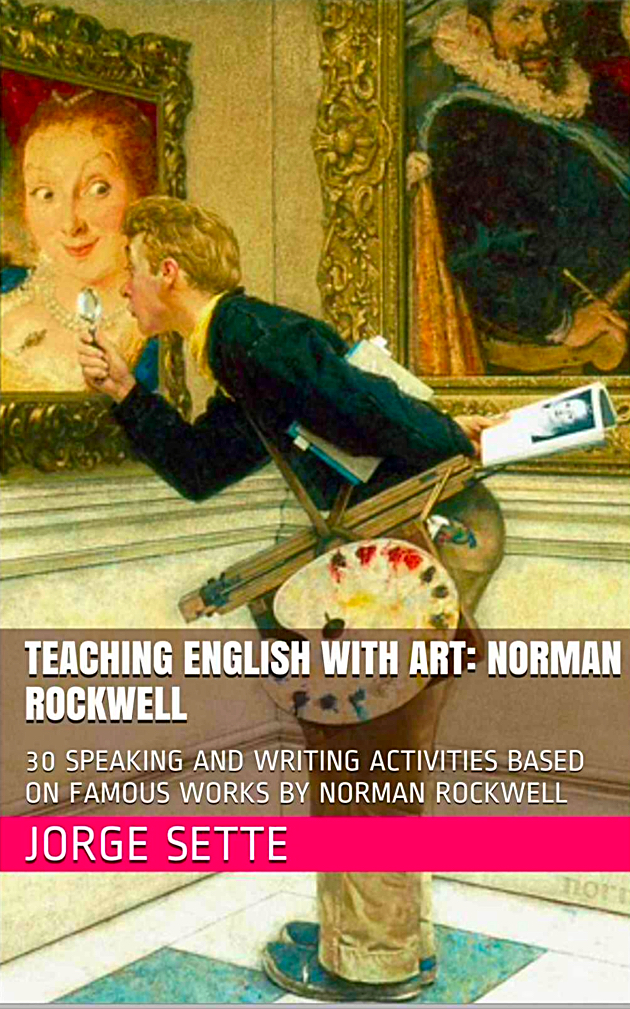
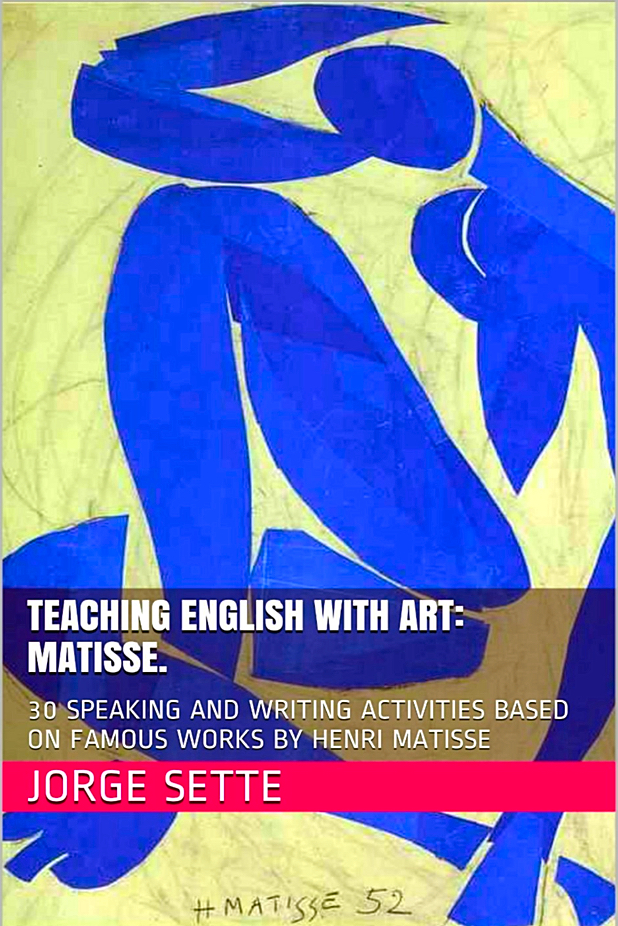
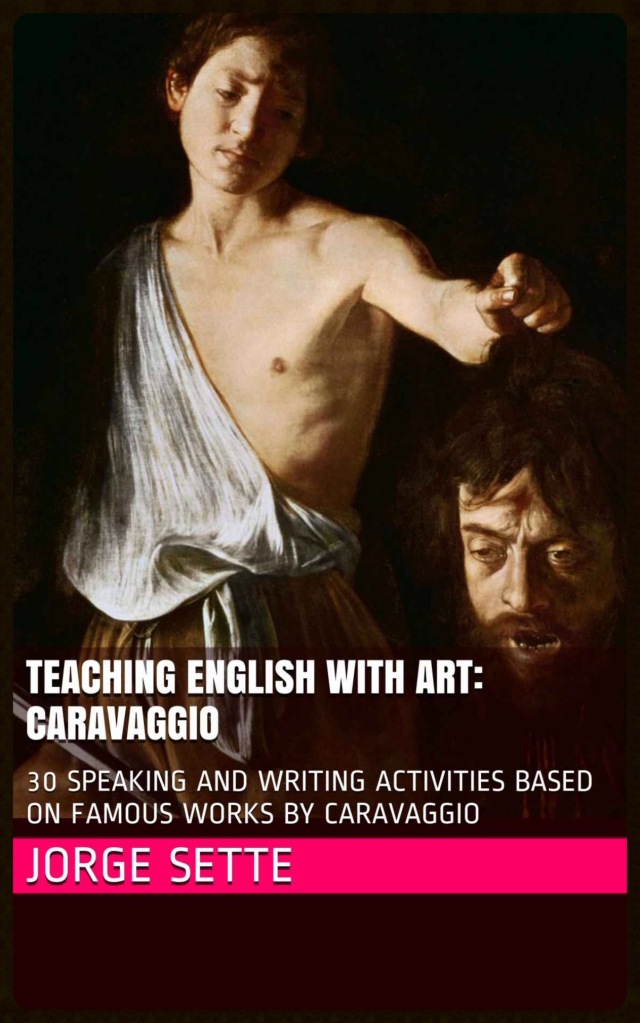
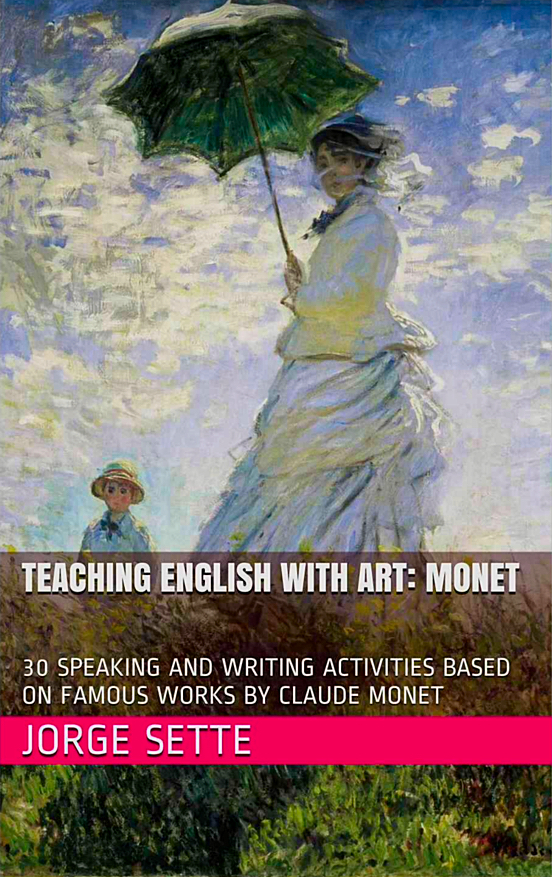
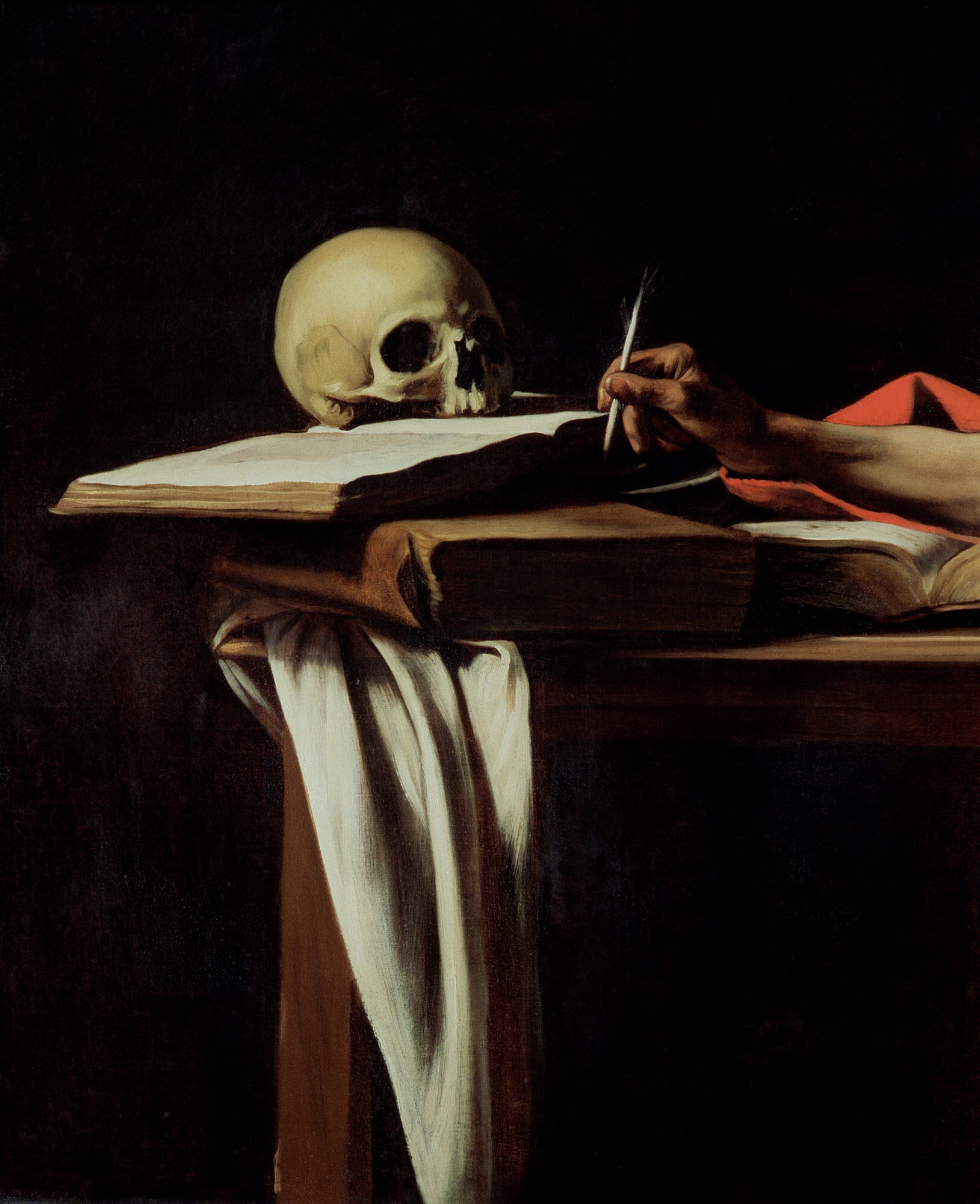
Click on the image above to access the KINDLE STORE. Teaching English with Art: Matisse, Picasso, Caravaggio, Monet, Norman Rockwell
Au revoir Jorge Sette
Teaching English with Art: the ENGLISH LANGUAGE LEARNING materials you have been waiting for:
TEACHING ENGLISH WITH ART: MATISSE. Click here for more info: http://wp.me/p4gEKJ-1kP
TEACHING ENGLISH WITH ART: PICASSO. Click here for more info: http://wp.me/p4gEKJ-1lA
#matisse #picasso #fauvism #cubism #moma #tate #teachingenglish #language #learningenglish
Ideal for online lessons!!
If you are having any of the following problems, we can help you…
a. Are your students often bored during the English class? b. Don’t they know what to say when you set up speaking activities? c. Do you spend the weekend correcting writing assignments that don’t seem to help them improve? d. Is it hard to personalize productive skills and link the English lesson to the other subjects in the school curriculum? e. The students know nothing about Art and high culture in general.
Click on each of the pictures below to get your copy from the KINDLE STORE:
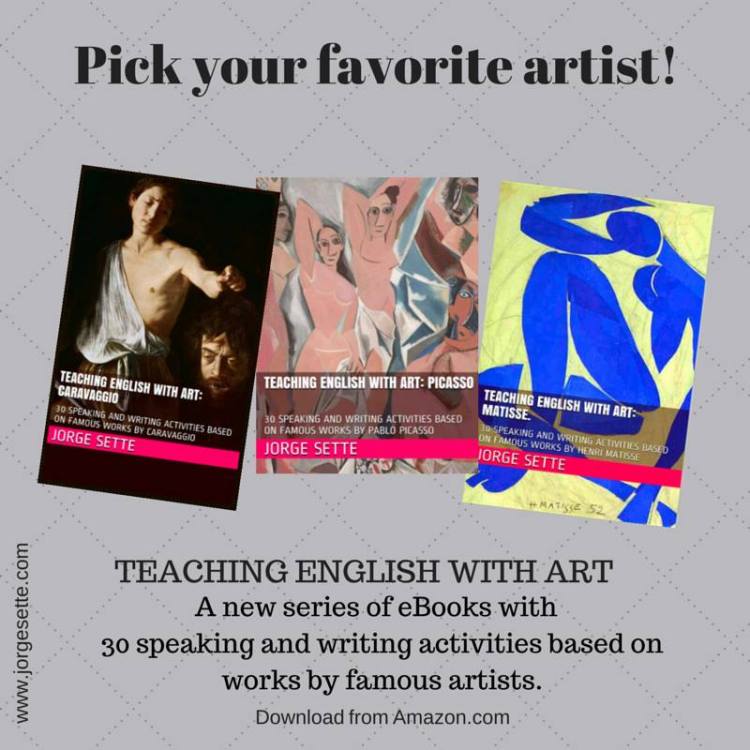
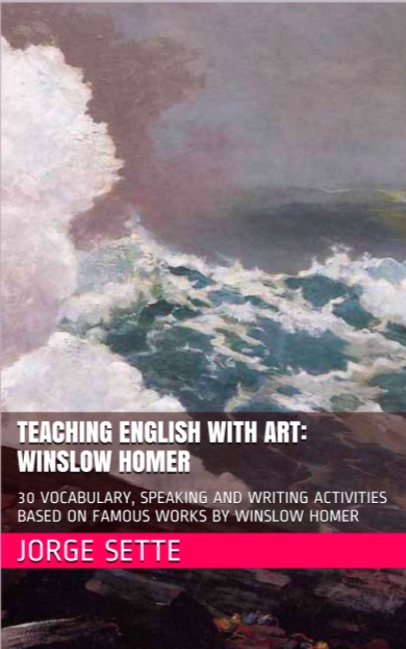
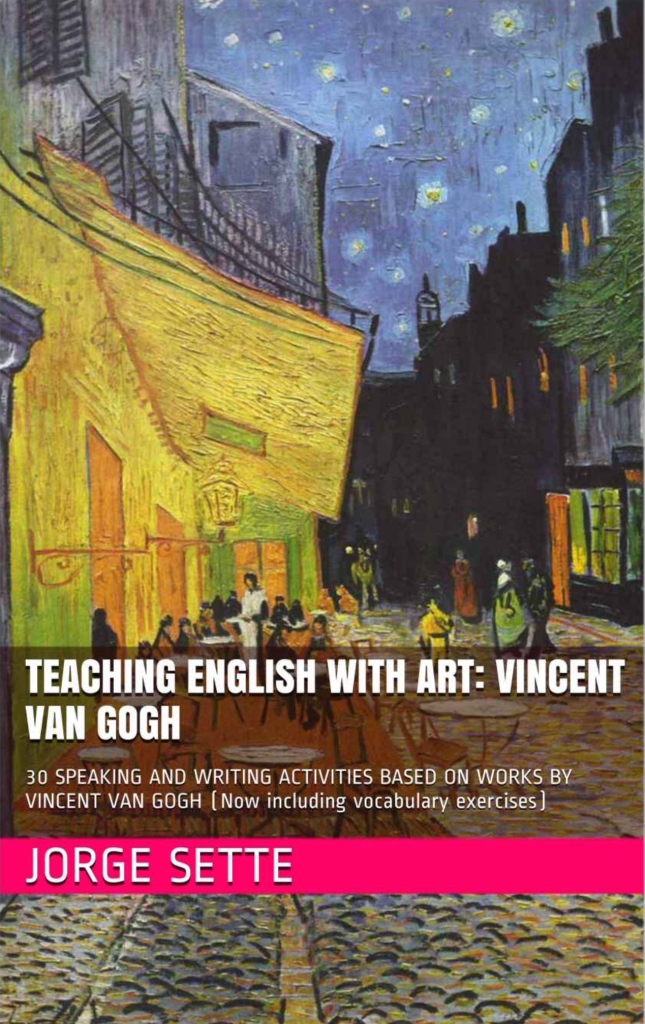
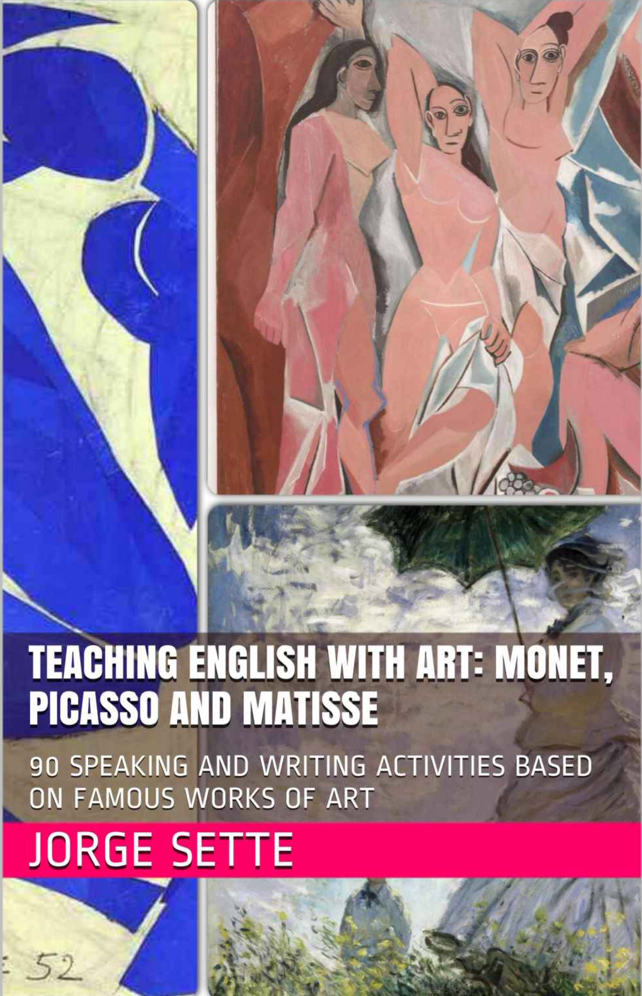
Teaching English with Art is the series for you! This eBook series is a wonderful supplement to any coursebook or extra materials your students may already be using in the English class. Each volume contains 30 speaking and writing activities for classroom use based on some of the most striking works by famous artists: for now we have MATISSE, PICASSO, CARAVAGGIO, MONET, NORMAN ROCKWELL, WINSLOW HOMER, a special three-in-one volume of MONET + PICASSO + MATISSE (90 activities), and we’ve just launched VAN GOGH.
IMPORTANT NOTE:
PERSONALIZATION: if you wish to change the cover of any of the ebooks, add your school logo, negotiate a special price for a determined number of students, or make other suggestions of customization, do not hesitate to talk to us. We are VERY FLEXIBLE. Make your ebook UNIQUE!
The objective of these eBooks is to expose the students to high art while having them practice English, fulfilling, therefore, one of the tenets of effective language acquisition: providing a realistic context for the language to be learned and practiced as a means to an end. Your students will love to practice their English discussing and doing writing tasks based on the works of these great artists. The activities are highly personalized, so the students can express their own opinions and feelings. This is a proven way to make language acquisition fun and effective by creating in the classroom an atmosphere of interest, motivation and personalization. Each activity is clearly correlated to the COMMON EUROPEAN FRAMEWORK OF REFERENCE (CEFR), and the level is stated next to it. Ideally both you and your students should purchase the material. For heads up activities, project the images on a white wall. Chose your favorite artist and click on the corresponding image below to go to AMAZON.COM and get your e-book:
If you need more instructions on how to purchase the eBooks, please click here: http://wp.me/p4gEKJ-1Cz
Jorge Sette.
Click on the image below to download your book FROM AMAZON.COM
You will never have bored students again.
For other eBooks of the series TEACHING ENGLISH WITH ART, please click here:
Check out the video clip on our eBooks below:
Au revoir
Jorge Sette
Pioneered by Pablo Picasso and Georges Braque, Cubism is one of the most revolutionary and seminal art movements of the 20th century. It has its origins in the post-impressionist paintings of Paul Cezanne, and aims at depicting reality in a non-naturalistic way, being considered the seed of the abstract paintings developed later on. Cubism in its more innovative and radical form lasted from 1907 to 1914, when the First World War broke out.
The end of the 19th century and the early decades of the 20th century were marked by great technological innovations that cried for an art form that could express these fast changes and new times. Traditional art, based on realistic works, which had been perfecting the use of perspective since the Renaissance, could not compete with the innovations of photography and film. They would be a mere replication of these more accurate methods of showing reality.
In an attempt to grasp the essence of the times, Picasso started to move towards more simplified depictions of objects and the human form, trying to represent simultaneously the different angles from which they could be seen, not only from a unique perspective. He started to flatten his images, making use of geometric shapes (such as cubes, hence the name of the movement) and deconstructing reality by slashing the image into different planes, producing, thus, an effect which had a more intellectual than sensorial impact on the viewer.
The iconic painting Les Demoiselles d’Avignon is considered the first Cubist work of art. Primitive art, such as African masks and Iberian sculptures, played an influential role in the development of Cubism. This first phase of the movement is usually known as analytic cubism, characterized by the use of dark, almost monochromatic color hues, and growing to a point where the deconstruction of reality became so radical that the viewer could hardly identify the object or person depicted. The second phase, synthetic cubism, was a lot more energetic and colorful, including the technique of collage, where real-life two-dimensional materials, such as colored paper, newspapers or even hair ribbons, were glued to the painting.
It’s hard to pinpoint when Cubism really finished, although we usually place it in the historical period between 1907-1914. It actually did not end, but transformed itself and evolved into other styles in the following decades.
Even today we can identify strong influences of Cubism in architecture, design and, of course, the arts in general.
NOTE: If you teach languages, you might want to check out our series of eBooks TEACHING ENGLISH WITH ENGLISH available from AMAZON.COM: http://wp.me/p4gEKJ-1lS
Au revoir
Jorge Sette
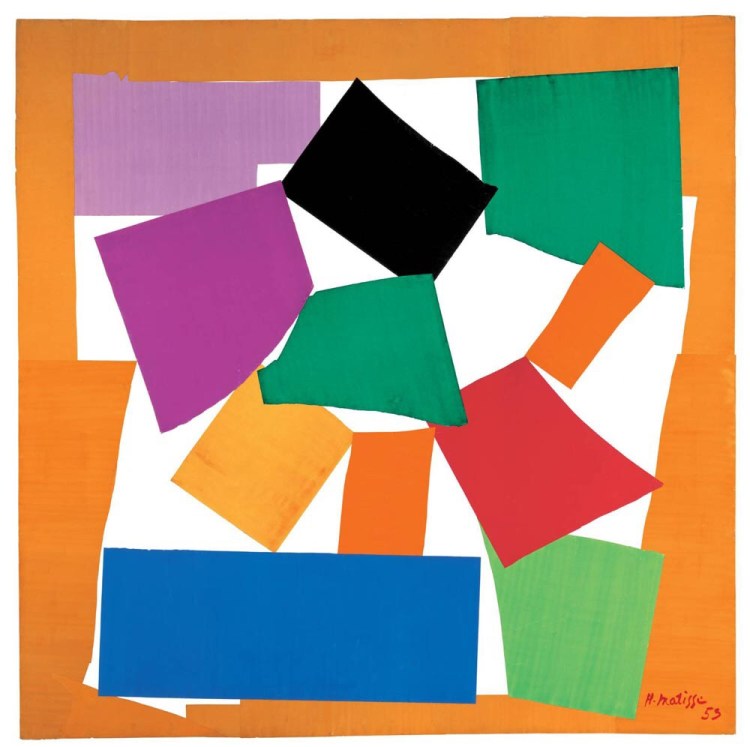
The summer of 2014 held an unforgettable event for the lovers of Matisse, one of the masters of 20th century visual arts. The Tate Modern in London offered an unprecedented exhibition of Matisse’s cut-outs, the art form he created and developed in the last decade of his life, after undergoing a very invasive and traumatic operation for intestinal cancer in the early 1940s. This exhibition, Matisse: the Cut-Outs, showed nothing less than 130 pieces of Matisse’s works, a unique feat that some claim won’t be repeated in the foreseeable future.
Matisse’s cut-outs are deceptively simple compositions made of shapes cut out from sheets of paper painted in vibrant gouache colors and assembled together as a collage in somewhat abstract forms. After his surgery, Matisse found it difficult to stand at the easel and paint for long hours, so he decided to start experimenting with this radically novel art form. Sitting on his bed or in a wheelchair, he would dexterously cut shapes directly from the sheets of paper with huge tailor scissors, and then ask his assistants to pin them together in a variety of patterns. He changed the arrangements many times before he was fully satisfied with the overall look and effect of the piece.
Matisse’s cut-outs are revolutionary in the sense that they broke the barriers between drawing and painting fusing them in enchanting colorful shapes. Each cut-out was directly sliced from the colorful sheet without a previous penciled outline to help define the form. They are basically a celebration of color and an affirmation of life. Many considered this new artistic phase of Matisse his second life. A rebirth in every sense.
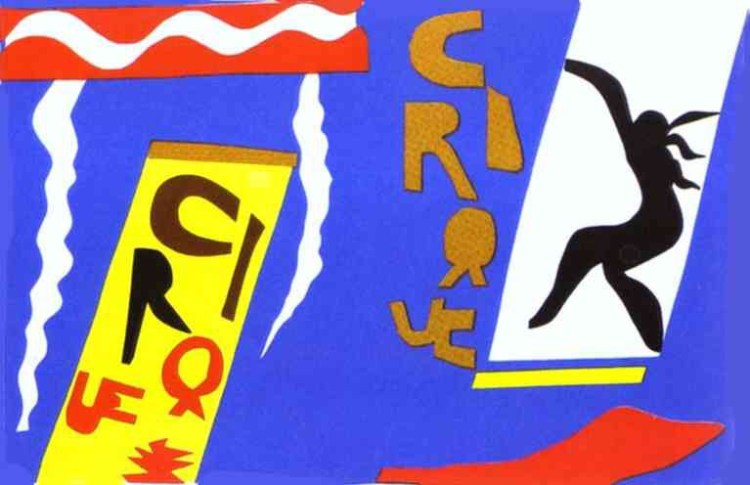
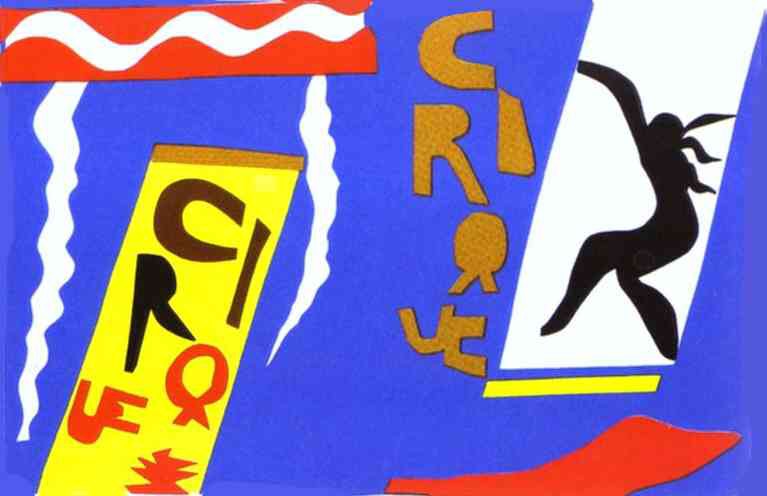
The first cut-outs appeared in a limited edition book called Jazz, which, in addition to the 20 screen printed cutouts, featured Matisse’s handwritten notes about the images, painted in black.The contrast between his beautiful monochromatic handwriting against the white paper and the fierce colors of the screen printed cut-outs creates a striking effect. In this book, a copy of which is kept at the Victoria and Albert Museum in London, the cut-cuts are mainly representations of circus performers, such as high wire walkers, trapeze artists, acrobats, clowns, knife-throwers and magicians.
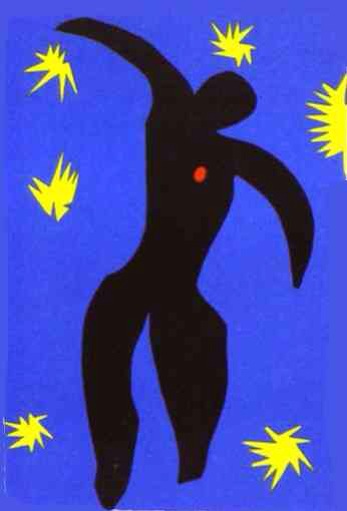
Despite its vibrant colors, some identify a darker side to this book, though. Produced at the end of the Second World War, it’s not difficult to read metaphors of these violent and disruptive times into it. Take the iconic Icarus below, for example. You might see it as a representation of the mythological figure of the son of Daedalus plunging across the sky to his death, having flown too close to the sun, which caused his wax wings to melt down. Or you can see a corpse in the middle of exploding shells with a bloody spot right over his heart, as a clear reference to the war.
Matisse did not stop painting altogether as he started creating the cut-outs. Some of his most amazing paintings date from this period as well. However, after 1948, maybe because of his progressive frailty and growing infirmity, he practically gave up on painting. His creative force, therefore, was channeled to the cut-outs, which began growing in size, becoming murals, and totally capturing the artist’s imagination, becoming almost an obsession.
At first sight, some people may be taken aback by the simplicity of this art form, and some even dare to say this is something even a kid could do. Well, we defy them to try it. Only an artist of the scope of Matisse would be able to combine those kinds of colors and variety of shapes to produce such an impactful and pleasurable effect on the viewer. Besides, the best ideas, as we know, are usually the simplest ones: only nobody thought about them before. Copy cats abound afterwards in all areas of life.
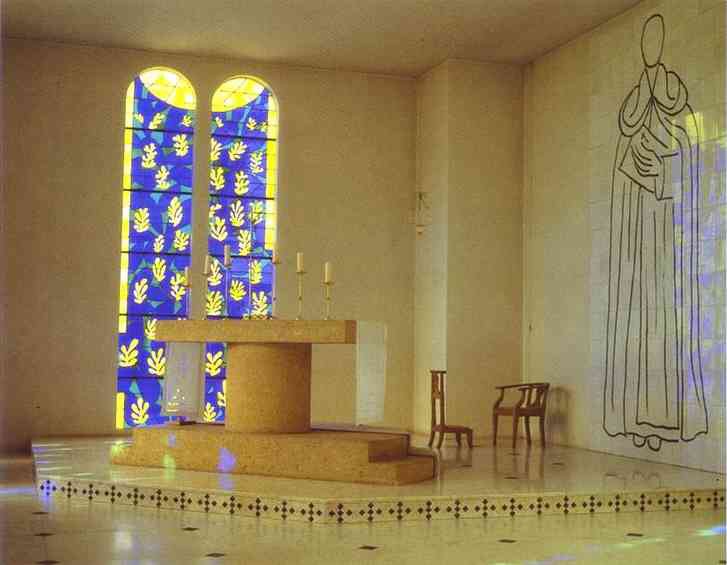
No discussion about Matisse’s cut-outs would be complete without mentioning his final masterpiece: the design of the Chapel of the Rosary in Vence, built just down the road from the bucolic house – Villa Le Rêve – where Matisse lived in the last years of his life. It took Matisse four years to complete the project, which included stained-glass windows, three ceramic murals, the interior decorations and even the priest’s robes.
The chapel is famous for the atmosphere of serenity it infuses in its visitors. His maquettes for the stained-glass windows were assemblages of cut-outs, in soothing hues of green, blue and yellow. As the sunlight filters through them, reflecting on the marble floor, one notices the three ceramic murals opposite them, bearing monochromatic drawings representing in utter simplicity and some audacity (such as emphasizing the breasts of the Virgin Mary), the Virgin Mary with Baby Jesus, the Stations of the Cross, and the founder of the order of the Dominicans, Saint Dominic.
Matisse was known for his atheism, which makes many wonder what prompted him to design this chapel and to consider it himself his greatest achievement as an artist. One reason might be he did it after becoming close friends with a Dominican nun, Sister Jacques-Marie, who nursed him during his period of convalescence after the surgery. Her convent did not have a chapel at the time, forcing the nuns to use an old garage for their rituals. Matisse used to say that he felt God only when he was working. Therefore, the chapel is more likely to be an expression of his devotion to the God of Art, using motifs of the Christian religion only as metaphors.
NOTE: You might want to check out our series of eBooks available from AMAZON.COM TEACHING ENGLISH WITH ART. Please click here: http://wp.me/p4gEKJ-1lS
Au revoir
Jorge Sette.
When you are at the stage of brainstorming for a nonfiction blog post or a piece of creative writing, it’s inevitable to remember a couple of articles, books and novels related to the topic you read at some point and enjoyed. They will be a source of inspiration and influence in your writing, making you somehow even slightly jealous, wishing you had thought of that first. But, of course, you would also have needed the right language to encapsulate it. After all, more important than the plot itself is how you say things.
Take the book Life of Pi by Yann Martel, for example, whose original idea some people claim was stolen from our Brazilian writer Moacyr Scliar. Well, plagiarism is hard to establish, there are a lot of gray areas, but one thing I’m sure of: Martel did not write the same story nor, most definitely, used the same language as Scliar. Jorge Luis Borges, in his marvelous piece Pierre Menard, Autor del Quixote, from the book Ficciones takes this idea even further, asserting that a book written with the exact same words by a different author at a different time would be read in a new way, due to the dissimilar historic contexts, and therefore would not be the same book at all. I agree.
After reading a comment on Facebook by a friend saying that she is full of ideas for blog posts but do not find the time to write them (yes, we all know how teachers are busy!), I made a joke saying that all my good ideas had already been stolen by the likes of Shakespeare, Tolstoy or Philip Roth.
Then I though for a moment, and decided to give serious consideration as to which novels I really wished I had written and why. This is my humble list:
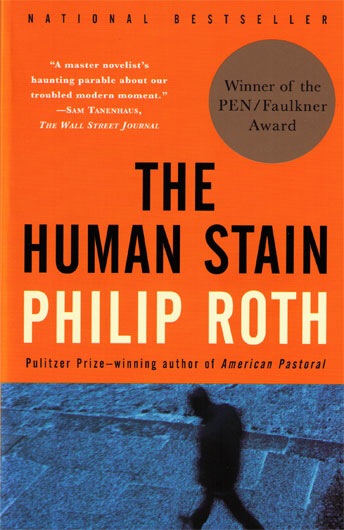
1.The Human Stain, by Philp Roth: it’s hard to discuss this book without giving a bit too much away, so apologies for the spoilers. The story of a light-skinned black boy who grabs the opportunity to pass for a Jew in 1950’s America and later becomes a Classics Professor at a small college is a complex account of the choices you make in life and the responsibilities and consequences that come with them. The need to make concessions and compromise basic values to achieve a bigger goal is the central theme of the book. The deep moral dilemma you face when you take such a radical decision, including the necessity to abandon and cut relations with your family and community to start a new life somewhere else as a completely different person, is evaluated by the author from unusual and unexpected angles in this impressive book. As irony is the hallmark of Roth, the book starts with the most paradoxal of incidents: the professor, noticing that two of the students enlisted in his class never seem to be present, asks the class the question which brings about his doom: “do they exist or are they spooks?” The latter being an old loaded word, a racist epithet for blacks. It turns out that the Professor, never having seen those students before, meant spooks in the most common sense of the word, that is, ghosts, and, after all the pressure and hassle he goes through, without support from any of his colleagues and students – for a number of political reasons – he decides to resign and end his career. I would love to have written this story for its universality: any minority can identify with what Coleman, the Jewish/Black professor, goes through, and can easily put themselves in his shoes. Given the opportunity would you do the same? Would you change your race, color, nationality, sexual orientation or gender? Or would you just give up all of your chances of fully growth and spend the rest of your life as a second class citizen in a society that will only offer you the fulfillment of your whole potential if you are the right color?
2. Dom Casmurro, by Machado de Assis: this must be the book I reread most often in my entire life. I know it almost by heart. What attracts me is the way the characters are so well-rounded and fully developed, leaping out of the page as if you could go for a walk and talk to them. This does not mean, however, that you will know them any better. This is the whole point of the story. The dissimulation, the fact that we never know anyone completely. The impossibility of dealing with only one version of the reality. I can’t get enough of the artistry of the author, who, narrating the story in the first person, never lets the reader be sure about what really happened: was the main character’s wife an adulterer? Is the boy she gives birth to his son or his best friend’s? The doubt will corrupt his marriage and ultimately destroy all the love in his life. He becomes empty and isolated, having chosen the version of reality which will cause him the most pain and damage. Don’t we all choose the latter?
3. We need to talk about Kevin, by Lionel Shriver: a professional woman is in love with her work and her husband. She writes and publishes travel guides, having the chance to go places, tour interesting and remote regions, avoiding getting stuck in a housewife’s rut, being independent most of the time. Yet, she can count on a loving husband to comfort and look after her when she comes back home after a long trip: this is a dream life. She has the best of both worlds. Then, what else is it that society claims will make every woman even happier and more complete: to have a baby. From the birth of Kevin, her firstborn, to the dantesque crime scene at the end of the book, We need to talk about Kevin reads like a nightmare. You can’t put it down. A thriller in every sense of the word. But one that goes way beyond the limitations of the genre. Shriver’s ambitions are a lot more encompassing. She discusses the nature of evil. Is it caused by nurture or nature? How is it created? Has Kevin always been the monster she feared he was or was his low self-esteem caused by his mother’s lack of love and care that turned him into a criminal? Was the mother’s resentment for having to give up all the pleasure and independence of her former life, her pre-baby life, toxic enough to corrupt and undo the little creature? The sense of guilt of a mother for not conforming to the patterns of a society that takes motherly love for granted only contributes to the character’s anguish and mental confusion. Of course, the book will show different perspectives of the scenarios we painted, but the conclusion will be up to the reader.
These are all great themes and I don’t need to tell you how masterfully these concepts and ideas are exploited by those wonderful writers. The angles they illuminate, the perspectives they reveal would hardly have occurred to the average reader. That’s why they are geniuses and we are blog writers. But we can always try to get closer to their art in our writing. According to Malcolm Gladwell, another writer whose books I wish I could have written (although they are nonfictional), all it takes is a dedication of 10,000 hours of work to become a world class master at your craft.
Which books would you like to have written yourself? Let us know.
Au revoir
Jorge Sette.
Writing is today more fashionable than it has been in a long time. Perhaps it’s at the peak of its importance ever, with all the blogs, messages, emails and tweets swamping our computer, tablet and smart phone screens every second of the day. Of course, most of the time it’s bad or unclear writing. But everyone is doing it one way or another, and job opportunities are opening up for those who do it well.
Content is the key word in the workplace today. Especially if you are in sales & marketing. The buyer has all the power today and they control when, how and where they will make their next purchase. In this context, writing can be a great asset in educating and persuading prospects, making them see you as the expert, or thought leader in your field. Writing great content and making it available will help you develop a relationship with your potential customers, who will definitely lean towards your offer when the time is right.
As a consequence of its importance, the Internet is full of advice about effective writing, how to put blogs together, the dos and don’ts and best practices of publishing anything. By all means, read all you can, as there is a lot of useful information online. Beware, however, of some of the most common misconceptions about writing: in general most of them were acquired or developed at school and academic settings rather than on the Internet. Here are five of the most common:
1. Writing is about inspiration and waiting for the muse to come down and sit on your keyboard. Well, I’m afraid there’s not enough room for the muse to relax and spread out on such a small space. Also, deadlines have a weird way of not accommodating the muse’s busy schedule, so do not wait to get started. Writing is not necessarily what Hemingway warned us against in his famous quote: “There is nothing to writing. All you do is sit down at a typewriter and bleed.” Make it more active: brainstorm ideas, do some research, check out what is trending online, use automatic topic generators on the Internet, and do not delay. Start the process as soon as you can,
2. Writing comes out as the masterpiece you usually read in the printed copy of good magazines, newspapers and books. Well, the final draft is not easy to get to. That’s what you see published. But anyone can get the process started and refine it until you achieve a satisfactory result. The saying writing is rewriting, or writing is more about transpiration than inspiration are indeed true. Once you spill out your first ideas and get them more or less outlined on the page, you will start the process of polishing them. And that is the hard part. This will take time, effort and immense patience.
3. You cannot self-edit. If we are not talking about your PhD thesis or your fiction masterpiece, do not believe you need a team of copyeditors, researchers and proofreaders ready to work for you. They are expensive and hardly available in enough numbers even for big publishing companies nowadays. So, unless you can count on close friends to help you out with it (remember you can always return the favor), you must learn tactics for self-editing. Do not hesitate to count on every piece of technology available to help you with the task: spell checkers, grammar checkers, dropdown thesaurus, online dictionaries, you name it. There are a lot of very useful tools out there. Read your drafts as many times as you can and carry on refining them. There will be a moment when you’ll get so fed up with reading your piece you will want to throw up. That’s when you take a serious break. I’m not talking about the proverbial coffee time (you have probably been drinking coffee nonstop throughout the whole process anyway). Just abandon your text for a couple of days (I hope you can afford to do that. Factor in those necessary breaks when you plan your timetable to meet the deadline). Next time you get back to the text, you will see it with fresh eyes, and give it the final touches as a Steven Pinker would.
4. Sophisticated writing is good writing. Write as you speak. Content that will help you sell is content that’s simple enough for the majority of readers to understand. So drop the long words and complex sentences. The golden rule of elegance is less is more. Apply this to your writing: precision and simplicity of vocabulary, clarity of ideas, avoidance of overuse of the passive voice, and keeping to what is essential are the tactics that will make you win the reader over. As you read and reread your text, try to leave out everything that is superfluous or redundant. Cut, cut, cut.
5. Not everyone can write. You are write (sorry: right) to think so, if you are using Oscar Wilde or Hemingway as your standard. Artistic and creative writing are not for everyone. It does not need to be for you. But most people can learn to develop and communicate clear, authoritative and persuasive ideas in writing. It takes practice, though. All the content marketing gurus agree on this single point: you need to write everyday if you are in the business. The blog post you will write as soon as you finish reading this text will sound a hundred times better than the one you wrote around the same time last year. They will be both there on the Internet: just read and compare them. You will have improved. So keep working at it and surprise yourself month after month at how much better you are becoming. Good luck!
Would you like to share with us any advice on writing? Please do not hesitate to do so on the comments section of this blog. You might as well rate us so we can improve.
Au revoir
Jorge Sette