Paintings in the Movies: Art within Art


I’m fascinated by the game of mirrors and metalinguistic reflections reverberating from the use of art inside art inside art inside art, and all the implications and possible interpretations that result from this spiraling labyrinth. More precisely, this post is about famous paintings that feature in movies either as a direct element of the plot, or, more subtly, as an aid to help compose the fabric of the subtext. I’ll cover 3 interesting instances of clever uses of famous works of art and artistic style in the movies, which always cause a jolt of pleasure in the viewer who recognizes them, and, as a consequence, is able to connect the dots and understand the references.

1. The Skin I live In, by Pedro Almodovar, 2011. Let’s start with this brilliant Almodovar classic, which was heavily criticized when it first came out for its alleged shift of style from what the director had been famous for. Well, if these critics meant the movie adds layers of complexity to Almodovar’s previous works, I couldn’t agree more. However, if they are implying the movie was not funny, I don’t think they got it. It’s hilarious, although in a somewhat dark way. In addition to the humor, one important aspect of the movie is the theme of the contrast between culture and nature, between what is innate and what is fabricated and handed down by civilization; how far can one go to change what is considered natural? Without going into too much detail about the plot of the movie, let’s just say it’s about a surgeon who thinks it’s OK to recreate the human skin in order to improve it. And he tests his theory on an unlikely guinea pig: the man who allegedly abused his daughter, and whom he has turned into a woman, through an unauthorized gender reassignment surgery! Too weird? Maybe. But the point here is to discuss the symbolic meaning of the painting that decorates the surgeon’s mansion in Toledo, and keeps popping up in the scenes where he goes up and down the elaborate staircase: The Venus of Urbino, by Titian, 1538. This painting summarizes the main theme of the movie: the idealization and beautification of the real world. In this case, a beautiful goddess, with flawless white skin, concocted by an artist, conveys the impossibility that she could be recreated outside of this imaginary world. She will not leap off the painting and exist in real life.
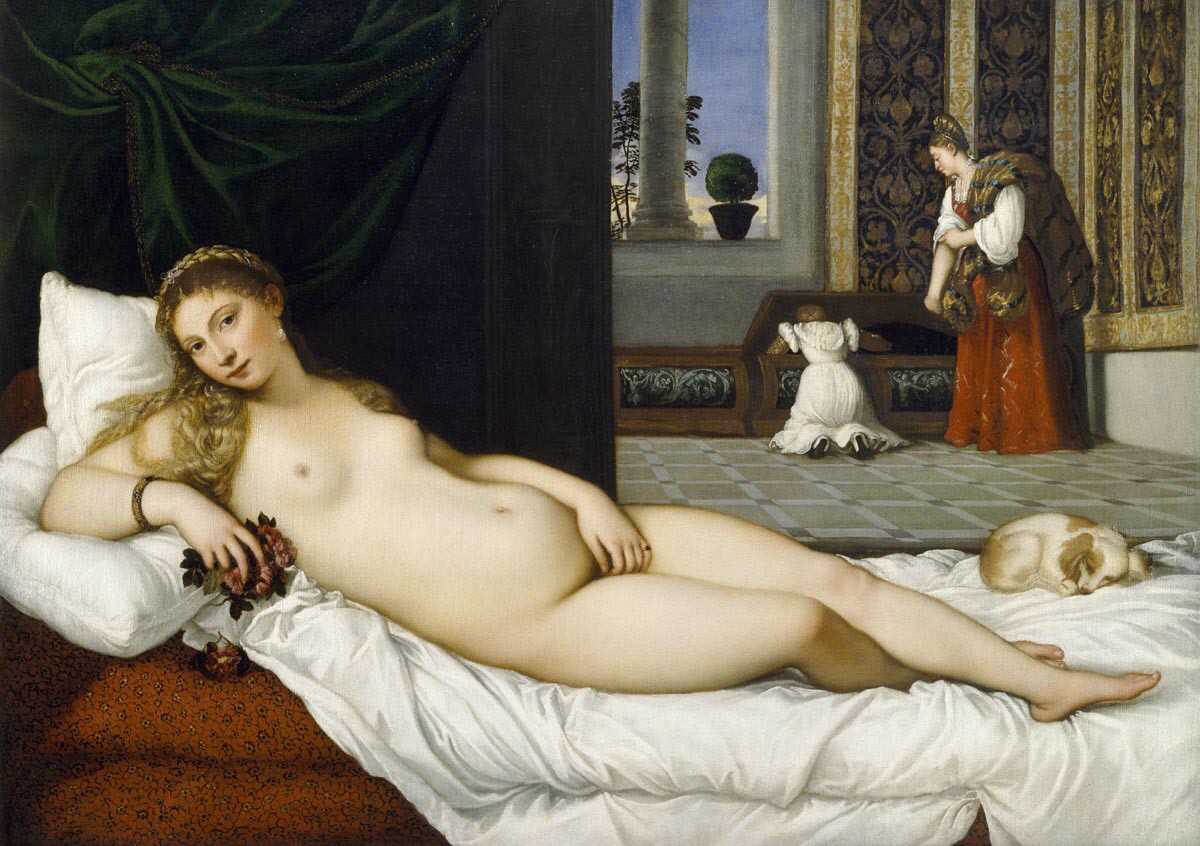
The Venus of Urbino, by Titian, 1538

The Venus of Urbino, by Titian, 1538

2. Skyfall, by Sam Mendes, 2012. By far my favorite 007 movie. Everything works perfectly to make this a classic: action-packed opening scene, dreamlike credit sequence showcasing Adele’s song, a lot of fighting and shooting throughout, stunning locations (London, Istanbul, Shanghai), sophisticated dialogue, superb acting. And, as the underlying theme, we are to led to confront the universal and always worrying issue of the inexorable passage of time and how human beings cope with it. The main theme is made explicit in an anthological scene (see video clip below) where an aging 007 meets his new and young quartermaster: Q. They are both at the National Gallery in London contemplating Turner’s The Fighting Temeraire, 1838, which depicts an old ship being tugged somewhere to be destroyed. These are the best lines of the blistering dialogue that ensues:

Q:    Old age is no guarantee of efficiency.

007: And youth is no guarantee of innovation.

Do I need to explain anything else?

Turner’s The Fighting Temeraire, 1838.

Turner’s The Fighting Temeraire, 1838.

Q meets James Bond:

3. Mean Streets, Martin Scorsese, 1973. In this movie the symbolism does not come from showing a specific artwork. However, you can tell the cinematography and art direction are heavily influenced by the style of Caravaggio. You seem to be watching the application in movies of Caravaggio’s artistic principles: Scorsese, just like his baroque predecessor, depicts the contemporary world (1973 New York) of the Italian Mob, shown in beautifully staged scenes where the technique of chiaroscuro or tenebrism predominates. Every scene seems to have the lighting coming from a single or, sometimes, two naked light bulbs carefully placed to focus on the foreground, where the action is taking place. The background is dimmed or blackened in shadows. The characters seem to behave as modern versions of Caravaggio and his mates themselves, rambling through the dark streets of VII century Rome (represented by 1973 New York) after nightfall, going to taverns (bars, and pool joints) and whorehouses (stripclubs). They are constantly gambling, getting involved in brawls and fights, some of those – in the movie – nicely choreographed to the Rolling Stones or the Beatles songs. In addition to that, you hardly ever see a shot without an element of the Catholic iconography featuring prominently in the setting: images of Christ, the Virgin Mary, crucifixes, photos of the pope and the interior of churches themselves. What would we call this? Post-modern baroque?

Caravaggio's Cardsharps, 1596.

Caravaggio’s Cardsharps, 1596.

Let us know what you thought of this post: write your feedback on the comments section of the blog.

NOTE: If you are into art, you may consider checking out our eBook series TEACHING ENGLISH WITH ART: http://wp.me/p4gEKJ-1lS

Au revoir

Jorge Sette.

Blog Linguagem: 1st Anniversary. Jan 2015: 100% Growth!


We broke all our records in Jan 2015 with a 100% growth.  Join us now: http://www.jorgesette.com

LINGUAGEM, MARKETING, SALES TRAINING, CULTURE, ART

100% GROWTH

100% GROWTH


Our main customers. Where do they come from?

Our main customers. Where do they come from?


Click on the link below to check out our latest stats in PDF format.

Blog LINGUAGEM- First Anniversary


Au revoir


Jorge Sette.
Caravaggio, Oscar Wilde, Salome…and the head of the Baptist!


One of the most famous versions of the myth of Salome is the play written by Oscar Wilde, originally in French, in 1891. In this version, Salome is the daughter of Herodias, wife of Herod Antipas, the tetrarch of Galilee and Peraea.

The prophet John the Baptist has been imprisoned by Herod for criticizing his marriage to Herodias, who had previously been Herod’s brother’s wife. John the Baptist claims the consortium is incestuous.

In Wilde’s play, the action takes place during a party thrown by Herod probably in celebration of his own birthday.

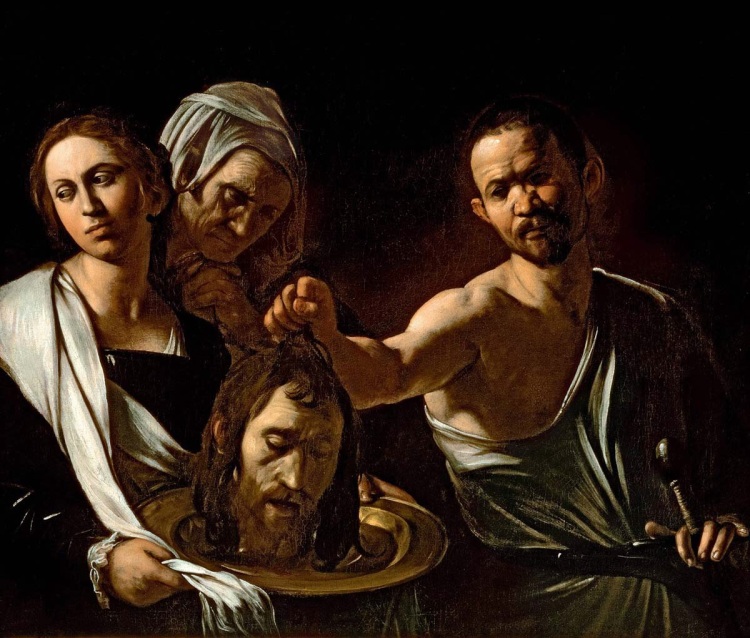
Caravaggio's Salome with the Head of John the Baptist, 1607.

Caravaggio’s Salome and the Head of John the Baptist, 1607

During the party, Salome tries to seduce the prisoner John the Baptist but does not succeed in her intent. A number of signs indicate that tragedy looms ahead: the moon looks strange and ominous; a soldier/servant has just committed suicide; Herod, coming out of the party, slips in a pool of the blood shed by the victim, and hears a sound like the one made by the flapping of giant wings…These are all bad omens. What is going to happen?

Soon afterwards, Herod, drunk on wine, and somewhat infatuated by his stepdaughter Salome, begs her to dance for him. Herodias, her mother, does not think this is appropriate and tries to forbid her, but Salome acquiesces when Herod promises she can have anything she wishes in return.

Salome then dances the famous “dance of the seven veils”, which mesmerizes Herod. Time has come now for her to ask for her reward: she wants it to come on a silver platter. Herod laughs: “sure, she can have it on a silver platter…but what is it that she wants?” Salome demands: “The head of the Baptist”, catching Herod completely off guard. He is horrified by the request.

Her demand is fully appreciated by Herodias, who hates the prophet. She insists that her daughter should get what she wants. Herod tries to make Salome change her mind by offering her lots of alternative gifts, such as jewels and beautiful birds, but she is adamant: all she wants is the prophet’s head on a silver platter.

Her wish is granted: John the Baptist is decapitated. Caravaggio painted in gory detail a gruesome scene based on the myth, almost 300 years before the play was written.

Note: the text above is from the ebook: TEACHING ENGLISH WITH ART: CARAVAGGIO. For further info on the series please CLICK HERE:  http://wp.me/p4gEKJ-1lS

Check out the video:

Au revoir

Jorge Sette

Caravaggio and the Myth of Medusa


Medusa was a beautiful priestess serving at the temple of Athena. Her beauty attracted a number of suitors, but she had to turn them down, as, according to her vows, she was supposed to remain a virgin.

However, Poseidon, God of the Sea, fell in love with Medusa and appeared to her in the shape of a bird. Being a god, it was easy for him to have his way with the poor maid and sleep with her.

As customary in mythological tales, the victim takes the blame for this sort of incident, and Athena, in a fury, turned Medusa into a horrific monster with the skin of a corpse and poisonous snakes for hair. Besides, anyone who dared to look her in the eyes would immediately turn to stone.

Caravaggio's Medusa

Caravaggio’s Medusa

Perseus, son of Jupiter with the mortal Danae, grew up on the Island of Seriphus. For many years he longed to receive a visit from his father, but it did not happen. His mother would tell him to be patient, as time did not work in the same way for gods.

Danae attracted the attention of Polydectes, king of the island, who tried to force her to marry him. She refused, but the King imposed one condition not to marry her: Perseus must bring him the head of Medusa as a gift.

Perseus, although unprepared and young, did not hesitate to accept the challenge. He knew he had first to find the Grey Sisters, horrible old hags who lived in the forest and shared one eye between them. They kept taking turns at using the eye ball. In a moment of distraction, while one of them was passing the eye to another, Perseus snatched it and told them that he would keep the eye unless they told him where the nymphs lived. The nymphs would tell him where to find Medusa and would give him the necessary weapons to fight her. The old hags acquiesced.

Perseus set out to meet the nymphs, who gave him three weapons: the sword of Jupiter, his father; the shield of Athena, the Goddess of Wisdom; and the winged sandals of Hermes, the Messenger of the Olympic Gods. He was also told not to look Medusa in the eye or he’d be turned to stone.

As he approached the lair of the monster, Perseus noticed a number of statues of men scattered in the garden. These were probably men who had tried to get to Medusa before him and were dully petrified. All was rock and desolation around the cave of the monster.

Perseus turned his back to the entrance and walked backwards towards the inner chambers of the cave, looking into the reflection on his polished shield for orientation. This way he would not have to look Medusa in the eyes directly. As he located her, he turned around with his eyes shut and struck her neck with the powerful sword of Jupiter, decapitating the creature.

Using Hermes’ sandals, he flew back to the Island of Seriphus, arriving right at the moment when the wedding between his mother and King Polydectes was about to take place. He shouted: Here’s your gift! And held the head of Medusa in front of the king. The King looked into the eyes of the dead monster and, as a result, was turned immediately to stone. And so Danae was free to go and live with her son again.

Caravaggio’s work, inspired by the myth of Medusa, was painted on an actual shield. It was not meant to be hung, but passed from hand to hand when viewed.

Note: the text above is from the ebook: TEACHING ENGLISH WITH ART: CARAVAGGIO. For further info on the series please CLICK HERE:  http://wp.me/p4gEKJ-1lS

Check out the video:

Au revoir

Jorge Sette


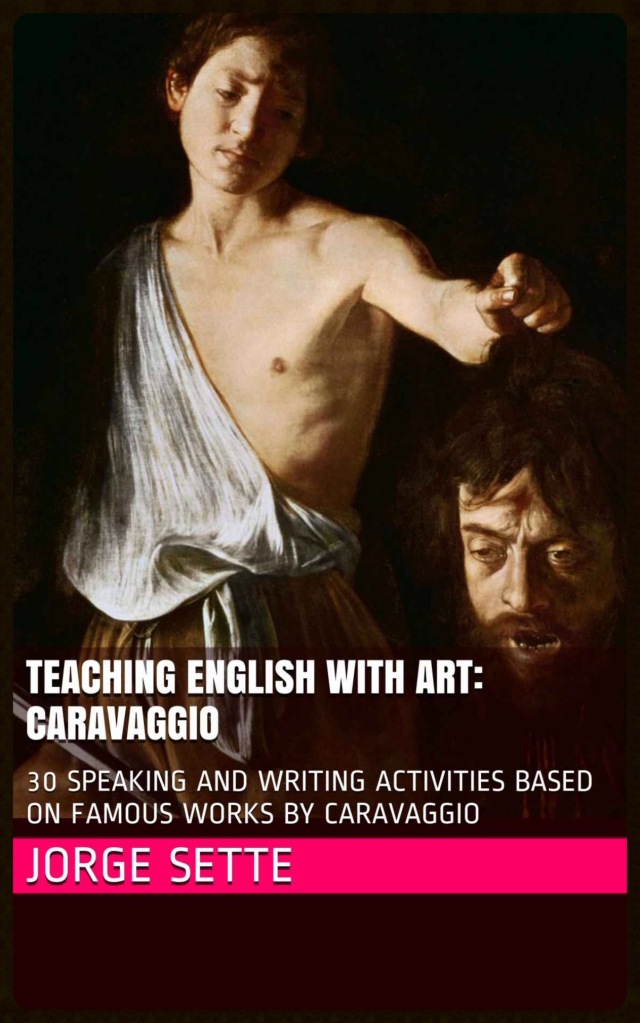
Teaching English with Art: Caravaggio


Click on the image below to download the eBook from AMAZON.COM

You will never have bored students again.

Click on the image to download the eBook

Click on the image to download the eBook

Watch the promo video clip:

http://youtu.be/Evuvs5AouQY

OUR BLOG “LINGUAGEM” HAS HAD A GREAT FIRST YEAR!


HAPPY NEW YEAR, EVERYONE.

Please find below some official stats sent by wordpress.com on the blog LINGUAGEM. We’ve had a great first year. Thanks for the support and we will back stronger than ever in 2015.

BLOG LINGUAGEM: 2014 official stats

BLOG LINGUAGEM: 2014 official stats


Screen Shot 2014-12-30 at 8.48.34 PM Screen Shot 2014-12-30 at 8.52.35 PM


Au revoir

Jorge Sette.

Sample activities from the eBook TEACHING ENGLISH WITH ART: PICASSO


Image 2: Acrobat on a Ball. 1905

Acrobat on a ball, Picasso

Acrobat on a ball, Picasso

Activity 4: speaking. Level A1/A2

  1. Describe the picture. What’s the predominant color?
  2. This is a painting from Picasso’s Rose Period (1904-1906). Everything is kind of pinkish. How was Picasso feeling during this period? Why do you think so?
  3. What does the color pink remind you of?
  4. Who are those people? What’s their relationship? Where do they work?
  5. The girl can stand on a ball. This is difficult to do. What else do you think she can do? Can you do anything difficult? What?


Activity 5: speaking. Level A2

  1. What’s this girl like? Tell us about her personality. What about the man?
  2. Describe the girl physically. Now describe the man.
  3. What do you think she likes doing in her free time? What do you like doing in your free time?
  4. Do you like the circus? What do you usually see in the circus?
  5. Pair work: students are divided into A and B. Student A lists the positive points of a circus. Student B disagrees and says why.
  6. Make a poster of a circus (a drawing or a collage or both) and present it to the class.

Activity 6: writing. Level B1/B2

  1. Write a composition imagining what your life would be like if you worked for a circus. Tell us about your job. What you usually do. The different kinds of people you work with. Do your relatives work there too? Who? (Do some research on the Internet to find out what kind of life circus people live. Use your own words in the composition. 400 – 700 words).
  2. Read your partner’s composition. Help her correct some mistakes and ask questions to help her write a more complete and better composition. Then ask her to help you with yours.

For more info about the series TEACHING ENGLISH WITH ART: Click on the link below to go to AMAZON.COM and get your ebooks: http://wp.me/p4gEKJ-1lS

Click on the image above to access the KINDLE STORE: Teaching English with Art: Matisse, Picasso, Caravaggio, Monet, Norman Rockwell

Click on the image above to access the KINDLE STORE. Teaching English with Art: Matisse, Picasso, Caravaggio, Monet, Norman Rockwell

Au revoir Jorge Sette

Teaching English with Art: make your online lessons stand out


Ideal for online lessons!!

If you are having any of the following problems, we can help you…

a. Are your students often bored during the English class? b. Don’t they know what to say when you set up speaking activities? c. Do you spend the weekend correcting writing assignments that don’t seem to help them improve? d. Is it hard to personalize productive skills and link the English lesson to the other subjects in the school curriculum? e. The students know nothing about Art and high culture in general. 

Click on each of the pictures below to get your copy from the KINDLE STORE:

Click on the image above to go to Amazon.com

Click on the image above to go to Amazon.com

Click on the image above to get your copy from the KINDLE STO

Click on the image above to get your copy from the KINDLE STORE.

Click on the picture above to get your copy.

Click on the picture above to get your copy.

Teaching English with Art: Norman Rockwell

Click on the image above to download the eBook.

Teaching English with Art

Click on the image to download the ebook.

Teaching English with Art: Picasso

Click on the image to download the eBook.

Click on the image to download the eBook

Click on the image to download the eBook

Teaching English with Art: Monet.

Click on the image to download the eBook.

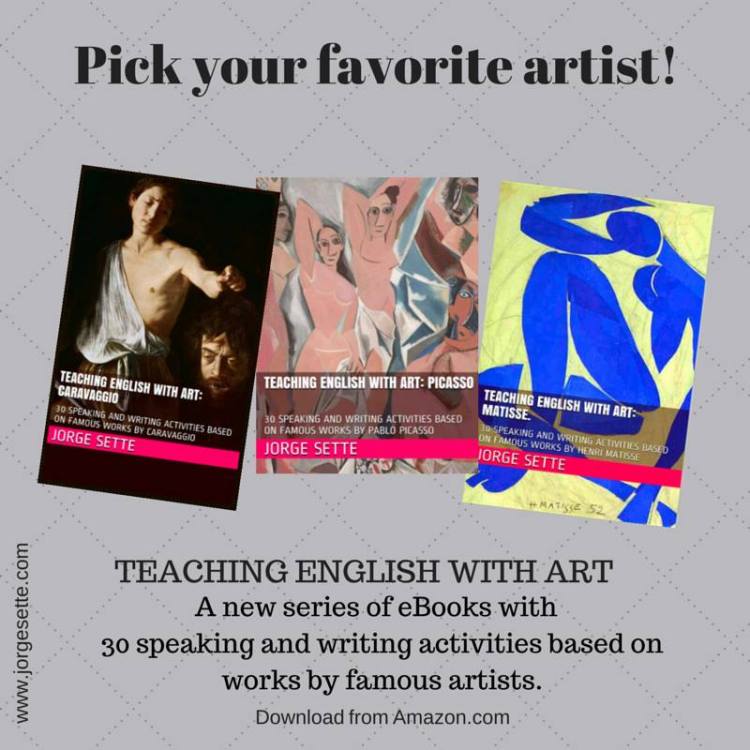
Teaching English with Art is the series for you! This eBook series is a wonderful supplement to any coursebook or extra materials your students may already be using in the English class. Each volume contains 30 speaking and writing activities for classroom use based on some of the most striking works by famous artists: for now we have MATISSE, PICASSO, CARAVAGGIO, MONET, NORMAN ROCKWELL, WINSLOW HOMER, a special three-in-one volume of MONET + PICASSO + MATISSE (90 activities), and we’ve just launched VAN GOGH.

IMPORTANT NOTE:

PERSONALIZATION: if you wish to change the cover of any of the ebooks, add your school logo, negotiate a special price for a determined number of students, or make other suggestions of customization, do not hesitate to talk to us. We are VERY FLEXIBLE. Make your ebook UNIQUE!

The objective of these eBooks is to expose the students to high art while having them practice English, fulfilling, therefore, one of the tenets of effective language acquisition: providing a realistic context for the language to be learned and practiced as a means to an end. Your students will love to practice their English discussing  and doing writing  tasks based on the works of these great artists.  The activities are highly personalized, so the students can express their own opinions and feelings. This is a proven way to make language acquisition fun and effective by creating in the classroom an atmosphere of interest, motivation and personalization. Each activity is clearly correlated to the COMMON EUROPEAN FRAMEWORK OF REFERENCE (CEFR), and the level is stated next to it. Ideally both you and your students should purchase the material.  For heads up activities, project the images on a white wall. Chose your favorite artist and click on the corresponding  image below to go to AMAZON.COM and get your e-book:

If you need more instructions on how to purchase the eBooks, please click here: http://wp.me/p4gEKJ-1Cz

Jorge Sette.

Cubism: the most revolutionary art movement of the 20th century


Pioneered by Pablo Picasso and Georges Braque, Cubism is one of the most revolutionary and seminal art movements of the 20th century. It has its origins in the post-impressionist paintings of Paul Cezanne, and aims at depicting reality in a non-naturalistic way, being considered the seed of the abstract paintings developed later on. Cubism in its more innovative and radical form lasted from 1907 to 1914, when the First World War broke out.

The end of the 19th century and the early decades of the 20th century were marked by great technological innovations that cried for an art form that could express these fast changes and new times. Traditional art, based on realistic works, which had been perfecting the use of perspective since the Renaissance, could not compete with the innovations of photography and film. They would be a mere replication of these more accurate methods of showing reality.

Portrait of Fernarde by Picasso, Pablo. 1909

Portrait of Fernande by Picasso, Pablo, 1909

In an attempt to grasp the essence of the times, Picasso started to move towards more simplified depictions of objects and the human form, trying to represent simultaneously the different angles from which they could be seen, not only from a unique perspective. He started to flatten his images, making use of geometric shapes (such as cubes, hence the name of the movement) and deconstructing reality by slashing the image into different planes, producing, thus, an effect which had a more intellectual than sensorial impact on the viewer.

The iconic painting Les Demoiselles d’Avignon is considered the first Cubist work of art. Primitive art, such as African masks and Iberian sculptures, played an influential role in the development of Cubism. This first phase of the movement is usually known as analytic cubism, characterized by the use of dark, almost monochromatic color hues, and growing to a point where the deconstruction of reality became so radical that the viewer could hardly identify the object or person depicted. The second phase, synthetic cubism, was a lot more energetic and colorful, including the technique of collage, where real-life two-dimensional materials, such as colored paper, newspapers or even hair ribbons, were glued to the painting.

Bottle, Guitar, and Pipe by Picasso, Pablo

Bottle, Guitar, and Pipe by Picasso, Pablo. 1912

It’s hard to pinpoint when Cubism really finished, although we usually place it in the historical period between 1907-1914. It actually did not end, but transformed itself and evolved into other styles in the following decades.

Even today we can identify strong influences of Cubism in architecture, design and, of course, the arts in general.

NOTE: If you teach languages, you might want to check out our series of eBooks TEACHING ENGLISH WITH ENGLISH available  from AMAZON.COM: http://wp.me/p4gEKJ-1lS

Teaching English with art

Teaching English with art

Au revoir

Jorge Sette

Matisse’s Cut-Outs: Drawing With Scissors


The summer of 2014 held an unforgettable event for the lovers of Matisse, one of the masters of 20th century visual arts. The Tate Modern in London offered an unprecedented exhibition of Matisse’s cut-outs, the art form he created and developed in the last decade of his life, after undergoing a very invasive and traumatic operation for intestinal cancer in the early 1940s. This exhibition, Matisse: the Cut-Outs, showed nothing less than 130 pieces of Matisse’s works, a unique feat that some claim won’t be repeated in the foreseeable future.

Matisse’s cut-outs are deceptively simple compositions made of shapes cut out from sheets of paper painted in vibrant gouache colors and assembled together as a collage in somewhat abstract forms. After his surgery, Matisse found it difficult to stand at the easel and paint for long hours, so he decided to start experimenting with this radically novel art form. Sitting on his bed or in a wheelchair, he would dexterously cut shapes directly from the sheets of paper with huge tailor scissors, and then ask his assistants to pin them together in a variety of patterns. He changed the arrangements many times before he was fully satisfied with the overall look and effect of the piece.

Matisse’s cut-outs are revolutionary in the sense that they broke the barriers between drawing and painting fusing them in enchanting colorful shapes. Each cut-out was directly sliced from the colorful sheet without a previous penciled outline to help define the form. They are basically a celebration of color and an affirmation of life. Many considered this new artistic phase of Matisse his second life. A rebirth in every sense.

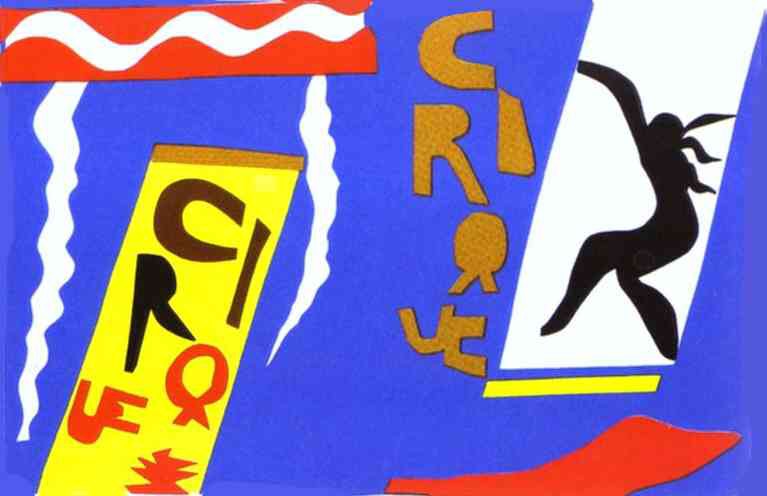
The Circus, 1947. Illustration for the book Jazz.

The Circus, 1947. Illustration for the book Jazz.


The first cut-outs appeared in a limited edition book called Jazz, which, in addition to the 20 screen printed cutouts, featured Matisse’s handwritten notes about the images, painted in black.The contrast between his beautiful monochromatic handwriting against the white paper and the fierce colors of the screen printed cut-outs creates a striking effect. In this book, a copy of which is kept at the Victoria and Albert Museum in London, the cut-cuts are mainly representations of circus performers, such as high wire walkers, trapeze artists, acrobats, clowns, knife-throwers and magicians.

Despite its vibrant colors, some identify a darker side to this book, though. Produced at the end of the Second World War, it’s not difficult to read metaphors of these violent and disruptive times into it. Take the iconic Icarus below, for example. You might see it as a representation of the mythological figure of the son of Daedalus plunging across the sky to his death, having flown too close to the sun, which caused his wax wings to melt down. Or you can see a corpse in the middle of exploding shells with a bloody spot right over his heart, as a clear reference to the war.

Icarus. 1947. Illustration for the book Jazz.

Icarus. 1947. Illustration for the book Jazz.


Matisse did not stop painting altogether as he started creating the cut-outs. Some of his most amazing paintings date from this period as well. However, after 1948, maybe because of his progressive frailty and growing infirmity, he practically gave up on painting. His creative force, therefore, was channeled to the cut-outs, which began growing in size, becoming murals, and totally capturing the artist’s imagination, becoming almost an obsession.

At first sight, some people may be taken aback by the simplicity of this art form, and some even dare to say this is something even a kid could do. Well, we defy them to try it. Only an artist of the scope of Matisse would be able to combine those kinds of colors and variety of shapes to produce such an impactful and pleasurable effect on the viewer. Besides, the best ideas, as we know, are usually the simplest ones: only nobody thought about them before. Copy cats abound afterwards in all areas of life.


The Snail. 1952/53.

The Snail. 1952/53.


No discussion about Matisse’s cut-outs would be complete without mentioning his final masterpiece: the design of the Chapel of the Rosary in Vence, built just down the road from the bucolic house – Villa Le Rêve – where Matisse lived in the last years of his life. It took Matisse four years to complete the project, which included stained-glass windows, three ceramic murals, the interior decorations and even the priest’s robes.

The chapel is famous for the atmosphere of serenity it infuses in its visitors. His maquettes for the stained-glass windows were assemblages of cut-outs, in soothing hues of green, blue and yellow. As the sunlight filters through them, reflecting on the marble floor, one notices the three ceramic murals opposite them, bearing monochromatic drawings representing in utter simplicity and some audacity (such as emphasizing the breasts of the Virgin Mary), the Virgin Mary with Baby Jesus, the Stations of the Cross, and the founder of the order of the Dominicans, Saint Dominic.

Matisse was known for his atheism, which makes many wonder what prompted him to design this chapel and to consider it himself his greatest achievement as an artist. One reason might be he did it after becoming close friends with a Dominican nun, Sister Jacques-Marie, who nursed him during his period of convalescence after the surgery. Her convent did not have a chapel at the time, forcing the nuns to use an old garage for their rituals. Matisse used to say that he felt God only when he was working. Therefore, the chapel is more likely to be an expression of his devotion to the God of Art, using motifs of the Christian religion only as metaphors.

Interior of the Chapel of the Rosary in Vince. 1950.

Interior of the Chapel of the Rosary in Vince. 1950.


NOTE: You might want to check out our series of eBooks available  from AMAZON.COM TEACHING ENGLISH WITH ART. Please click here:  http://wp.me/p4gEKJ-1lS

Teaching English with Art

Teaching English with Art


Au revoir

Jorge Sette.