Cubism: the most revolutionary art movement of the 20th century


Pioneered by Pablo Picasso and Georges Braque, Cubism is one of the most revolutionary and seminal art movements of the 20th century. It has its origins in the post-impressionist paintings of Paul Cezanne, and aims at depicting reality in a non-naturalistic way, being considered the seed of the abstract paintings developed later on. Cubism in its more innovative and radical form lasted from 1907 to 1914, when the First World War broke out.

The end of the 19th century and the early decades of the 20th century were marked by great technological innovations that cried for an art form that could express these fast changes and new times. Traditional art, based on realistic works, which had been perfecting the use of perspective since the Renaissance, could not compete with the innovations of photography and film. They would be a mere replication of these more accurate methods of showing reality.

Portrait of Fernarde by Picasso, Pablo. 1909

Portrait of Fernande by Picasso, Pablo, 1909

In an attempt to grasp the essence of the times, Picasso started to move towards more simplified depictions of objects and the human form, trying to represent simultaneously the different angles from which they could be seen, not only from a unique perspective. He started to flatten his images, making use of geometric shapes (such as cubes, hence the name of the movement) and deconstructing reality by slashing the image into different planes, producing, thus, an effect which had a more intellectual than sensorial impact on the viewer.

The iconic painting Les Demoiselles d’Avignon is considered the first Cubist work of art. Primitive art, such as African masks and Iberian sculptures, played an influential role in the development of Cubism. This first phase of the movement is usually known as analytic cubism, characterized by the use of dark, almost monochromatic color hues, and growing to a point where the deconstruction of reality became so radical that the viewer could hardly identify the object or person depicted. The second phase, synthetic cubism, was a lot more energetic and colorful, including the technique of collage, where real-life two-dimensional materials, such as colored paper, newspapers or even hair ribbons, were glued to the painting.

Bottle, Guitar, and Pipe by Picasso, Pablo

Bottle, Guitar, and Pipe by Picasso, Pablo. 1912

It’s hard to pinpoint when Cubism really finished, although we usually place it in the historical period between 1907-1914. It actually did not end, but transformed itself and evolved into other styles in the following decades.

Even today we can identify strong influences of Cubism in architecture, design and, of course, the arts in general.

NOTE: If you teach languages, you might want to check out our series of eBooks TEACHING ENGLISH WITH ENGLISH available  from AMAZON.COM: http://wp.me/p4gEKJ-1lS

Teaching English with art

Teaching English with art

Au revoir

Jorge Sette

Matisse’s Cut-Outs: Drawing With Scissors


The summer of 2014 held an unforgettable event for the lovers of Matisse, one of the masters of 20th century visual arts. The Tate Modern in London offered an unprecedented exhibition of Matisse’s cut-outs, the art form he created and developed in the last decade of his life, after undergoing a very invasive and traumatic operation for intestinal cancer in the early 1940s. This exhibition, Matisse: the Cut-Outs, showed nothing less than 130 pieces of Matisse’s works, a unique feat that some claim won’t be repeated in the foreseeable future.

Matisse’s cut-outs are deceptively simple compositions made of shapes cut out from sheets of paper painted in vibrant gouache colors and assembled together as a collage in somewhat abstract forms. After his surgery, Matisse found it difficult to stand at the easel and paint for long hours, so he decided to start experimenting with this radically novel art form. Sitting on his bed or in a wheelchair, he would dexterously cut shapes directly from the sheets of paper with huge tailor scissors, and then ask his assistants to pin them together in a variety of patterns. He changed the arrangements many times before he was fully satisfied with the overall look and effect of the piece.

Matisse’s cut-outs are revolutionary in the sense that they broke the barriers between drawing and painting fusing them in enchanting colorful shapes. Each cut-out was directly sliced from the colorful sheet without a previous penciled outline to help define the form. They are basically a celebration of color and an affirmation of life. Many considered this new artistic phase of Matisse his second life. A rebirth in every sense.

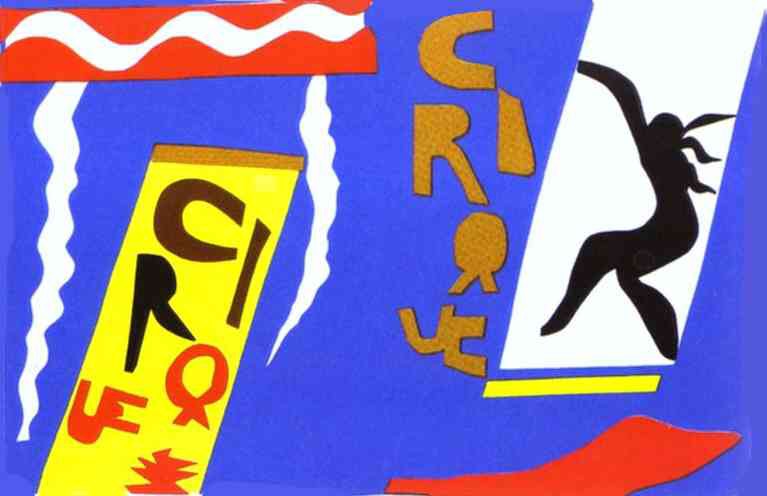
The Circus, 1947. Illustration for the book Jazz.

The Circus, 1947. Illustration for the book Jazz.


The first cut-outs appeared in a limited edition book called Jazz, which, in addition to the 20 screen printed cutouts, featured Matisse’s handwritten notes about the images, painted in black.The contrast between his beautiful monochromatic handwriting against the white paper and the fierce colors of the screen printed cut-outs creates a striking effect. In this book, a copy of which is kept at the Victoria and Albert Museum in London, the cut-cuts are mainly representations of circus performers, such as high wire walkers, trapeze artists, acrobats, clowns, knife-throwers and magicians.

Despite its vibrant colors, some identify a darker side to this book, though. Produced at the end of the Second World War, it’s not difficult to read metaphors of these violent and disruptive times into it. Take the iconic Icarus below, for example. You might see it as a representation of the mythological figure of the son of Daedalus plunging across the sky to his death, having flown too close to the sun, which caused his wax wings to melt down. Or you can see a corpse in the middle of exploding shells with a bloody spot right over his heart, as a clear reference to the war.

Icarus. 1947. Illustration for the book Jazz.

Icarus. 1947. Illustration for the book Jazz.


Matisse did not stop painting altogether as he started creating the cut-outs. Some of his most amazing paintings date from this period as well. However, after 1948, maybe because of his progressive frailty and growing infirmity, he practically gave up on painting. His creative force, therefore, was channeled to the cut-outs, which began growing in size, becoming murals, and totally capturing the artist’s imagination, becoming almost an obsession.

At first sight, some people may be taken aback by the simplicity of this art form, and some even dare to say this is something even a kid could do. Well, we defy them to try it. Only an artist of the scope of Matisse would be able to combine those kinds of colors and variety of shapes to produce such an impactful and pleasurable effect on the viewer. Besides, the best ideas, as we know, are usually the simplest ones: only nobody thought about them before. Copy cats abound afterwards in all areas of life.


The Snail. 1952/53.

The Snail. 1952/53.


No discussion about Matisse’s cut-outs would be complete without mentioning his final masterpiece: the design of the Chapel of the Rosary in Vence, built just down the road from the bucolic house – Villa Le Rêve – where Matisse lived in the last years of his life. It took Matisse four years to complete the project, which included stained-glass windows, three ceramic murals, the interior decorations and even the priest’s robes.

The chapel is famous for the atmosphere of serenity it infuses in its visitors. His maquettes for the stained-glass windows were assemblages of cut-outs, in soothing hues of green, blue and yellow. As the sunlight filters through them, reflecting on the marble floor, one notices the three ceramic murals opposite them, bearing monochromatic drawings representing in utter simplicity and some audacity (such as emphasizing the breasts of the Virgin Mary), the Virgin Mary with Baby Jesus, the Stations of the Cross, and the founder of the order of the Dominicans, Saint Dominic.

Matisse was known for his atheism, which makes many wonder what prompted him to design this chapel and to consider it himself his greatest achievement as an artist. One reason might be he did it after becoming close friends with a Dominican nun, Sister Jacques-Marie, who nursed him during his period of convalescence after the surgery. Her convent did not have a chapel at the time, forcing the nuns to use an old garage for their rituals. Matisse used to say that he felt God only when he was working. Therefore, the chapel is more likely to be an expression of his devotion to the God of Art, using motifs of the Christian religion only as metaphors.

Interior of the Chapel of the Rosary in Vince. 1950.

Interior of the Chapel of the Rosary in Vince. 1950.


NOTE: You might want to check out our series of eBooks available  from AMAZON.COM TEACHING ENGLISH WITH ART. Please click here:  http://wp.me/p4gEKJ-1lS

Teaching English with Art

Teaching English with Art


Au revoir

Jorge Sette.

What’s your social media strategy as a salesperson?


As I have been stating in a number of previous posts in this blog, the barriers between Sales, Marketing and Customer Service need to come down fast, if companies are to become more effective. The upper hand of the relationship between customers and companies has shifted significantly towards the former in today’s market place. Salespeople must focus on the client as an individual and cater for her specific needs at every stage of the buying process. Therefore companies need to adapt and be way more attentive and responsive to be able to move the client along the sales funnel (the steps towards the purchase) and close the deal. Companies need to train their staff to develop sophisticated social media skills if they want to succeed.

Sales, Marketing and Customer Service have to work closer than ever to provide a seamless experience to the client, regardless of the different touch points (email campaign, sales call, the various social media channel communications, print ads, etc) she is exposed to and chooses to use on the path to a purchase.

The old system of departmentalization between Sales, Marketing and Customer Service is becoming obsolete: in the past, sales leads were generated by Marketing, which would qualify them and pass them on to Sales, which, in turn, would hand post-sales issues to Customer Service for support and help. This process does not work so neatly anymore. It has become a lot more complex, not to say messy. Customers are probably exposed to your product through a number of sources and the communication and the responsibility for the process of following up on their requests must be handled together, as a team, by your employees. Software is available to make all the history of this interaction clear to whoever deals with that client.

Selling through social media

Selling through social media

For starters the client is bound to already know a lot about the product even before she first contacts you. She has a number of ways to research and get precise info on what she needs to purchase. The idea is to be fast and prompt in your response, adding to what is already known, whether it be: passing on more specific info on the benefits, clarification on functionality, scheduling a live demonstration, an invitation to a webinar with a specialist, drawing the terms of a contract, the negotiation of a discount, etc.

Let’s focus in this post on how specifically the sales force could use social media more proactively to meet the customer’s needs and move them along the sales funnel towards a successful goal. They can use any or all of the following tools as a supplement to what they already do (such as personal sales calls or phone calls). In many cases, however, you will notice that if they use these online tools properly, parts of the more traditional in person face-to-face sales process might be replaced smoothly by digital communication – which, not rarely, are more likely to yield results.

1. LinkedIn: this is your personal online ID card. Chances are customers will check out your profile immediately after you schedule an appointment to see them. Make sure you live up or surpass their expectations. Choose your profile picture carefully. Only you can decide on the level of formality or informality expected from professionals in your industry. Play by the rules. Fill in as much relevant info about your career as possible, and do not hesitate to ask coworkers, bosses and senior management for recommendations and endorsements. You can always return the favor. Publish only work-related posts on this platform. Avoid jokes and cat photos (you can use other social networks for that, don’t worry). Think twice before you post an update here. Remember that slips may jeopardize your chances of a future job. Nurture and grow your contacts daily. Be courteous and answer communications sent to you as quickly as possible.

2. Facebook: if you are uncomfortable using your personal profile professionally, create a specific professional one (I’ve confronted that dilemma of separating private and public life myself for a couple of years, so I’m totally sympathetic to whoever has the same problem). However, I gave up the on the struggle and unified my profiles. In this day and age, customers expect to deal with genuine human beings, so developing skills to be able to post the right content to the right group of people through a single profile will surely make your life easier and boost your career. If you wish to post photos of your family barbecue, do create a little private group for the only people who would care about this. Besides, as you probably know, you have the option to post to your whole audience of “friends”, to a few chosen people, or to the public in general, by adjusting the platform settings for every post. Just exercise some common sense in your content publishing strategy and you should be OK. This works better than keeping separate profiles. What you can’t do is avoid creating a digital presence for the development of your personal brand on the Internet. Gather as many clients and prospects as your “friends” as possible, and start posting relevant and useful content (not annoying and interrupting ads) on your newsfeed. You will be building what they call “thought leadership”, presenting yourself as an expert in a specific subject, and, naturally, prospects will grow to depend on you when they have a problem that needs the kind of solution you have been discussing or blogging about.

3. Instagram: develop a similar a strategy. Of course, the focus here, however, is on visuals: photos and videos. Publish a balanced mix of personal and work-related content. The personal stuff will make it easy for the customers to relate to you as a person (so the occasional cat pictures are fine, don’t worry), whereas the work-related publications will hopefully help you build a friendly and caring image for your company and for yourself as a professional. You could, for example, post photos of your products and services (a dynamic teacher in action using the latest technology in the classroom, if you sell edtech products, for example). Try not to use fashion models – this is not an ad after all (lose the glitter and fake glamour) – but real life photos of actual happy users of your product instead. Show people you work with. Post pictures of the offices of your company, to make it more relatable to customers. The main thing to keep in mind is you should be providing valuable or fun information, educating your prospects, training your users, not interrupting your audience with a sales pitch. In the meantime, Marketing should be working on building a bank of images, video clips, ebooks, blog posts, white papers and other useful pieces of content to help you pass them on in a more personalized way to your prospects, but there’s nothing wrong in your creating your own content, if you have the skills and the authorization of your boss. Do not rely solely on the Marketing Department’s support for your success, it doesn’t work like that.

4. Twitter: don’t waste time using your Twitter account only for personal interactions. Think of it, as of any other social media channel, as a powerful tool to create an Internet presence and carve a unique personal brand. This may advance your career in unexpected ways. Create or curate as much germane content to your customers as possible. Retweet, for example, your company’s invitations to webinars and events. Indicate and promote useful and complementary websites to the customers. Share relevant information about your industry. Educate the prospects on the benefits of a new product or service. I know you have only 140 characters to use, but you’d be amazed at how much can be accomplished with that. Don’t forget you can use links to more comprehensive information (such as a blog post, a landing page or a how-to video clip), although I wouldn’t recommend you overuse this technique. The recommended balance goes more or less like this: for each 15 new updates, think 10/4/1: 10 posts should be about content from other people you are curating and sharing; 4 posts should direct them to your latest blog post or video clip; 1 post should invite them to a special offer on your company’s landing page. Don’t use this ratio as a straightjacket, though.

The bottom line is nobody has a perfectly safe job in today’s corporate world. Companies will not give you all the support you wish you had to carry out the ideal sales performance everyone expects from you. You need to stand up for yourself and imagine you are an external consultant hired to do the best job you can for a limited period of time. Lay-offs are around the corner. I don’t mean to scare you, but this is the brutal reality of our times. Therefore, you have no choice. Dive into social media, develop a powerful personal brand on the Internet, nourish a healthy and trusting base of clients and feed them all the relevant content you can. The pay off will be the empowering of your personal brand and the resulting sale – when and only when the customers are ready for it. The good news is this method will yield a lot more closings than the more traditional approaches, in which you need to wrestle down the poor customer to the floor and drag her across the room by the hair to force the purchase of the latest edition of your Manual for Reluctant Customers.

For more on the same topic, please refer to my previous post:

https://jorgesette.wordpress.com/2014/05/02/salespeople-need-to-become-marketers/

Please let me know your thoughts about this article. Use the comments section for your reaction.

Au revoir

Jorge Sette

Which novels do you wish you had written yourself?


When you are at the stage of brainstorming for a nonfiction blog post or a piece of creative writing, it’s inevitable to remember a couple of articles, books and novels related to the topic you read at some point and enjoyed. They will be a source of inspiration and influence in your writing, making you somehow even slightly jealous, wishing you had thought of that first. But, of course, you would also have needed the right language to encapsulate it. After all, more important than the plot itself is how you say things.

Take the book Life of Pi by Yann Martel, for example, whose original idea some people claim was stolen from our Brazilian writer Moacyr Scliar. Well, plagiarism is hard to establish, there are a lot of gray areas, but one thing I’m sure of: Martel did not write the same story nor, most definitely, used the same language as Scliar. Jorge Luis Borges, in his marvelous piece Pierre Menard, Autor del Quixote, from the book Ficciones takes this idea even further, asserting that a book written with the exact same words by a different author at a different time would be read in a new way, due to the dissimilar historic contexts, and therefore would not be the same book at all. I agree.

After reading a comment on Facebook by a friend saying that she is full of ideas for blog posts but do not find the time to write them (yes, we all know how teachers are busy!), I made a joke saying that all my good ideas had already been stolen by the likes of Shakespeare, Tolstoy or Philip Roth.

Then I though for a moment, and decided to give serious consideration as to which novels I really wished I had written and why. This is my humble list:

Books I wish I had written

Books I wish I had written

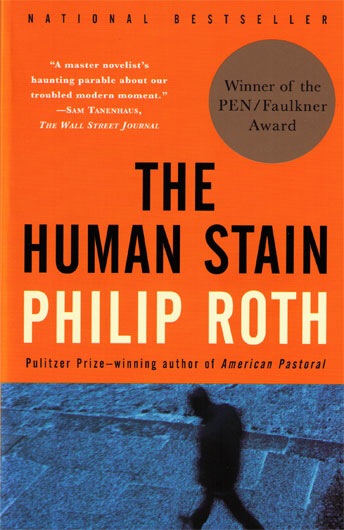
1.The Human Stain, by Philp Roth: it’s hard to discuss this book without giving a bit too much away, so apologies for the spoilers. The story of a light-skinned black boy who grabs the opportunity to pass for a Jew in 1950’s America and later becomes a Classics Professor at a small college is a complex account of the choices you make in life and the responsibilities and consequences that come with them. The need to make concessions and compromise basic values to achieve a bigger goal is the central theme of the book. The deep moral dilemma you face when you take such a radical decision, including the necessity to abandon and cut relations with your family and community to start a new life somewhere else as a completely different person, is evaluated by the author from unusual and unexpected angles in this impressive book. As irony is the hallmark of Roth, the book starts with the most paradoxal of incidents: the professor, noticing that two of the students enlisted in his class never seem to be present, asks the class the question which brings about his doom: “do they exist or are they spooks?” The latter being an old loaded word, a racist epithet for blacks. It turns out that the Professor, never having seen those students before, meant spooks in the most common sense of the word, that is, ghosts, and, after all the pressure and hassle he goes through, without support from any of his colleagues and students – for a number of political reasons – he decides to resign and end his career. I would love to have written this story for its universality: any minority can identify with what Coleman, the Jewish/Black professor, goes through, and can easily put themselves in his shoes. Given the opportunity would you do the same? Would you change your race, color, nationality, sexual orientation or gender? Or would you just give up all of your chances of fully growth and spend the rest of your life as a second class citizen in a society that will only offer you the fulfillment of your whole potential if you are the right color?

The Human Stain

The Human Stain

2. Dom Casmurro, by Machado de Assis: this must be the book I reread most often in my entire life. I know it almost by heart. What attracts me is the way the characters are so well-rounded and fully developed, leaping out of the page as if you could go for a walk and talk to them. This does not mean, however, that you will know them any better. This is the whole point of the story. The dissimulation, the fact that we never know anyone completely. The impossibility of dealing with only one version of the reality. I can’t get enough of the artistry of the author, who, narrating the story in the first person, never lets the reader be sure about what really happened: was the main character’s wife an adulterer? Is the boy she gives birth to his son or his best friend’s? The doubt will corrupt his marriage and ultimately destroy all the love in his life. He becomes empty and isolated, having chosen the version of reality which will cause him the most pain and damage. Don’t we all choose the latter?

Dom Casmurro

Dom Casmurro

3. We need to talk about Kevin, by Lionel Shriver: a professional woman is in love with her work and her husband. She writes and publishes travel guides, having the chance to go places, tour interesting and remote regions, avoiding getting stuck in a housewife’s rut, being independent most of the time. Yet, she can count on a loving husband to comfort and look after her when she comes back home after a long trip: this is a dream life. She has the best of both worlds. Then, what else is it that society claims will make every woman even happier and more complete: to have a baby. From the birth of Kevin, her firstborn, to the dantesque crime scene at the end of the book, We need to talk about Kevin reads like a nightmare. You can’t put it down. A thriller in every sense of the word. But one that goes way beyond the limitations of the genre. Shriver’s ambitions are a lot more encompassing. She discusses the nature of evil. Is it caused by nurture or nature? How is it created? Has Kevin always been the monster she feared he was or was his low self-esteem caused by his mother’s lack of love and care that turned him into a criminal? Was the mother’s resentment for having to give up all the pleasure and independence of her former life, her pre-baby life, toxic enough to corrupt and undo the little creature? The sense of guilt of a mother for not conforming to the patterns of a society that takes motherly love for granted only contributes to the character’s anguish and mental confusion. Of course, the book will show different perspectives of the scenarios we painted, but the conclusion will be up to the reader.

We need to talk about Kevin

We need to talk about Kevin

These are all great themes and I don’t need to tell you how masterfully these concepts and ideas are exploited by those wonderful writers. The angles they illuminate, the perspectives they reveal would hardly have occurred to the average reader. That’s why they are geniuses and we are blog writers. But we can always try to get closer to their art in our writing. According to Malcolm Gladwell, another writer whose books I wish I could have written (although they are nonfictional), all it takes is a dedication of 10,000 hours of work to become a world class master at your craft.

Which books would you like to have written yourself? Let us know.

Au revoir

Jorge Sette.

Five Most Common Misconceptions About Writing


Writing is today more fashionable than it has been in a long time. Perhaps it’s at the peak of its importance ever, with all the blogs, messages, emails and tweets swamping our computer, tablet and smart phone screens every second of the day. Of course, most of the time it’s bad or unclear writing. But everyone is doing it one way or another, and job opportunities are opening up for those who do it well.

Content is the key word in the workplace today. Especially if you are in sales & marketing. The buyer has all the power today and they control when, how and where they will make their next purchase. In this context, writing can be a great asset in educating and persuading prospects, making them see you as the expert, or thought leader in your field. Writing great content and making it available will help you develop a relationship with your potential customers, who will definitely lean towards your offer when the time is right.

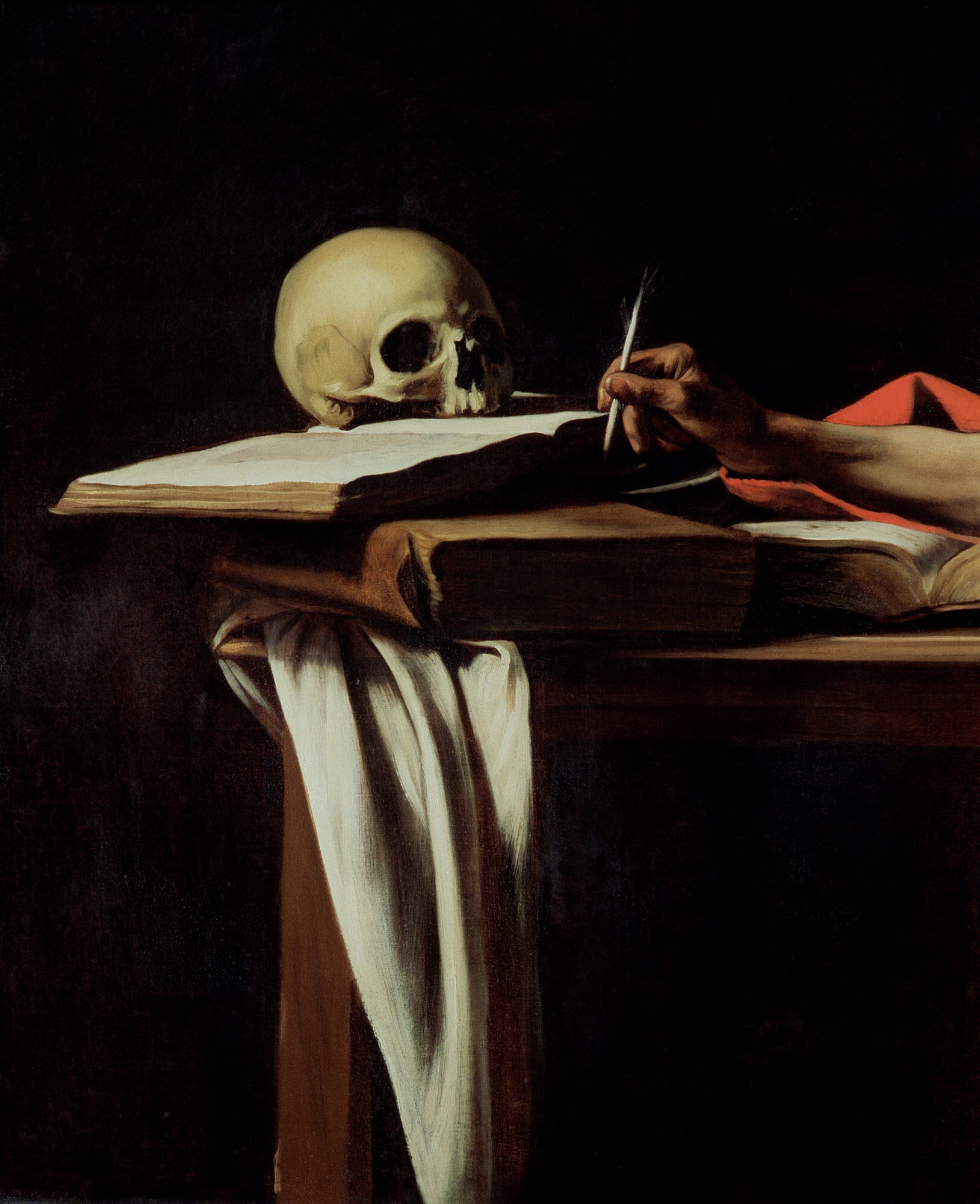
Saint Jerome Writing (detail) by Caravaggio

Saint Jerome Writing (detail) by Caravaggio

As a consequence of its importance, the Internet is full of advice about effective writing, how to put blogs together, the dos and don’ts and best practices of publishing anything. By all means, read all you can, as there is a lot of useful information online. Beware, however, of some of the most common misconceptions about writing: in general most of them were acquired or developed at school and academic settings rather than on the Internet. Here are five of the most common:

1. Writing is about inspiration and waiting for the muse to come down and sit on your keyboard. Well, I’m afraid there’s not enough room for the muse to relax and spread out on such a small space. Also, deadlines have a weird way of not accommodating the muse’s busy schedule, so do not wait to get started. Writing is not necessarily what Hemingway warned us against in his famous quote: “There is nothing to writing. All you do is sit down at a typewriter and bleed.” Make it more active: brainstorm ideas, do some research, check out what is trending online, use automatic topic generators on the Internet, and do not delay. Start the process as soon as you can,

 2. Writing comes out as the masterpiece you usually read in the printed copy of good magazines, newspapers and books. Well, the final draft is not easy to get to. That’s what you see published. But anyone can get the process started and refine it until you achieve a satisfactory result. The saying writing is rewriting, or writing is more about transpiration than inspiration are indeed true. Once you spill out your first ideas and get them more or less outlined on the page, you will start the process of polishing them. And that is the hard part. This will take time, effort and immense patience.

3You cannot self-edit. If we are not talking about your PhD thesis or your fiction masterpiece, do not believe you need a team of copyeditors, researchers and proofreaders ready to work for you. They are expensive and hardly available in enough numbers even for big publishing companies nowadays. So, unless you can count on close friends to help you out with it (remember you can always return the favor), you must learn tactics for self-editing. Do not hesitate to count on every piece of technology available to help you with the task: spell checkers, grammar checkers, dropdown thesaurus, online dictionaries, you name it. There are a lot of very useful tools out there. Read your drafts as many times as you can and carry on refining them. There will be a moment when you’ll get so fed up with reading your piece you will want to throw up. That’s when you take a serious break. I’m not talking about the proverbial coffee time (you have probably been drinking coffee nonstop throughout the whole process anyway). Just abandon your text for a couple of days (I hope you can afford to do that. Factor in those necessary breaks when you plan your timetable to meet the deadline). Next time you get back to the text, you will see it with fresh eyes, and give it the final touches as a Steven Pinker would.

4. Sophisticated writing is good writing. Write as you speak. Content that will help you sell is content that’s simple enough for the majority of readers to understand. So drop the long words and complex sentences. The golden rule of elegance is less is more. Apply this to your writing: precision and simplicity of vocabulary, clarity of ideas, avoidance of overuse of the passive voice, and keeping to what is essential are the tactics that will make you win the reader over. As you read and reread your text, try to leave out everything that is superfluous or redundant. Cut, cut, cut.

5. Not everyone can write. You are write (sorry: right) to think so, if you are using Oscar Wilde or Hemingway as your standard. Artistic and creative writing are not for everyone. It does not need to be for you. But most people can learn to develop and communicate clear, authoritative and persuasive ideas in writing. It takes practice, though. All the content marketing gurus agree on this single point: you need to write everyday if you are in the business. The blog post you will write as soon as you finish reading this text will sound a hundred times better than the one you wrote around the same time last year. They will be both there on the Internet: just read and compare them. You will have improved. So keep working at it and surprise yourself month after month at how much better you are becoming. Good luck!

Would you like to share with us any advice on writing? Please do not hesitate to do so on the comments section of this blog. You might as well rate us so we can improve.

Au revoir

Jorge Sette

Why is TV becoming better than the movies?


It all started when a mob family guy began to have panic attacks after a flock of ducks flew away from his backyard  leaving him with an irreparable sense of loss and despair. He started seeing a psychiatrist. We also noticed an uncanny resemblance between the way he conducted his mob activities and the way big companies operate in the real world.  Was this possibly a metaphor of corporate America? Then there was the focus on his family – unusual in mafia movies (except for The Godfather). We had hardly ever seen a mob wife on the small screen before, with all the details of her lifestyle, including a sense of how her ambition blinds her to the criminal work of her husband. As long as she is able to afford the nice house in the suburbs of Newark and the espresso machine, she is not complaining. If you add to these ingredients the fact the the husband is played by the ultra charismatic late actor James Gandolfini and the wife by the remarkable Edie Falco, you begin to understand why TV is changing into a medium of great content and art work. Of course I’m talking about The Sopranos in this case, the show that basically changed the way cable TV producers, liberated from the pressure of sponsors, started to want to experiment with new formats. The revolution is continuing in streaming video now.

The new TV

The new TV

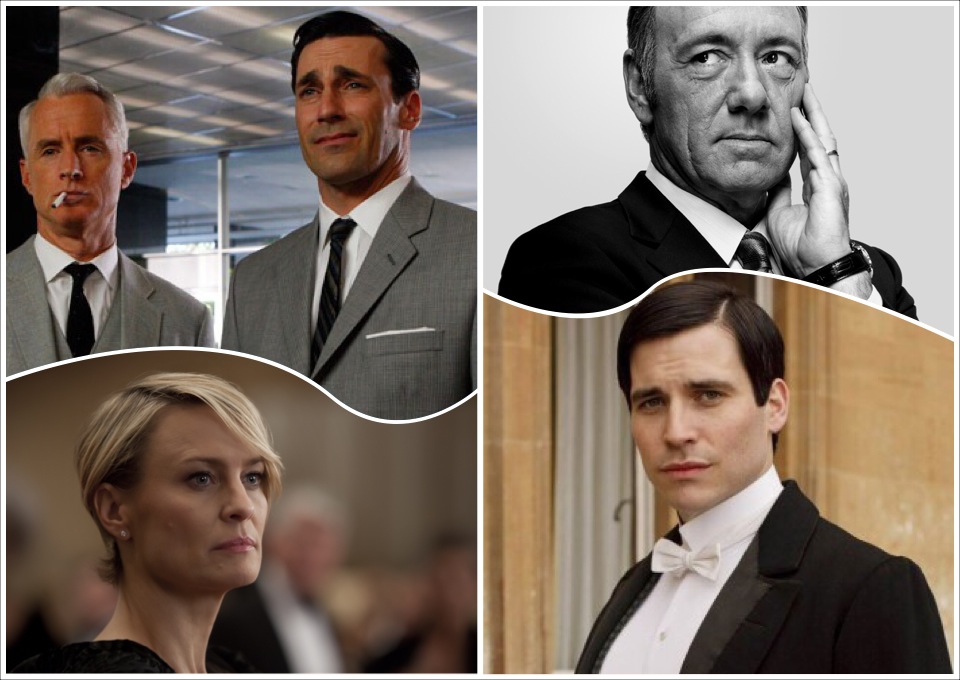
Almost ten years after the end of that seminal show, we have now an offer of excellent series and made-for-tv movies all over the place, competing in quality of content and presence of great actors in the cast. The bar is being raised continuously.  Movie stars don’t think twice before crossing the bridge to the former lower land of television, when the invitation is tempting enough. Some of them, such as academy-award winner Kevin Spacey even bring their own projects to new media channels (which is the case of the successful House of Cards on Netflix.)

I’ve always been a lover of the movies, but I must confess these days I’d much rather watch an episode of Downton Abbey or Mad Men from the comfort of my couch than struggle to park at the nearest mall to watch a superhero blockbuster or a silly Brazilian comedy on the big screen. Besides, there is the new pleasure of binge watching on weekends, that is, covering sometimes a whole season or two in less than 48 hours. I’m aware of the perils of addiction, don’t worry. Look at the tragic end that befell most of the Candy Crush Saga players…

I forced myself to think why it is that TV is so much better now. Could I pinpoint some of the main differences between Charlie’s Angels in the seventies and The Shield? They are both cop shows. Therefore, they’re basically about catching the bad guys, right? So what’s new? Well, for starters, the protagonists in the new shows are not saints, but multifaceted human beings. They all have a dark side and are badly flawed somehow, like the heroes of Greek tragedies. Vic Mackey (Michael Chiklis), one of the main characters in The Shield, for example, doesn’t think twice before partaking in the spoils of war the drug dealers he chases accumulate. Don Draper (Jon Hamm) of Mad Men has  a compulsive infidelity drive, despite the nice and caring women who love him. He also hides a dark secret from his past. Walter White (Bryan Cranston) from Breaking Bad or Dexter (Michael C. Hall) from the show of the same name are both hardcore criminals! Walter runs a meth lab and is the kingpin of an international drug operation. His family knows nothing about it at first, but then his wife gets coopted and starts working for her husband. Dexter carves his victims with sadistic pleasure: OK, they only get submitted to the horrific ritual if they’ve committed crimes themselves but then again… Nurse Jackie, also played beautifully by Edie Falco in the show of the same name, is a committed nurse, who loves and cares for her patients, always going the extra mile to help them. Only she has sex with a coworker, jeopardizing the stability of her nice family structure, to have access to the painkillers she is addicted to.

 The new TV

The new TV

In addition to the flawed heroes, you will notice that most of these shows are about ensembles. There’s of course the main hero and his journey, but all the other subplots are as interesting or sometimes even more enticing than the main one. Supporting roles are usually played by very accomplished actors, so even a small scene played by a guest star can be a little gem.

Last but not least, there is the superb writing. If movies are the domain of directors and producers, as they have total control over their work, TV or streaming video is the realm of writers. They run the show there.  And surely this is a very strong reason why plots, structure, dialogues, and subtext have gained a lot more prominence over their big screen counterparts. A lot is not said in these shows’s plots. The subtlety of the dialogues, the importance of silences and the facial expression of great actors add a lot to the the depth of a scene. Also, the fact that sometimes the storyline or specific scenes focus on very small things of everyday life, and yet highlight unusual details and reveal interesting motives of a character make for great entertainment: the theft of a bottle of wine by a gay footman (Downton Abbey) or the puberty troubles of a girl (Mad Men) add a lot to the attraction of a show,  illuminating areas of the human experience that in the past were limited to literature or art movies.

If you have not watched any of the shows we discussed above, I strongly recommend you have a go at them. Let us know what you think by sharing your thoughts in this space.

In the meantime, check out my Pinterest board on BEST TV SHOWS (click on the picture below):

Au revoir

Jorge Sette.

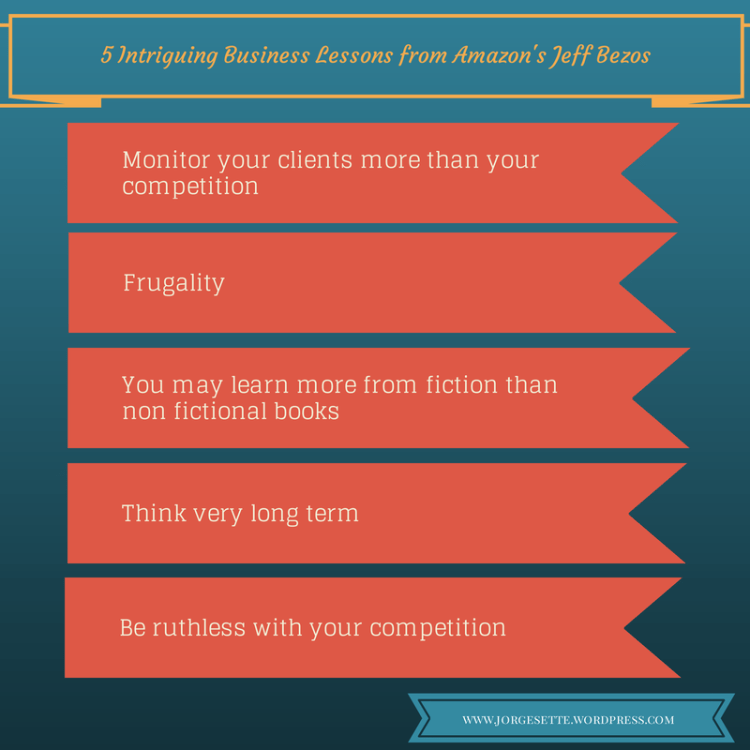
5 INTRIGUING BUSINESS LESSONS FROM AMAZON’S JEFF BEZOS


5 INTRIGUING BUSINESS LESSONS FROM AMAZON'S JEFF BEZOS

Click on the image above to access the full text.

5 Intriguing Business Lessons from Amazon’s Jeff Bezos


If you haven’t had the chance to read Brad Stone’s THE EVERYTHING STORE: JEFF BEZOS AND THE AGE OF AMAZON, reach out for your Kindle and download it right now. It’s an exciting account of the creation and development of Amazon into one of the most unique companies in history and the life of his peculiar founder Jeff Bezos.

IJeff Bezos and the Everything Store

Jeff Bezos and the Everything Store

Amazon.com started as an online book retailer and grew to become a company where you can purchase virtually anything, from apparel, to art to web services. It originated the concept of cloud computing service and was the first company, through the Kindle,  to turn online reading into a reality for thousand of hundreds of people on the planet. In addition, it claims it will be launching rockets into outer space soon.

If Amazon puts the client first – and, as customers,  you and I can certainly attest to that – working for Bezos looks like it’s not a lot of fun. Amazon is supposed to have all the depressing and Orwellian political atmosphere and red tape of huge corporations combined with the lack of resources of a startup. Many of his ex-employees are said to suffer from post-traumatic stress disorder, and the ones who remain there live under constant pressure and fear of getting fired before the end of the day. Bezo’s explosive personality is not very different from that of another difficult boss – Steve Jobs. It is kind of sad to think Nature tends to offset their kind of genius and creativity with a terrifying temperament and underdeveloped interpersonal skills.

Despite these drawbacks, you may find below a number of interesting lessons and facts about Jeff Bezos and his company. They are all based on info I got from the book. You may either try to apply them in your own business or, at least,  enjoy these points as mere trivia:

1. Monitor your clients more than your competition. Of course Amazon has always kept a close eye on Walmart, Apple, Barnes and Noble,  and Google – their main competitors. But he has always been much more likely to create or optimize processes that, rather than simply emulate these companies breakthroughs in terms of profitability, would actually benefit the client. For him, the client experience has always come first. Short term profit has always been an afterthought.

2. Frugality. Bezos is obsessed with simplicity and adept of an ascetic life style (in this he was not very different from Jobs either, by the way). He has always kept his staff on a very tight budget, cutting all kinds of extra costs with the aim of investing in the clients’ experience. His mantra was low prices everyday (just like Walmart’s), and he would go out of his way to make this happen, keeping his margins to a minimum or even giving them up altogether, such was his confidence in a business model that, if trusted by the client, would payoff in the future. Bezos would carefully  consider the need of every extra expense or cost and try to connect it directly to a benefit to the client. Lack of resources, according to him, would spur creativity and imagination from his staff.

3. You may learn more from fiction than non-fictional books. His favorite novel is Kazuo Ishiguro’s  The Remains of the Day. I was very happy to hear about this, as I love reading novels and this is certainly one of my all-time favorites. However, I don’t really think you can learn the hard facts about being an entrepreneur from the likes of Philip Roth or Machado de Assis. Fiction in my opinion will help you deal with the human side of business, and will probably keep you from having to resort to antidepressants when you struggle to work under bosses like Bezos, get sabotaged by coworkers or even fired.  But,  in my humble opinion, only the actual experience and the study of technical reading material will help you grow in your career. The most interesting thing about this aspect of Bezos’s personality  is  that his love for books boosted the launch of the Kindle, whereas Steve Job’s passion for music  – especially Bob Dylan’s and the Beatles’s – was a strong inspiration in his creation of iTunes. Do what you love and you are more likely to succeed.

4. Think very long term. Entrepreneurs need to persist in seeding. The payoff never comes immediately. Especially now, in this fast-paced, ever-changing technological landscape. Appreciate the little victories you achieve every day and fight on. Celebrate every little step towards a moving target you don’t even know if you will ever reach.

5. Be ruthless in the negotiation with your competition. For Jeff Bezos “win-win” was an unamazon way of thinking. You need to score an advantage over your opponents. Think football during these times of World Cup.  A draw is not acceptable. Do not even be afraid of disrupting your own business model in your pursuit to win. Do everything to destroy it and create something new instead. If you don’t do it, others will. Cannibalization is OK.

You may not agree with every tip Bezos has to offer, but remember where he got to by using them. Of course, you should always take successful entrepreneurs’s  and  gurus’ advice with a grain of salt, for, as Malcolm Gladwell explains in his brilliant book OUTLIERS, there is always a lot more to success than meets the eye. A set of special conditions not available to all is always present in the these Cinderella’s stories of ash to riches, so look out for them.

What is your formula for success? Please share it with us (if we are not competing with you).

NOTE: If you are interested in TEACHING ENGLISH WITH ART, you might want to check out our successful series of eBooks available from AMAZON.COM (KINDLE STORE). Just click here: http://wp.me/p4gEKJ-1lS

Teaching English with art

Teaching English with art

Au revoir

Jorge Sette

Should you have a blog as a marketer?


Should you have a blog as a marketer?

Click on the image for the full text.

Should you have a blog as a marketer?


“There is nothing to writing. All you do is sit down at a typewriter and bleed.” Ernest Hemingway

As we all bloggers know, Hemingway did nail the writing process in his quote above. Yes, it’s hard; yes, it’s time-consuming; no, it’s never right the first time around. Writing is rewriting. For a 1000-word blog post, I would say the average blogger would write at least 10 drafts before he is reasonably satisfied with the result. He is lucky if he has an editor to help with the polishing, but that is not usually the case.

However, in this day and age of content marketing, you would be crazy as a marketer if you did not sit down at least once a week to create or repurpose some  written content to post on the Internet. Let me highlight in this post the features of good blog posts and how your business could benefit from them.

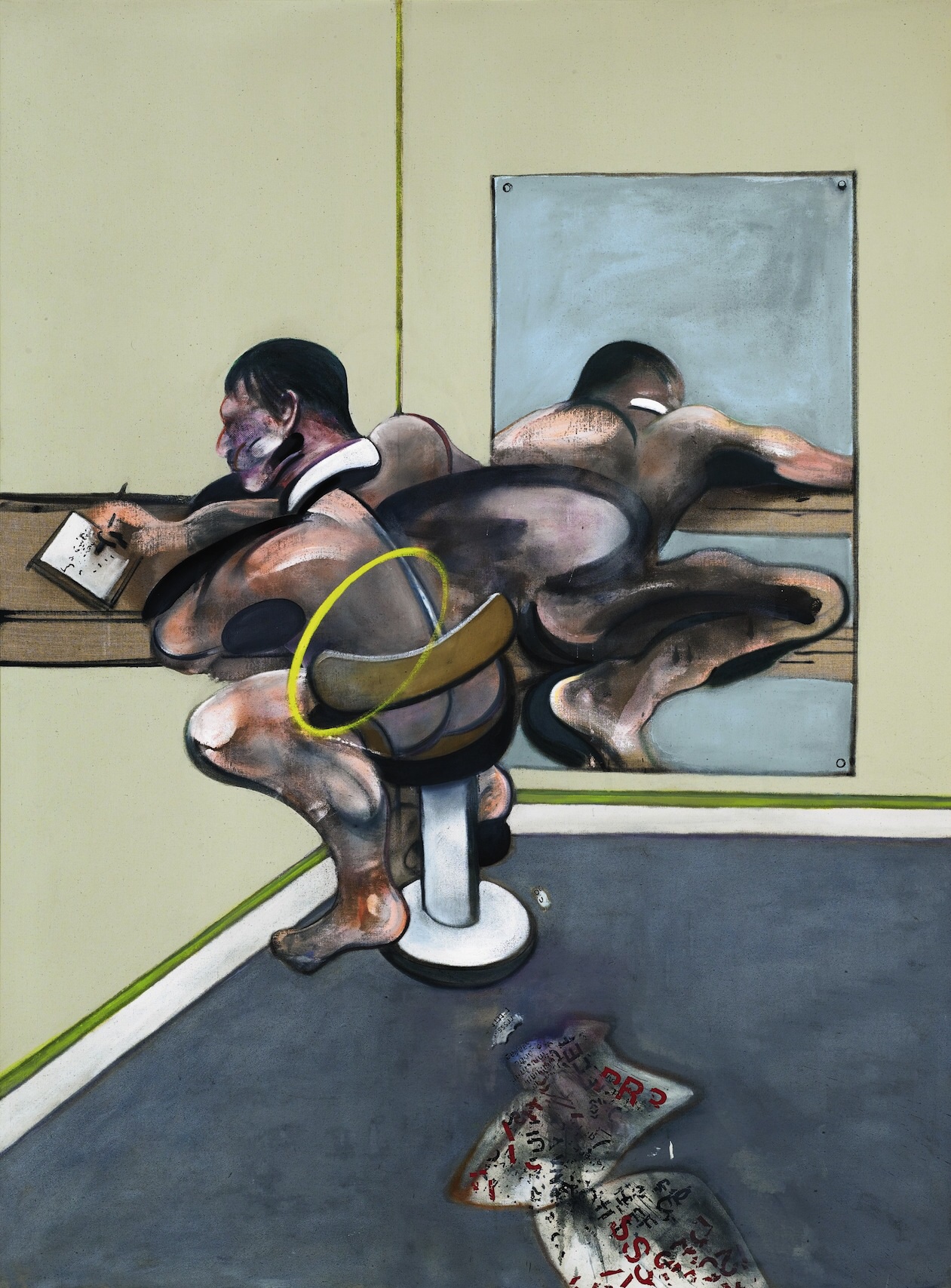
Figure Writing Reflected in a Mirror by Bacon, Francis, 1976

Figure Writing Reflected in a Mirror by Bacon, Francis, 1976

1. Search engine optimization: provided you offer useful and original content, employing the relevant key words, blogging will help your business show up on the SERPs (search engine results pages) of your prospective clients. I don’t know many people today who will not go to Google at some point during the buying cycle to do a search before actually purchasing a product or service. So, to be available, to show up, it will help to have a carefully SEOed (search engine optimized) blog to pop up on the first page.

2. Answer your customers questions: the buying process – the cycle your prospects go through before committing to a purchase –  consists of the the following phases: first, the prospect needs to identify a need or problem; second, they will try to learn about possible solutions; third, they will start shopping for the ideal solution; afterwards, when they are ready, they will look for directions to actually buy it (online or offline); finally, when they start using the product, they might have problems or questions about it, so you need to offer them prompt customer service. Your blog needs to account for each one of these phases and provide the appropriate answers to help them at the stage they are, moving them along the sales funnel. It takes close communication between Marketing, Sales and Customer Service to identify the customers most frequently asked questions and issues, and try to solve them through your blog content. So it’s time to cooperate (there’s no need to tell me how hard this can be, but it’s worth trying): salespeople and customer service professionals need to develop their marketing skills, while marketers should learn more about the customers from sales and customer service so they can provide qualified leads.

3. Thought leadership: by covering content that speaks to the different needs of your customers at the different stages of the buying process you will soon develop a reputation of an expert in the field. Even if you don’t get conversions in terms of sales at the first moment, your customers will grow to trust your opinions and respect your points of view. When the time comes for them to make a buying decision, who do you think they will turn to?

4. Style: your blog is not supposed to be a work of art if you are a marketer. So write as simply and elegantly as possible, as if you were actually “talking” to the prospect. A marketer’s blog is not a piece of literature, so tone down your message, and be objective and direct. Of course it would help to be aware of the reading level of your audience, but “according to many reports (including the U.S. National Center for Education Statistics’ 1992 Adult Literacy survey), the average reading level is the 7th or 8th grade. Combine that with reports of increasingly low-attention spans of Internet users who require even milder language and you’re looking at a reading level of the 6th or 7th grade”  (http://blog.ezinearticles.com/2013/10/ezinearticles-asks-what-reading-level-should-you-target.html) . If you really wish to fine tune your text’s level of difficulty, there are some tools on the Internet (try the Readability Test Tool, for example, http://read-able.com) that will allow you to measure it.

5. The title: the importance of a catchy title to crown your blog post cannot be underestimated. This is the first impression you will make on the reader, and you only have a couple of seconds to entice them. So think carefully about it. Putting yourself in the shoes of a journalist may help, after all, this is your headline. Research says that questions are a good way to go, as they tease the reader into looking for the answer in the text.

6. Promoting and Repurposing: to make the most of all the effort you put into writing your piece, promoting your blog is a must. Use your social media channels with this objective. Putting links to your blog post repeatedly, however,  may not be the solution (although you’ll have to do it occasionally). Be careful not to make your audience feel spammed. Another solution is to repurpose your content and distribute it in different formats to suit the different social media channels: write a summary of the content as an image (for Instagram); use the photos you put in your blog post with a link to it (Instagram, Facebook); write a headline for your blog with a link to it (Twitter); turn it into an infographics poster (Pinterest); use the main points for a slide presentation (slideshare), etc.

As with most things in life, practice makes perfect. Some people say they blog everyday so they can improve.  Research indicates that to be excellent at a skill you need to have spent at least 10,000 hours at it (read Malcolm Gladwell’s “Outliers”  for a deeper explanation on this). Maybe you don’t have that  amount of time available anymore, but I would say it’s never too late to get started. What you can’t afford to do as a marketer is NOT to have a blog. How about starting today?

Au revoir

Jorge Sette