5 Booker Prize Winners that will Rock your World


The Booker Prize or The Man Booker Prize for Fiction – initially called the Booker-McConnell Prize, due to the company which sponsored it – is an English literary prize created in 1968. It is awarded to the best novel of the year. At first, only Commonwealth, Irish, and Zimbabwean writers were eligible, but as of 2013, the eligibility was extended to any novel written in English and published in the UK. Being awarded, or even shortlisted for it, is a great honor, as the prize warrants success and fame for every writer who’s associated with it.

0370F7A4-E9C4-4DBB-BDFE-DECD608E0582


As a voracious reader, I can assure you that, whenever you finish a novel and are left with that familiar void, yearning for another great book to come your way, taking a look at the Booker Prize list of winners or shortlisted books is a great way to begin your search. You will hardly be disappointed.

The list below is my personal choice of great Booker Prize Winners. I’m sure they will stay with you long after you finished reading them, as the language is stunning and the plots are both original and gripping. The books below are listed according to the year they received the prize:

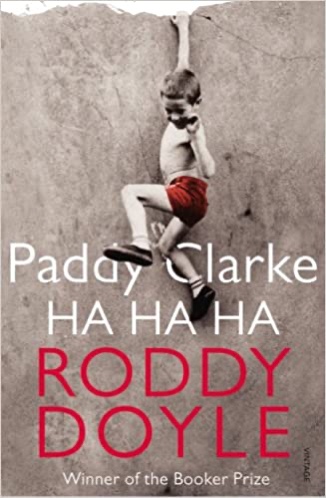
  1. Paddy Clark Ha Ha Ha by Roddy Doyle (winner of the 1993 Booker Prize)

Funny, moving and poignant, this novel is told from the perspective of a 10-year-old Irish boy growing up in the 1960s. As he narrates his experiences – using the logic and language of childhood – we get to know his discoveries, games and adventures with his little brother, the relationship between his parents and the daily routine of his family. Despite the cheerful tone of the book, at some point, readers begin to suspect they are being misled by the unreliable narrative of a child: not everything is going well at home, the truth is his parents are drifting apart and about to break up.
02ABD8EB-5C9A-4D14-9F13-D3ECCA4D753E_4_5005_c

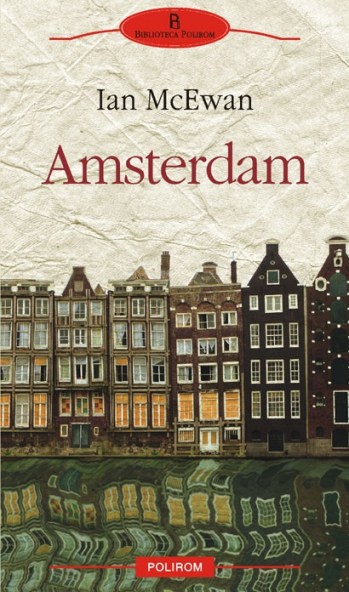
  1. Amsterdam by Ian McEwan (winner of the 1998 Booker Prize)

Three former lovers cross paths at the cremation of their common mistress, Molly Lane, without realizing that the meeting will be a turning point in their lives. Their careers and personal lives will be cleverly manipulated by the woman’s jealous and resentful widower, George, who will set them on a collision course with one another, crafting a spiderweb of blackmails, mutual blames and lies, tabloid stories, debauched cross-dressing photographs, sinister euthanasia doctors and, ultimately, violence and tragedy. Clive Linley, one of the lovers, is a musician who, after attending the cremation, embarks on a depressive behavior, worried that he may get sick and die as young and unexpectedly as Molly. As a consequence, he is having a mental block, which prevents him from finishing up the Millennium symphony he was assigned to compose. Fame and recognition are at stake here and he is frantic (the language used by the author to describe the composer’s creative process and its drawbacks is already a good reason to make you love the book); Molly’s second lover, Vernon Halliday, is a mediocre editor of a serious and conventional newspaper whose circulation and readership are going seriously down. He is suddenly given the chance to resort to dirty and cheap tabloid tactics to try to reverse the process, publishing intimate photographs which are likely to destroy the family life and career plans of the third lover, Julian Garmony, a foreign secretary with aspirations of becoming prime minister.
D0DD3A38-1BB2-4A1A-B890-E64F5B575E87

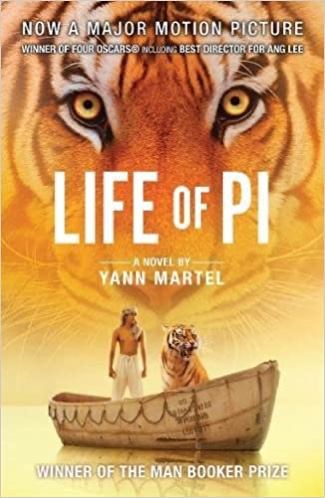
  1. Life of Pi by Yann Martel (winner of the 2002 Booker Prize)

A hymn to religious tolerance, a celebration of life in all its forms, and the recognition of the power of storytelling make Life of Pi an unforgettable novel. The story contrasts myth and reason, religion and science, asking the reader to compare the effectiveness of simply narrating the factual sequence of events of a journey with the alternative of fictionalizing it through the use of allegories. Which version would you choose as the more insightful and helpful way to understand the world? A Canadian writer in search of ideas for his new book is promised the opportunity to hear a story that will make him believe in God. With this aim, he agrees to meet and listen to the life story of an Indian man who spent 227 days adrift in the Pacific Ocean, sharing a lifeboat with none other than a Bengal tiger, after the shipwreck of the Japanese cargo ship which would take his family to Canada. Brutal, scatological, philosophic, funny and poetic, Life of Pi saddens, cheers and inspires the reader, who will certainly come out of the experience loving tales and metaphors even more than when he started the book.
D108C970-DBD2-43C4-A62B-B4A810470BF7_4_5005_c

  1. Wolf Hall by Hilary Mantel (winner of the 2009 Booker Prize)

The first part of this trilogy tells the known story of the marriage of Henry Tudor and Anne Boleyn and all the political, religious and social upheavals involved in making it happen. The novelty is the choice of perspective chosen by the author, who decides to focus the novel on a lesser historical character, whose life details are not very well-known: Thomas Cromwell. Choosing Cromwell – who rises from being the son of a Putney blacksmith to Master Secretary of the kingdom, due to his intelligence and cunning – as the protagonist of the story allows the author to fill in the blanks of history books with her fertile imagination, transporting and placing the reader smack in the middle the exciting events that happened more than 500 years ago.

A21F84FD-CFA8-4B15-9EC7-F13900DF9E9D_4_5005_c

  1. Bring up the Bodies by Hilary Mantel (winner of the 2012 Booker Prize)

This is the second volume of the Cromwell trilogy, and, in my opinion, better written and even more exciting than the first – to me, it sounds like the author finally found the best way to tell the story. Despite all the efforts and machinations of the court to bring Anne Boleyn and Henry Tudor together, causing England to sever links with the Catholic Church, and antagonizing its powerful neighbors in Europe by appointing Henry VIII the head of the Church of England, the queen fails to deliver a male heir and will have to be ousted. Craftily paving the way to Henry’s new marriage to Jane Seymore, Cromwell will become Anne’s main nemesis, ruthlessly plotting the annulment of her marriage and driving her to a thunderous fall, which will bring many others down with her. Terrific reading.

8F6B6A9D-735E-4E32-97EC-FF679A8EAF24_4_5005_c

Have you read any of these books? Share your comments with us. Also, watch this space for further suggestions on the wonderful books out there you may not have heard about.

Au revoir

Jorge Sette
Las Meninas by Velázquez – under the magnifying glass


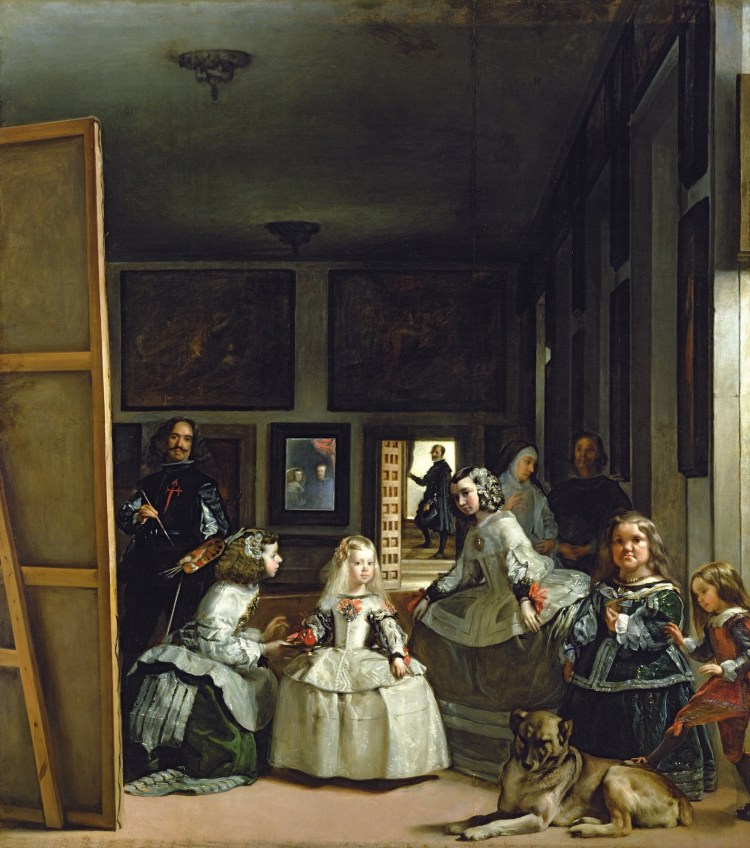
One of the most controversial paintings in Western Art History is Velázquez’s intriguing The Maids of Honor (Las Meninas). Painted in 1656, it’s considered the Sevillian artist’s masterpiece. Critics and specialists have been debating how best to interpret this work for centuries, and of course, no analysis is conclusive.

5E6049CA-98C5-4A51-A6F2-4B80677E1F38

Las Meninas  (The Maids of Honor) by Velázquez, Diego.

The first question seems to be what Velázquez, who’s depicted on the left of the scene, in front of a huge canvas, is painting on it. Is he working on the very painting we see? This seems to be suggested by the palette in his left hand, whose blurred and mixed colors appear to replicate the image in front of us. However, how and why would he include himself in it?

Others, on the other hand, point out that there’s a mirror in the center background, reflecting the images of the king and queen of Spain at the time, Phillip IV and his second wife, Mariana de Austria, who would occupy the same position as the viewer as we look at the painting. This would explain why everyone seems to be gazing outward from the picture. They are actually staring at the royal couple, who would be the subject of Velazquez’s canvas within the painting. Complicated? Wait, it gets even more complex.

A third theory says that Velázquez is painting in front of a mirror (the clue is the way the parting of the hair of the Infanta Margarita, the blond girl in the center foreground, is reversed from what it would look like in reality). This would explain how the artist managed to include himself in the painting. This would also mean that everything we see is also flipped.

More interesting facts about the picture:

The central figure of the scene is the Princess or Infanta Margarita, who was about 5 years old at the time. Who are the other ten people represented in the painting? We can identify all of them historically, except for one. Flanking the Infanta, who’s at the center of the painting, we see the maids of honor. To the right of the Infanta, bowing – possibly due to the arrival of the king and the queen – we see Isabel de Velasco, and to the left, kneeling, as she offers the princess a glass of water or some kind of grease for the princess to dip her fingers in, as she seemed to have had some kind of disease, we have Doña Maria Augustina Sarmiento. On the right, we see the dwarfs Maria Barbola and Nicolas Pertusato, who is playing with the dog. The job of the dwarfs was to entertain the court members.

Behind the dwarfs, obscured by the lack of lighting, we notice Doña Marcela de Ulloa, the princess’s chaperone, and next to her, the only unrecognized figure in the painting, possibly a bodyguard. At the back, going up the stairs and opening the door, the queen’s chamberlain, José Nieto Velázquez, can be identified. The other three people are Velázquez himself and the reflections of the king and the queen in the mirror.

Another question is what kind of painting is this? It does not seem to be a portrait of Princess Margarita, due to its informality. Velázquez was a great portraitist and we have plenty of examples of what a portrait of the higher members of the court of Philip IV should look like: formal, pompous, rigid, authoritarian, exuding power. This depiction of Princess Margarida is nothing like that, resembling more a genre painting, like the bodegones (kitchen and tavern paintings Velázquez produced at the beginning of his career): this could be a snapshot of a regular day in the painter’s studio, known as “el cuarto del prince”.

Ultimately, Las Meninas could be a very personal statement of the artist about his own social status. A self-promoting artwork, to show his intimacy with the higher members of the court. The red cross painted on the left of his chest, which represents the Order of Santiago, seems to indicate this, although some critics guarantee this cross was painted only after the death of the artist, as a way of honoring him for his work under the king.

Now, all this complexity only adds to the attraction of this unique work of art, which not only shows masterful draftsmanship and use of color (the brushstrokes that make up the dresses of the ladies and their decorations seem to anticipate the Impressionist movement in some 250 years), but also to establish the concept of the painter as an intellectual.

If you ever go to Madrid, don’t even think of skipping a visit to The Prado, the museum in which this artwork hangs in all its majesty.

Jorge Sette

Four of Brazilian Writer Lima Barreto’s Main Works – As Modern and Relevant as Ever


Lima Barreto, the acclaimed journalist and author of the Brazilian Belle Époque, is more popular than ever these days. The author was honored at the FLIP (International Literary Party of Paraty) a couple of years ago and that made him even more well-known.  New editions of his work have been released since then. Along with these, there was also the publication of a very well-researched biography, Lima Barreto – Triste Visionário, by historian Lilia Moritz Schwarcz (Companhia da Letras), available at the main bookstores.

02224_gg

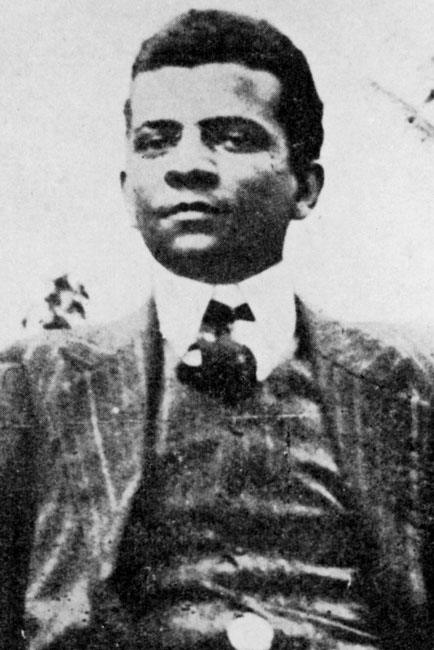
Lima Barreto was born in 1881 in Rio de Janeiro and dedicated his life to writing and literature. His father was a typographer with connections with the powerful Empire Senator Viscount of Ouro Preto, who became Lima Barreto’s godfather. His mother, a freed slave, was a school teacher. She died when the writer was only six.

The key to understanding his artistic work is the overlap between the stories he created and his biography. Dark skinned (a mulato, as we say in Portuguese) and born in the lower echelons of society himself, he understood very well, and experienced first hand the issues discussed in his novels and short stories.

The main themes of his realistic pre-modernist fiction are the problems of the recently founded Brazilian Republic: class and race prejudices; the cynicism, incompetence, and arrogance of academics, journalists, politicians and the police force in general; the oppression women were subjected to. Not surprisingly, many of the problems Brazil had a hundred years ago are still current, making Lima Barreto’s works powerfully modern and still very relevant.

Lima Barreto had a productive but short life. He died at the young age of 41, plagued by alcoholism and related mental illnesses.

The books listed below have not been translated into English yet (except for The Sad End of Policarmo Quaresma), but, if you speak Portuguese, you can easily order them from Bookwitty.

  1. Recordações do Escrivão Isaias Caminha (Memories of the Clerk Isaías Caminha)


85012_gg

Lima Barreto’s debut novel was received coldly by the critics and the literary community of the time. The resentment of the protagonist-narrator and the sarcastic (although disguised) way in which he describes powerful figures of the contemporary society irritated many people who possibly identified themselves with the characters depicted in the novel and felt ridiculed by it. In the novel, Isaías, a boy from the countryside, does exceptionally well in school and is predicted to have a bright future, due to his intelligence and hard work. As a young man, full of hopes and willing to expand his horizons, he leaves his family and hometown, coming to Rio de Janeiro with a letter of recommendation for a congressman. Isaias thought it would not be difficult to find a good job, given his previous scholarly success and this single connection with a powerful politician. It does not take long, though, for his dreams to be crushed. Rio turns out to be a concrete jungle, where the doors are tightly closed to dark-skinned men. The novel tells the story of the deterioration of the young man’s self-esteem and his progressive submission and passive acceptance of the brutal rules that govern Brazilian society.

  1. The Sad End of Policarpo Quaresma

51nCUZicH4L._SX326_BO1,204,203,200_

This novel marks the transition from Realism/Naturalism to the Pre-Modernist literary movement in Brazil.

Policarpo Quaresma, the protagonist, is a methodical civil servant who lives with his spinsterish sister in the suburbs of Rio at the end of the 19th century. He is a naïve and rather optimistic nationalist, who believes that he himself can act as a force to preserve the traditions of Brazil in the face of the fast modernization and internationalization the country is going through.

To accomplish his nationalist objectives, first, he writes a letter to the Parliament proposing that the national language be replaced by Tupi, the indigenous language spoken by the local tribes who lived along the coast of the country before the arrival of the Portuguese. The idea is received with such mockery and disbelief that Quaresma suffers a nervous breakdown, being confined, for a while, to an asylum for the mentally ill.

Recovering from the illness, Quaresma decides to move with his sister to a farm on the outskirts of the city to live a more peaceful life in contact with nature. There, he tries to initiate, again practically single-handedly, an agricultural reform, aiming at setting an example to his countrymen, teaching them how to make the most efficient and rational use of the fertile soil of his beloved fatherland. This results in another failure, as he cannot count on any official help with his endeavour.

Finally, he sides with President Marshal Floriano Peixoto (a real historical figure), joining the military, to fight against the Second Naval Revolt, only to find out that the leader, contrary to Quaresma’s idealization, lacks the brains and military-strategic mind of a Napoleon, being nothing more than an authoritarian and unskilled dictator to a barbaric country in the periphery of civilization and capitalism.

  1. Clara dos Anjos

41dMg-rX03L

Published after Lima Barreto’s death, the novel has a simple and direct plot. It’s the story of a dark-skinned girl from the suburbs (the impoverished neighborhoods on the outskirts of the city of Rio de Janeiro, rarely portrayed in our literature) who gets seduced and abused by the white guitar player Cassi Jones, a notorious crook from a slightly higher social social class. However, the focus of the book is not really the plot. Clara’s sad story is just a pretext for the author to explore important connected issues. The main theme of the novel is the suburbs and its inhabitants: the members of the poorer classes of Brazil. Lima Barreto, with his precise journalistic prose, describes their small and difficult lives, the destitute environment they are forced to live in – despite the high taxes they pay, which are hardly used for their own benefit; the excessive drinking habits of the men; their music and literature; and the repression suffered by their passive and conservative women.

  1. Contos Completos de Lima Barreto (Lima Barreto’s Complete Short Stories)

livro-contos-completos-de-lima-barreto-D_NQ_NP_668299-MLB29809797900_042019-F

Besides journalistic articles and novels, Lima Barreto also left us a great number of short stories. Again, in those works, his main themes are the description of daily life in the city of Rio de Janeiro and its suburbs during the years of the Brazilian Old Republic (the period comprised between the end of 19th century and the beginning of 20th century), written with irony and sharp criticism against the political system of the time, the ingrained racism of our society, the oppression of the lower classes in general and the limitations imposed on women in particular. He also rebuked the mediocrity of the cultural and literary elites of the country. His attempts to mock Brazilian society while denouncing its serious flaws have made a profound mark in our literature.

Would you like to share your opinion about Lima Barreto? Please write your comments below.

Au revoir

Jorge Sette


Velázquez – The Iconic Painter of the Spanish Baroque


Considered the painter’s painter, Diego Rodríguez de Silva y Velázquez was born in Seville in 1599, growing up in the old Jewish quarter of that booming city.

Velázquez was an apprentice to Sevillian artist Francisco Pacheco for 5 years. However, it did not take long for the pupil to surpass the master in technique, which did not bother Pacheco at all. He was very proud of the young artist, who would later become his son-in-law. At the age of 19, Velázquez married Pacheco’s daughter, Juana, and had two daughters by her.

XIR221119

Velázquez

In 1623, he was invited to go to Madrid to paint the portrait of King Philip IV. The king liked the painting so much he commanded Velázquez to became his personal painter. From then on, only Velázquez was allowed to paint the king, and all his other portraits were taken out of circulation. Later on, Velázquez rose in the court to also become the king’s curator (being the person in charge of choosing and purchasing the furniture and paintings that would decorate the king’s palaces). Velázquez served the king for over 40 years, while Philip IV was the most powerful man on Earth.

At the beginning of his career, Velázquez soon distanced himself from the usual religious themes most Spanish painters produced at the time, due to the influence and power of the Catholic Church, and the overwhelming surveillance of the Spanish Inquisition. Instead, he started painting bodegones – kitchen and tavern scenes, involving common people – which, despite being considered a low genre of painting in those days, started to attract the attention of rich purchasers and patrons. Among these paintings, we have, for example, Old Woman Frying Eggs, and the breathtaking Water Seller.

0105vela.big

Old Woman Frying Eggs

His art was clearly influenced by Caravaggio in his use of contemporary, common people as models, and also in the use of the dramatic contrasts of light and shadow (chiaroscuro). Another major influence on Velázquez’s work was the art of Flemish baroque painter Peter Paul Rubens, who spent seven months at the court of King Philip IV on a diplomatic mission. Later, after spending time in Italy on two different occasions, he incorporated elements of both the contemporary local art and features of the Renaissance into his technique.

When he began working for King Philip IV, his main assignments consisted of portraits. He painted the members of the royal family in a great number of portraits, but his most famous ones are his own slave and studio assistant Juan de Pareja’s and the stunning portrait of Pope Innocent X. The realism and strength of these works, in which Velázquez managed to capture not only the physical but also the personality traits of his models, astonished his contemporaries and are a source of awe and inspiration to many artists to this day. Since most of Velázquez’s works were made for the king, they remained unseen for many years, hanging from the private walls of the royal family’s many residences.

Image-1

Pope Innocent X

In addition to the bodegones and portraits, he also produced famous mythological scenes (e.g. The Triumph of Baccus; Vulcan’s Forge; The Spinners; The Rokeby Venus), landscapes (e.g. Philip IV Hunting Wild Boar) and historical scenes (e.g. The Surrender of Breda).

XIR974

Vulcan’s Forge

Velázquez’s technique, draftsmanship and use of color have amazed the general public, critics and other painters for centuries. He’s many people’s candidate for the post of best painter ever. His paintings are included in what is called the Spanish Baroque movement of the XVII century, but they stand out as very personal and unique, the work of a genius.

Velázquez struggled his whole life to become part of the nobility he served so faithfully. His Jewish blood, however, was a constant obstacle for him to achieve such recognition. Only at the very end of his life, in 1658, did he become a knight, receiving the insignia of the Military Order of Santiago, the red cross that features on his chest in his most famous painting Las Meninas.

Velázquez died on August 6th, 1660, at the age of 61.

Au revoir

Jorge Sette


Machado de Assis – o Bruxo do Cosme Velho – em 10 pensamentos expressos nas suas obras.


Machado de Assis é considerado por muitos o maior escritor brasileiro de todos os tempos. Conhecido como o Bruxo do Cosme Velho (o tradicional bairro carioca onde morava), Machado foi um dos fundadores da Academia Brasileira de Letras (1987).


486px-Machado_de_Assis_big_photo

Machado de Assis

Autor de poemas, peças, romances e inúmeros contos, suas obras mais famosas incorporaram as características do movimento literário realista no final do século XIX e início do século XX. Destacam-se, sobretudo, os romances Memórias Póstumas de Brás Cubas, Quincas Borba, Dom Casmurro, Esaú e Jacó, e Memorial de Aires. Machado morreu aos 69 anos, deixando um legado literário inestimável.


IMG_1255

Pão de Açúcar: o maior cartão-postal do Rio de Janeiro.

Irônico, perceptivo e sagaz, Machado revelou-se um profundo conhecedor da sociedade brasileira (especialmente a carioca) da sua época, e da alma humana de forma geral. Eis alguns dos seus pensamentos mais populares, expressos nos seus livros:

Tudo acaba, leitor; é um velho truísmo, a que se pode acrescentar que nem tudo o que dura dura muito tempo. Esta segunda parte não acha crentes fáceis; ao contrário, a ideia de que um castelo de vento dura mais que o mesmo vento de que é feito, dificilmente se despegará da cabeça, e é bom que seja assim, para que se não perca o costume daquelas construções quase eternas. (Dom Casmurro)

A imaginação foi a companheira de toda a minha existência, viva, rápida, inquieta, alguma vez tímida e amiga de empacar, as mais delas capaz de engolir campanhas e campanhas, correndo. (Dom Casmurro)

O destino não é só dramaturgo, é também o seu próprio contra-regra, isto é, designa a entrada dos personagens em cena, dá-lhes as cartas e outros objetos, e executa dentro os sinais correspondentes ao diálogo, uma trovoada, um carro, um tiro. (Dom Casmurro)

Assim, apanhados pela mãe, éramos dois e contrários, ela encobrindo com a palavra o que eu publicava pelo silêncio. (Dom Casmurro)

Prazos largos são fáceis de subscrever; a imaginação os faz infinitos. (Dom Casmurro)

Eu não sou propriamente um autor defunto, mas um defunto autor. (Memórias Póstumas de Brás Cubas)

Gosto dos epitáfios; eles são, entre a gente civilizada, uma expressão daquele pio e secreto egoísmo que induz o homem a arrancar à morte um farrapo ao menos da sombra que passou. (Memórias Póstumas de Brás Cubas)

Matamos o tempo, o tempo nos enterra. (Memórias Póstumas de Brás Cubas)

O maior pecado, depois do pecado, é a publicação do pecado. (Quincas Borba)

Deus, para a felicidade do homem, inventou a fé e o amor. O Diabo, invejoso, fez o homem confundir fé com religião e amor com casamento. (Esaú e Jacó)

Au revoir

Jorge Sette


What Does Bob Dylan Mean Today?


Bob Dylan’s poetry has been enchanting generations for more than half a century now. His songs remain as relevant and powerful as they used to be for the counterculture youth of the 1960s.

To this day, those songs continue to inspire, constantly featuring in contemporary movies and TV series, as a way to contextualize and illuminate universal themes and feelings. A Shelter from the Storm, for example, was recently used in the soundtrack of Danny Boyle’s biopic Steve Jobs as an effective tool to highlight the turbulent relationship between the Apple co-founder and his daughter Lisa; the poignant Don’t Think Twice, It’s All Right, marked the end of season one of the iconic TV series Mad Men, when Don Draper, its unstable protagonist, hits rock bottom, arriving at his suburban home at the end of the day to find out that Betty, his wife, has finally left and taken their kids away.

9485872031_d15878ded8_b

On October 13 Bob Dylan was awarded one of the most important literary prizes in the world: the Nobel. To celebrate the recognition of one of the greatest poets of the XX century, let’s listen to his landmark anti-war hymn, BLOWIN’ IN THE WING (see You Tube video clip below), and reflect on its relevance for today’s audiences. With your study group, family or friends, discuss the questions below. You can share some of your answers with us in the comments section.

How do the 1960s in general compare to the 2010s? Point out some similarities and differences.

 What does the song Blowin’ in the Wind originally refer to? What could it refer to now?

 How would you rephrase the verse “how many roads must a man walk down before we call him a man”?

 What do we turn our heads to and pretend not to see today?

 What does the metaphor to look up and really see the sky mean?

 Enjoy!

Jorge Sette


Philip Roth on Love (The Dying Animal)


“The only obsession everyone wants: ‘love.’ People think that in falling in love they make themselves whole? The Platonic union of souls? I think otherwise. I think you’re whole before you begin. And the love fractures you. You’re whole, and then you’re cracked open. ”


philip-roth_wide-e08158b825c8ee12ea3f56b15636ea3f4a320417

Famous Greek Quotes


“A man who takes no interest in politics has no business here at all.”


Unknown

Pericles (495 – 429 BCE)

Janis: Little Girl Blue


The new documentary about the life of incendiary 1960s blues singer Janis Joplin, by director Amy Berg, has opened in São Paulo this week. Contrary to the classic biography on the singer – Buried Alive, written by Myra Friedman, and first published in 1973 – the documentary chooses to show a less torturous and painful facet of Janis, who comes off in the movie as an intelligent, charismatic and sensitive human being. An extremely talented woman, way ahead of her time, who looks to fame and acclaim to fit in and be loved, Janis’s short and intense life is celebrated, rather than mourned, in this mind-blowing film.

Janis_Joplin_performing

Born on January 19, 1943, into a conservative and suffocating family, who wanted her to become a teacher, Janis grew up an outcast, the target of frequent bullying at school in the backward Texan city of Port Arthur. Unconventional, outspoken and aggressive, Janis broke the mold of what was expected from women in those repressive years of the 1950s and early 60s.

San Francisco

When zitty-faced and overweight Janis found out she would never become one of the curvaceous and cute models who leapt from the covers and pages of the women’s magazines everyone read when she was a teenager, she left home and headed for San Francisco. The neighborhood of Haight-Ashbury welcomed Janis with open arms. She had found her soulmates. She felt totally at home and could finally blossom as a woman and artist.

3640992771_0acb1e7449_z

Janis Joplin belonged on the stage. She would rip herself open in front of an audience. Her performances – many of which feature in the documentary, but can also be found on YouTube– are raw and soul-wrenching. Audiences – both in the live presentations depicted in the film and the one watching it from the comfortable seat of a movie theater – look on enthralled and silent – experiencing a jolt of pleasure, pain and self-realization, through the music emanating from this force of nature.

When I sing, I feel like when you’re first in love. It’s more than sex. It’s that point two people can get to they call love, when you really touch someone for the first time, but it’s gigantic, multiplied by the whole audience. I feel chills, explains the singer.

The movie narrates Janis’s story from her childhood in Port Arthur to her untimely death due to an overdose of heroin at a hotel in Hollywod at age 27, covering in detail all the phases of her meteoric career. Janis struggled with drug abuse from the very first years in San Francisco; the problem only got worse as she became more popular.

Monterey

The addiction, however, did not stop Janis from exploding to notoriety during the Monterey Pop Festival in 1967, when she debuted as a full-fledged blues singer, mesmerizing the audience with a legendary rendition of Ball and Chain (see video on YouTube).

From then on, many doors started to open and Janis never stopped climbing the steps of success and recognition, as one of the best blues singers of all time. Stardom, however, which she had sought for most part of her life, proved elusive and unsatisfactory, after all. On stage I make love to twenty five thousand people; and then I go home alone, complained the lonely diva. She could never shut out her personal ghosts, insecurities and anxieties, unless she was working.

Career

Although, Janis Joplin recorded only 4 albums in her 4-year career: Big Brother and the Holding Company (1967); Cheap Thrills (1968) ; I Got Dem Ol’ Kozmic Blues Again Mama! (1969) Platinum and Pearl (1971, released posthumously), her fame is enduring and she continues to captivate new fans with songs such as Cry Baby, Summertime, Mercedes Benz, Maybe, and Me and Bobby McGee (her best selling single).

images

Janis Joplin – Little Girl Blue, the documentary – will surely enlist a new wave of fans. After all, many young people can’t wait to find music which is not as innocuous and washed-out as most pop songs they download from the Internet today.

Au revoir

Jorge Sette.


Vincent van Gogh: meet the man behind the legend


Vincent van Gogh was born in the village of Groot-Zundert, south of the Netherlands on March 30, 1853, to upper middle class parents. His father was a protestant pastor and the family lived in the parsonage near the border with Belgium. His family: father, mother, and five siblings were very important to the artist all his life. He had a love-and-hate relationship with them, especially his father Dorus, breaking up with him a number of times, but always patching things up and trying to reconcile with them. Reliving the peace and harmony of his childhood days in the Zundert parsonage, when the whole family lived together remained an obsession and an impossibility throughout van Gogh’s life.

Before he launched his career as an artist in 1880, van Gogh worked as an art dealer in the business of richer members of his family (Goupil and Cie), a teacher and an evangelist, never quite managing to succeed in any of these jobs. He was not lucky at love either, having been rejected by a cousin, which caused him, heartbroken, to decide to live with a prostitute, Sien, and her son for a couple of years. He claimed it was his duty to rescue her.

Vincent van Gogh, self-portrait

Vincent van Gogh, self-portrait

He considered himself a failure for not being able to find a place in society and to follow a proper career, blaming sometimes himself and other times the lack of support and vision of his family and acquaintances for not finding a professional role. His parents were in fact ashamed of his lonesome and difficult eldest son. In spite of all this, he spent most of his life living off the financial support of his father and, then, his brother Theo, 6 years his junior, with whom he developed a strong bond and carried out an extensive written correspondence. It’s through these letters that we know so much about the convoluted life and inner feelings of this artist.

Vincent van Gogh lacked interpersonal skills, was awkward in society, and full of contradictory feelings. Having trouble getting along with people in general was perhaps the main reason he was not able to keep the many jobs he held. He was eccentric, explosive and reclusive. Under the advice of his brother Theo, he finally found his true path as an artist. But, at the beginning he refused to produce anything commercial, so he could not live off his craft and talent. He focused on painting the human figure, especially members of the lower classes. And he didn’t like to use color. His drawings were mostly in black and white, made with pen or charcoal, or paintings in drab colors. He only drew and painted what he wished, never making any concessions to the market’s taste, which made his financial life very hard.

As we mentioned before, his favorite subject at the time was the human figure, and he was always striving to hire models among the common people of the various towns he lived in: peasants, miners, weavers and prostitutes. Most of them found it very hard to work with him, and he was always requiring more money from Theo to be able to hire more professional models in places like Antwerp, where he lived for a while.

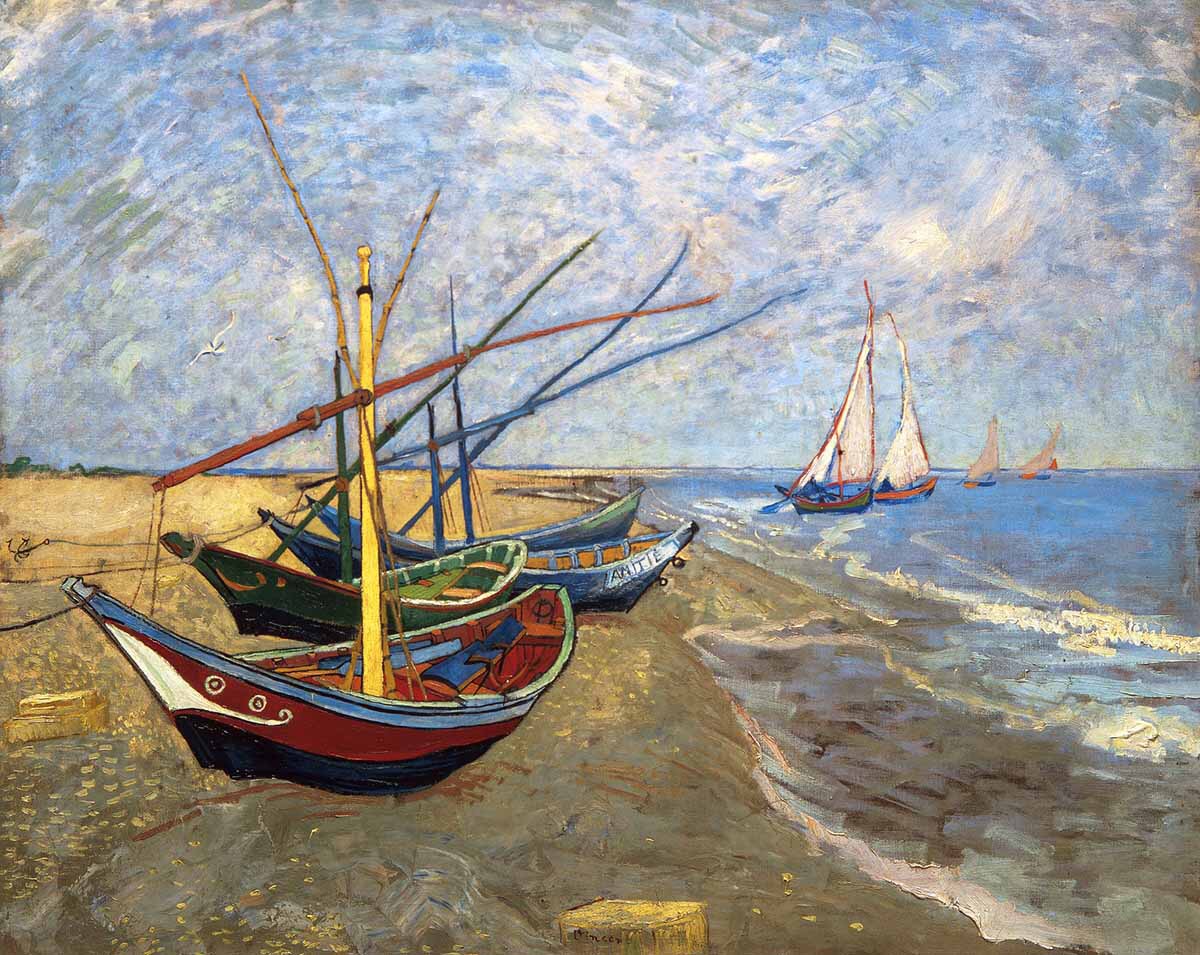
Fishing Boats on the Beach at Saintes-Maries-de-la-Mer by Gogh, Vincent van

Fishing Boats on the Beach at Saintes-Maries-de-la-Mer by Gogh, Vincent van

Only when he moved to Paris in the late years of his short life, sharing a space with Theo, he started to fully develop as an artist, incorporating in his painting traits of the Impressionists – which were becoming very popular at the time – Japanese art, the social works of Manet and Courbet, features of the English landscapist John Constable, the pointillism of Seurat, among other influences. It was then that he started to use bright colors, leaving the drabness and the gloominess of his previous drawings and paintings behind.

In February 1888, he moved to Arles, in the south of France, to make use in his paintings of the bright colors under the Provence sun. There, he rented and lived in what became the famous Yellow House of his biography, initiating one of the most productive periods of his career, painting from day to night, sometimes finishing 3 works a day. Vincent dreamed of turning the place into a utopian community for modern artists – the Studio of the South – where they could work together, exchange ideas and create something unique, based on the strong influences of the past masters and yet innovating painting radically. He aimed for a new Renaissance.

In October 1888 the French painter Paul Gauguin came to Arles to live and work with van Gogh. They had a very tense and tumultuous relationship, though, which ended up with Gauguin leaving the house a couple of months after his arrival. Vincent was left in such an unstable mental state after the quarrel with Paul that he allegedly cut off part of his ear and sent it to a prostitute. He was committed to mental institutions twice after that.

Despite all the external influences van Gogh incorporated in his work, his paintings and drawings remained true to his deep feelings and notions of art. He developed idiosyncratic traits as an artist and imbued his landscapes, portraits, and still lives with his own very unique style, characterized by the use of bright and sometimes unusual combination of colors, large brushstrokes, and fine draftsmanship, which turned his works into effective channels to express his innermost feelings. The seeds of the XX’s century expressionism have been identified in van Gogh’s final and most famous woks.

His most famous paintings were produced during the last two years before his suicide on July 29t, 1890, at age 37. Out of more than 900 pieces of work he put out throughout his short but productive career, only one painting – The Red Vineyards Near Arles – was sold while he was still alive.

He never foresaw how successful he would become, although he was fully aware of how powerful his work was and never doubted his talent and vision as an artist. Today, his paintings sell for tens of millions of dollars, and he’s one of the most famous and beloved artists of Western culture. Among his most recognized paintings, we can list masterpieces such as The Potato Eaters, The Yellow House and Starry Night.

If you wish to a have a chance to discuss and practice English vocabulary, speaking and writing skills based on some of the invaluable works of this unique artist, please check out our series of supplementary materials TEACHING ENGLISH WITH ART, featuring, works not only by van Gogh, but also by Matisse, Picasso, Caravaggio, Monet and Norman Rockwell so far. New materials are scheduled to come out in the near future, watch this space.

Click on the link below to know more about the eBooks: http://wp.me/p4gEKJ-1lS

Teaching English with Art

Teaching English with Art


Watch our promo video on the eBook TEACHING ENGLISH WITH ART: VICENT VAN GOGH:

What’s your favorite artist? Let us know so we can feature him/her in our series.

Au revoir

Jorge Sette