What Does Bob Dylan Mean Today?


Bob Dylan’s poetry has been enchanting generations for more than half a century now. His songs remain as relevant and powerful as they used to be for the counterculture youth of the 1960s.

To this day, those songs continue to inspire, constantly featuring in contemporary movies and TV series, as a way to contextualize and illuminate universal themes and feelings. A Shelter from the Storm, for example, was recently used in the soundtrack of Danny Boyle’s biopic Steve Jobs as an effective tool to highlight the turbulent relationship between the Apple co-founder and his daughter Lisa; the poignant Don’t Think Twice, It’s All Right, marked the end of season one of the iconic TV series Mad Men, when Don Draper, its unstable protagonist, hits rock bottom, arriving at his suburban home at the end of the day to find out that Betty, his wife, has finally left and taken their kids away.

9485872031_d15878ded8_b

On October 13 Bob Dylan was awarded one of the most important literary prizes in the world: the Nobel. To celebrate the recognition of one of the greatest poets of the XX century, let’s listen to his landmark anti-war hymn, BLOWIN’ IN THE WING (see You Tube video clip below), and reflect on its relevance for today’s audiences. With your study group, family or friends, discuss the questions below. You can share some of your answers with us in the comments section.

How do the 1960s in general compare to the 2010s? Point out some similarities and differences.

 What does the song Blowin’ in the Wind originally refer to? What could it refer to now?

 How would you rephrase the verse “how many roads must a man walk down before we call him a man”?

 What do we turn our heads to and pretend not to see today?

 What does the metaphor to look up and really see the sky mean?

 Enjoy!

Jorge Sette


Start your blog today: what are you waiting for?


I have some 2000 friends on Facebook.  Of course not all of them are close friends, but also family and business peers. Most of all are in ELT (ENGLISH LANGUAGE TEACHING)  one way or another: as teachers, publishers, writers, distributors or students. Of course, our news feeds are packed with info about methodologies, new materials, suggestions on lessons, and self-congratulatory posts on how great it is to be a teacher. The latter, I must confess, are not among my favorite posts: you didn’t see Steve Jobs talking about how great it was to be a brilliant marketer all the time. He presented us the results of his work in terms of concrete products. Of course, with teaching, not all products are tangible, customers are more likely to talk about the quality of our service. However, if we are teachers, we should be teaching on the Internet: not only languages  – our main job – but other stuff we have fun with, things we like, activities we are good at and we can share with other people.

Sharing your interests and expertise with the world.

Sharing your interests and expertise with the world.

We live in a fascinating age where we can show our work on as many and varied platforms as we care to look for: photos on Instagram; videos on YouTube and Vimeo; pictorial suggestions and ideas on Pinterest; snippets of your expertise on Twitter; blogs on WordPress…. to name just the most common. I’m surprised you guys – the experts in inparting knowledge and sharing strategies in meaningful and structured ways –  are not doing that more often online. Most of you keep posting cat pictures and your latest dinner photo on Facebook. That’s fine: some of the cats are even cute, but you can do so much more.

Everytime I go through my news feed I’m fascinated to find out how my friends know about so many different and interesting things:  pets and how to treat them, unusual recipes, places to go to on vacation, art, suggestions on movies to watch, you name it. Most times, however, they just share a copy of something written by another person they might have come across online and expand  a little bit on that.

Well, do more.

Create a blog on the topic and let us learn from you. I have no idea how to cook, and would love to read a simple cooking blog written by any of my friends and would be glad to share with her the results of my efforts, for example. If, for some reason, you don’t like to write, use pictures, videos, cartoons. The important thing is to come up with a story. Create a thread that can lead us to what you are trying to teach us, the goal you wish us to reach. Make it didactic and systematic, set exercises, answer our questions, help us. Who knows, you may even make money out of it, if it gets great readership.

I myself started a blog (LINGUAGEM: jorgesette.com) a year ago just for fun, discussing not only language, my favorite topic, but other themes I enjoyed (movies, art, books, culture, TV shows,  marketing, sales),  but now the blog is becoming more and more professional, as it’s helping me promote the language eBooks I publish on Amazon.com. As I write in English, I’m easily read all over the world, and it’s really gratifying the sense of pride and accomplishment you get when  I see my humble stuff being read in the US, India, Pakistan, France, etc.  This year (2015) we’ve been getting more than 3000 views per month,  and getting stronger.

So, my recommendation is don’t think about the money first: publish something on the Internet for fun: gather an audience, build a network,  and make new friends. Then, if it works out, turn it into a business.

Don’t waste time: start teaching us today! It’s fun.

On the other hand, for those interested in reading how a professional blog for customers should be written, please refer to my previous article: Should you have a blog as a marketer:

 http://wp.me/p4gEKJ-1bv

Au revoir

Jorge Sette.


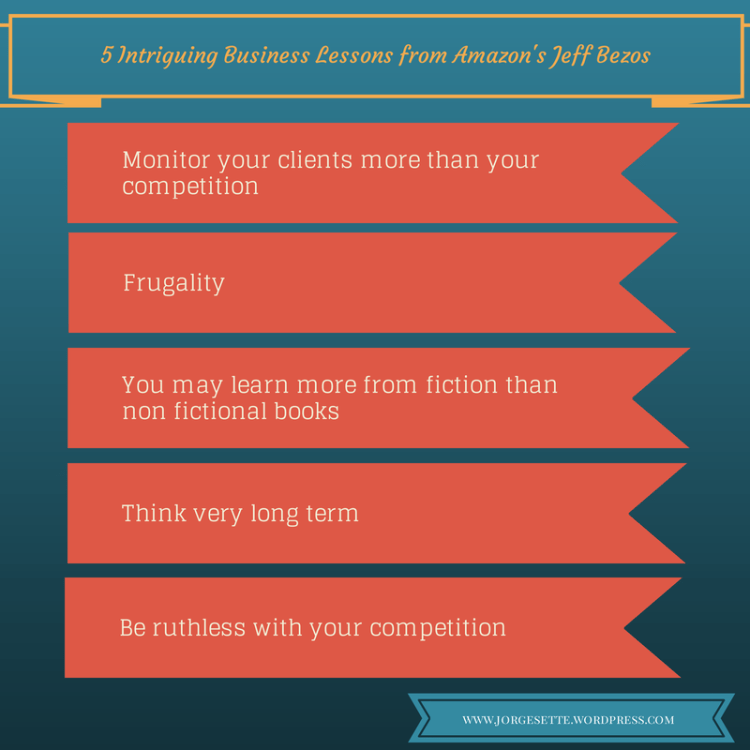
5 INTRIGUING BUSINESS LESSONS FROM AMAZON’S JEFF BEZOS


5 INTRIGUING BUSINESS LESSONS FROM AMAZON'S JEFF BEZOS

Click on the image above to access the full text.

5 Intriguing Business Lessons from Amazon’s Jeff Bezos


If you haven’t had the chance to read Brad Stone’s THE EVERYTHING STORE: JEFF BEZOS AND THE AGE OF AMAZON, reach out for your Kindle and download it right now. It’s an exciting account of the creation and development of Amazon into one of the most unique companies in history and the life of his peculiar founder Jeff Bezos.

IJeff Bezos and the Everything Store

Jeff Bezos and the Everything Store

Amazon.com started as an online book retailer and grew to become a company where you can purchase virtually anything, from apparel, to art to web services. It originated the concept of cloud computing service and was the first company, through the Kindle,  to turn online reading into a reality for thousand of hundreds of people on the planet. In addition, it claims it will be launching rockets into outer space soon.

If Amazon puts the client first – and, as customers,  you and I can certainly attest to that – working for Bezos looks like it’s not a lot of fun. Amazon is supposed to have all the depressing and Orwellian political atmosphere and red tape of huge corporations combined with the lack of resources of a startup. Many of his ex-employees are said to suffer from post-traumatic stress disorder, and the ones who remain there live under constant pressure and fear of getting fired before the end of the day. Bezo’s explosive personality is not very different from that of another difficult boss – Steve Jobs. It is kind of sad to think Nature tends to offset their kind of genius and creativity with a terrifying temperament and underdeveloped interpersonal skills.

Despite these drawbacks, you may find below a number of interesting lessons and facts about Jeff Bezos and his company. They are all based on info I got from the book. You may either try to apply them in your own business or, at least,  enjoy these points as mere trivia:

1. Monitor your clients more than your competition. Of course Amazon has always kept a close eye on Walmart, Apple, Barnes and Noble,  and Google – their main competitors. But he has always been much more likely to create or optimize processes that, rather than simply emulate these companies breakthroughs in terms of profitability, would actually benefit the client. For him, the client experience has always come first. Short term profit has always been an afterthought.

2. Frugality. Bezos is obsessed with simplicity and adept of an ascetic life style (in this he was not very different from Jobs either, by the way). He has always kept his staff on a very tight budget, cutting all kinds of extra costs with the aim of investing in the clients’ experience. His mantra was low prices everyday (just like Walmart’s), and he would go out of his way to make this happen, keeping his margins to a minimum or even giving them up altogether, such was his confidence in a business model that, if trusted by the client, would payoff in the future. Bezos would carefully  consider the need of every extra expense or cost and try to connect it directly to a benefit to the client. Lack of resources, according to him, would spur creativity and imagination from his staff.

3. You may learn more from fiction than non-fictional books. His favorite novel is Kazuo Ishiguro’s  The Remains of the Day. I was very happy to hear about this, as I love reading novels and this is certainly one of my all-time favorites. However, I don’t really think you can learn the hard facts about being an entrepreneur from the likes of Philip Roth or Machado de Assis. Fiction in my opinion will help you deal with the human side of business, and will probably keep you from having to resort to antidepressants when you struggle to work under bosses like Bezos, get sabotaged by coworkers or even fired.  But,  in my humble opinion, only the actual experience and the study of technical reading material will help you grow in your career. The most interesting thing about this aspect of Bezos’s personality  is  that his love for books boosted the launch of the Kindle, whereas Steve Job’s passion for music  – especially Bob Dylan’s and the Beatles’s – was a strong inspiration in his creation of iTunes. Do what you love and you are more likely to succeed.

4. Think very long term. Entrepreneurs need to persist in seeding. The payoff never comes immediately. Especially now, in this fast-paced, ever-changing technological landscape. Appreciate the little victories you achieve every day and fight on. Celebrate every little step towards a moving target you don’t even know if you will ever reach.

5. Be ruthless in the negotiation with your competition. For Jeff Bezos “win-win” was an unamazon way of thinking. You need to score an advantage over your opponents. Think football during these times of World Cup.  A draw is not acceptable. Do not even be afraid of disrupting your own business model in your pursuit to win. Do everything to destroy it and create something new instead. If you don’t do it, others will. Cannibalization is OK.

You may not agree with every tip Bezos has to offer, but remember where he got to by using them. Of course, you should always take successful entrepreneurs’s  and  gurus’ advice with a grain of salt, for, as Malcolm Gladwell explains in his brilliant book OUTLIERS, there is always a lot more to success than meets the eye. A set of special conditions not available to all is always present in the these Cinderella’s stories of ash to riches, so look out for them.

What is your formula for success? Please share it with us (if we are not competing with you).

NOTE: If you are interested in TEACHING ENGLISH WITH ART, you might want to check out our successful series of eBooks available from AMAZON.COM (KINDLE STORE). Just click here: http://wp.me/p4gEKJ-1lS

Teaching English with art

Teaching English with art

Au revoir

Jorge Sette

Six influential Marketing Books you should read


Everyone needs marketing. We are all marketers one way or another.

Most people seem to think that marketing is something done by a restricted group of people in a specific department of big companies, whose job consists mainly of yelling silly slogans at you, hoping they will stick, and perhaps make you stop in your tracks to buy something you don’t really need.

Marketing as a strategy, however, is something much deeper, scientific and even artistic, I should say. It’s sad that many companies and professionals fail to understand this concept. Marketing is needed to acquire, grow and maintain clients not only for companies but also for you as a professional. We are all selling something to someone: the product of the company we work for or our professional value, our time and dedication.

Nevertheless, let’s keep in mind that marketing has undergone a radical change in the past two decades. Digital marketing completely changed the landscape. I would say that it leveled the playing field for small companies and autonomous professionals, allowing both to compete worldwide with bigger corporations for an audience on the Internet. Since I have worked in this area for most of my professional life, and really love the subject,  I thought I could use this post to make a humble contribution, sharing with you the best marketing books I have ever read.
Photo

1. Marketing Management, by Philip Kotler. This is considered the bible of the field. If you take any marketing course, you will surely be referred to it. It covers the basics, and it’s an essential tool for anyone interested in the subject. It will dedicate specific chapters to each of the four traditional Ps of marketing (product, price, promotion, and place), analyze consumer markets and buyer behavior, will give you tips on how to deal with the competition, discuss segmentation, etc. It is a lot of information, and some readers will complain that the topics are not exploited in depth. The text will, however, give you a general, if a bit superficial, overview of marketing as a whole.

2. Positioning,  the Battle for Your Mind, by Al Ries and Jack Trout. One of the most seminal books in the area. It explains the fundamental concept of differentiation. How to plant the concept of your brand in the clients’ minds, making them see you in a specific and unique way. As a marketer, you need to look for a space that has not been occupied yet and fill it. It is necessary to make your brand mean something special to your target audience. As a private teacher of English in Brazil, for example, how do you want to position yourself? As a cool native speaker from Australia who would appeal to a young and and adventurous audience (You need to be Australian to pull that off, remember.)?  As an experienced Brazilian who had to learn the second language fluently yourself and therefore will understand the needs of your students better? Do you want to be seen as the best business English teacher available in São Paulo? These are options. Work to your strenghts and pick a suitable, convincing positioning and a niche to exploit.

3. Permission Marketing, by Seth Godin. This book will forever change your views on how to promote your product. If you are a fan of Mad Men, the famous TV show featuring these clever guys from Madison Avenue, you will understand that the way they conducted a marketing campaign back in the 60s would have very little chance to succeed today. For at least 40 years, from the time the show is set, marketing was all about interrupting people to make them listen to your call (ads broadcast through TV and radio, billboards, flashy ads in magazines…) With today’s noise, when clients are bombarded with thousands of promo messages every minute, it would be impossible to break through the clutter with traditional marketing. Ideally, customers will now come looking for you instead, if you apply the strategy suggested in the book (which is also known as inbound marketing). You will still interrupt them once, probably (maybe by luring them with a display ad on the website they’re browsing), but, then, the conversation will need to continue with their permission (or opt-in), and most certainly they will be the ones in charge.

4. The New Rules of Marketing & PR, by David Meerman Scott. This book summarizes in a very simple and direct way all the contemporary trends in marketing. It will show you the spectrum of tactics you can use to reach your client in this digital age: how to keep the conversation going with your target audience;  how to position yourself as a “thought leader” (expert) in your industry, through blogging, podcasting, video-blogging, and social media interaction; it also covers tactics on search engine marketing.  D. M. Scott explains the useful concept of buying personas, which is a method of breaking down the different segments of your market to create a clear personality for each one, so you can have a more relevant conversation with the customer, through the messages you send out and the feedback you get in response.

5. Advanced Web Metrics with Google Analytics, by Brian Clifton. One of the most remarkable changes in marketing is the shift towards more accountability expected from practitioners. Metrics is the key word in today’s marketing. If you don’t measure and demonstrate objectively that you can improve the ROI (return on investment) of your campaigns,  you won’t keep your job for very long. Not every company has changed yet, though, and some still seem to value marketers who are famed only for their creativity, even if they do not show proven results for their interesting ideas. I firmly believe their days are numbered. Clifton’s book will teach you in a very thorough way how to operate and benefit from Google Analytics, one of the most widely used services on the Web. The book offers invaluable insights on how to crunch the numbers and improve your marketing efforts.

6. Steve Jobs, by Walter Isaacson. Since the visionary depicted in this biography is one of the most inspiring people ever in my humble opinion, I must admit to being partial including this book on the list, as it’s not really a marketing book but a book about an extremely effective and successful marketer. The main lesson here is the product is the marketing. In the words of Seth Godin, who also preached this approach, you need a PURPLE COW – a very special and original product – to win in the ultra competitive market place of today. All promotional tactics will feel gimmicky and deceitful if you can’t deliver the iPhone or iPad of your industry. Another lesson is the importance that design has acquired in the making of any product in recent years. It goes without saying that function has not lost any of its importance, but if not integrated seamlessly with extraordinary design, your product will be in trouble.

Remember that the new marketing is very dynamic: Tactics, apps, methodologies (automation) and a great variety of tools are being created every moment in the marketing landscape.  Therefore, to keep up with this ever-evolving environment, besides reading the fundamental and seminal books of the field, you are advised to sign up and follow a number of blogs on the subject. It can feel a bit overwhelming at first, but, eventually, you will learn to filter the information and focus on a couple of the best blogs in the field. I strongly recommend, for example, Occam’s Razor, by metrics evangelist Avinash Kaushik and the Hubspot blog on inbound marketing.

Now it’s your turn. Could you please recommend any good marketing books to us?

Jorge Sette.