Dom – The First Brazilian Series of Amazon Prime (Review)


The first Brazilian series on Amazon Prime, based on Tony Belloto’s novel (2020) and on the biographical account The Witch’s Kiss (2009), written by Victor Lomba – Pedro Dom’s father in real life – doesn’t disappoint.

Dom – Amazon Prime series

Against the backdrop of the military dictatorship, the beginning of the war against drugs, and the origins of the dissemination of cocaine in Brazil (in the early 1970s), we first meet Victor Dantas (Dom’s father, played by Filipe Bragança in the 1970s scenes of the series ), a naive and idealistic young man who gives up scuba diving and joins the police to fight the drug traffic.

Then, the series, in the course of three seasons, covers the development of Victor’s activities as a police agent, his marriage, the birth and raising of his kids, and the overall vicissitudes of the family until 2005.

The story of a middle-class family dealing with the addiction of one of their members, Victor’s son, Pedro Dom, a bright and energetic teenager, who starts snorting coke at the age of fourteen, and then rises to become one of the most feared and famous criminals in Rio, will keep you glued to the screen.

Gabriel Leone as Pedro Dom.

Since the movie City of God, Rio‘s complex environment (inequality, favelas, drugs, political corruption, and the destruction that chemical addiction inflicts within loving families) has never been shown with such brutality and realism.

Unlike City of God, though, the series’s producers don’t shrink from showing Rio de Janeiro in all its glorious beauty. So, scenes depicting the extreme poverty of life in the favelas are contrasted with stunning views of Copacabana Beach.

Copacabana Beach – Rio

The cast is fantastic across the board.

The love and bond between the father, Victor (played in his maturity by the excellent Flávio Tolezani), and the problematic son, Dom (Gabriel Leone‘s charismatic performance makes the character rather likable, a glamorous antihero) feels very real and moving.

The close bond between a father and his drug addicted son.

Dom and Victor are played by different actors at different ages – all of them do a wonderful job!

Don’t miss it.

If you saw the show and read any of the books about Pedro Dom, please leave your comment in the section below.

Jorge Sette

10 Books You Should Read to Understand Brazil Better


Congratulations, you got a new job. You will be relocated to Rio? How exciting. How did you manage to grab such an interesting post? You must know a lot about Brazil and speak good Portuguese. Or maybe you are just the only person who had the availability to move to this country. Whatever the reason, or despite how much you might already know about Brazil, I would strongly recommend you read the books listed below to get a crash course in the country. They are all fun to read and will contribute in their own way a small piece of understanding to complete the puzzle.

I’m Brazilian myself, spent most of my life here, and still profited a lot from reading these texts. Here they are:

1. The Brazilians, by Joseph Page.

510O0emLBRL._SX331_BO1,204,203,200_

This is one of my favorite books about Brazil. It’s visibly written by someone who loves the country, and despite its very objective, and sometimes hurtful, analysis, makes you feel appreciated and liked as a local. Besides, it covers many different aspects of the culture and history of the country, including the national religions and the nuances of the current power structure, all written in a light and pleasant language. I particularly liked the way it analyzes the way the different social classes interact with each other in Brazil, with all the hypocrisy and paternalism that underlies these brutal relationships. However, the book was written way before the passing of a new set of Constitutional amendments (PEC 478 – known as PEC das Domésticas) in 2013, regulating the working  life of the “empregadas domésticas” (Live-in maids; a very typical Brazilian institution), and therefore broadening the professional rights of these underpaid and exploited workers more than 100 years after the abolition of slavery took place in the country.

2. Brazil on the Rise, The Story of a Country Transformed, by Larry Rother.

5153cEwXJ+L

Written around the time when the now infamous cover of the magazine THE ECONOMIST showed an illustration of the statue of Christ the Redeemer in Rio taking off to the skies as a potent rocket on its way to a future of fully developmental glory and economic power, the book gives us the historical and economic background necessary to understand how we got to where we were by the end of the two mandates of the Labor Party, under president Luís Inácio da Silva (Lula). It focuses on the economic and political aspects and the obstacles the country had to overcome on its path towards democracy and to arrive at the reasonable level of economic stability we had some 6 years ago. Of course, things are not looking now as great as when that issue of THE ECONOMIST came out, but corrections are being made along the way and I firmly believe we will realize the bright potential we have been predicting for the past 500 years.

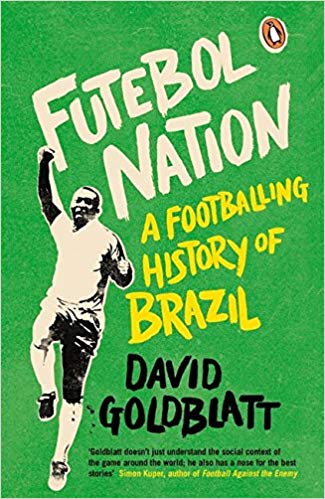
3. Futebol Nation: A Footballing History of Brazil, by David Goldblatt.
510bwbxTBGL._SX323_BO1,204,203,200_

The English writer does not sound very sympathetic to the country and its people. The writing is a cold and dispassionate account of the importance football gained in Brazil since its introduction in the early years of the 20th century and its ramifications through the history of the country. Although it became clear after the World Cup (2014) that football seems to have lost a lot of its importance to Brazilians – given the sense and irony most of the population demonstrated after the historic loss to Germany with a scoreline of 7×1, the book makes it clear that, especially from the 1950s to the 1990s, football was Brazilians’ greatest source of pride. It is also evident how strongly we identified the values of the nation with this foreign sport, allowing and making it easy for politicians to tap into its people’s naive passion to advance their own agendas. Although the book does not take into account the World Cup of 2014, it covers the June 2013 social unrest and popular demonstrations directed mainly against the realization of the over-budgeted upcoming event. All in all, it’s a very interesting read, even for those who are not really into the sport.

4. Backlands: The Canudos Campaign, by Euclides da Cunha.

9780143106074-1

Considered one of the most important books of the Brazilian canon, this text is a journalistic account of the conflict of Canudos – supposedly a civil war between monarchists and republicans at the end of the nineteenth century – which took place in the arid and difficult geographic region known as the backlands in the interior of Bahia. The official story says that a group of backlanders (sertanejos), led by a religious fanatic, Antônio Conselheiro, the Counselor, built up a settlement constituted of thousands of huts forming a kind of overcrowded slum, spreading over the valleys and hills of the region. The book reads like a novel, once you manage to get through the slow and dragging geological, topographical and climactic minutiae used to describe the region in the first couple of chapters. Then it finally gets to the action, depicting with cinematographic vigor the 4 military incursions into the settlement of Canudos, defended fiercely by the backlanders (sertanejos and jagunços, the latter considered bandits infiltrated in the community).

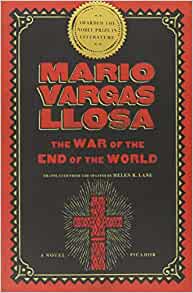
5. The War at the End of the World, by Mario Vargas Llosa.
Unknown

While Backlands was meant to be an objective report of the Canudos War in Brazil, this book by Peruvian writer Llosa is a fictionalized version of the events. It tells the same story, but as novels go, adding the thrill and emotional twists of the format. The book depicts characters on both sides of the war, offering a balanced perspective of what happened. It’s considered one of the author’s best books. Llosa himself considers it his most accomplished novel, and it features in Harold Bloom’s The Western Canon.

6. A Death in Brazil, by Peter Robb.

51wRrAw-XyL

A thrilling account of 500 hundreds years of Brazilian history, Australian writer Peter Robb’s book also reads like a novel. The writer lived in Brazil and offers authentic and knowledgeable insights into the country, its people and culture. He also talks very candidly and passionately about the country’s serious problems and inequalities. The death of the title is the mysterious assassination of PC Faria’s, fixer and bagman to corrupt President Collor in the early 1990s, but the book does not focus on this. It covers, among other things, the brutal slavery system we had in the country until 1888 (longer than anywhere else in the Western world), the destruction of the fugitive slave settlement of Palmares, the Canudos war, Brazilian cuisine and literature. A must-read.

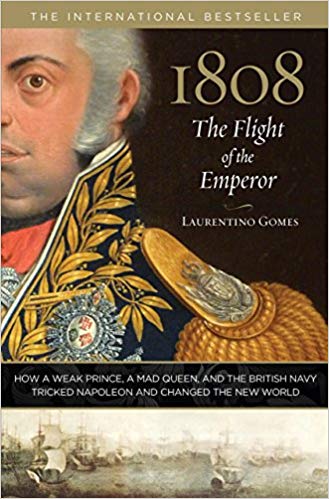
7. 1808 – How a mad queen, a coward prince and a corrupt court fooled Napoleon and changed the History of Portugal and Brazil, by Laurentino Gomes.
517MnMhRr7L._SX327_BO1,204,203,200_

Written by one of the most influential journalists of Brazil, this is the first installment of a trilogy that covers the history of the country from the transfer of the Portuguese royal court to Rio de Janeiro in 1808, in a maneuver to escape the Napoleonic wars, to the events surrounding the Proclamation of the Republic in 1889.

It took 10 years of research for the first volume to come to light. It’s a well- written, direct and very readable account of the story of the arrival in Brazil of D. Joao VI, his wife, Carlota Joaquina, and their entourage, changing the destiny of the colony forever by paving the way for the declaration of independence 14 years later. Mixing the personal anecdotes of these characters – some of them very funny – with important historical events, Gomes offers the reader a sprawling overview of those times in the colony.

1808 was awarded two Jabuti Prizes, in the categories of best reportage-book and non-fiction book of the year.

Screen Shot 2020-02-16 at 8.18.00 AM

8. 1822 – How a wise man, a sad princess and a money crazy Scotsman helped D. Pedro create Brazil, a country that had everything to go wrong, by Laurentino Gomes.

This is the second volume of the trilogy we mentioned above. Now we are focusing on the story of D. Joao VI’s son, Prince Pedro, and the role he played in the declaration of the independence of the country, culminating in the historic Cry of Ipiranga, and then becoming the first Emperor of Brazil. The book reads like a thriller, depicting the highly charged political events, the confronting factions and the many different interests that led Pedro to decide to stay in the country and cut its ties with Portugal. It portrays D. Pedro I as a wild, sensual and determined young man, who did not refrain from playing the role history reserved for him. 1822 added two other Jabuti Prizes (the third and fourth) to Laurentino Gomes’s collection, again in the categories of best reportage-book and non-fiction book of the year.

9. 1889 – How a tired emperor, a vain marshal and a wronged teacher collaborated for the end of the Monarchy and the Proclamation of the Republic in Brazil, by Laurentino Gomes.

The third volume of Gomes’s acclaimed trilogy revolves around the Proclamation of the Republic in Brazil, bringing down the Empire, which had been the most stable and solid government in the region for 67 years. Emperor D. Pedro II – 0ne of the most educated man of his time – was banned from Brazil with his family, being exiled in Europe. Marshal Deodoro da Fonseca, a former anarchist and a friend of the deposed emperor’s, was in charge now, despite his old age and debilitated health.

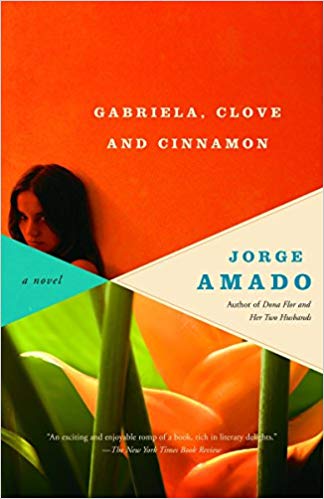
10. Gabriella, Clove and Cinammon, by Jorge Amado.
416OrtEBdpL._SX322_BO1,204,203,200_

Besides The War at the End of the World, this is the only other novel I included on our list of top 10 choices for the reader who wishes to understand Brazil. Written by Jorge Amado, Gabriella takes place in the small town of Ilheus, in the state of Bahia, during the economic boom of the cacao in the 1920s. The book consists of two intertwined stories: the first is the romance between the bar-owner Nacib, of Syrian origin, and the drought immigrant worker Gabriella, who becomes his cook and mistress; the second story is the confrontation between the conservative plantation colonels (powerful heads of landowner families) and the wealthy young man Mundinho Falcão, who represents the arrival of modernity, efficacy and urban values in the rural underdeveloped and backward region. Readers will be delighted to have all their senses and intellect arrested, as they immerse in the world of Gabriella: Amado describes the tastes, smells, and texture of the local foods; the funny, and sometimes violent, local customs; the hypocrisy of a narrow-minded and provincial society; the brutality of machismo; and the bright colors of what is supposed to be a microcosm of Brazil and Latin America.

I guess these 10 books will give newcomers enough introductory background and information on the beautiful, challenging and diverse country I’m lucky to live in. Welcome, good luck with your new job, and don’t forget to rate and comment on this post.

Au revoir

Jorge Sette.

 

On reading – from Roald Dahl’s Matilda


“Mr Hemingway says a lot of things I don’t understand, Matilda said to her. ‘Especially about men and women. But I loved it all the same. The way he tells it I feel I am right there on the spot watching it all happen.’ ‘A fine writer will always make you feel that,’ Mrs Phelps said . ‘And don’t worry about the bits you can’t understand. Sit back and allow the words to wash around you, like music.”

51p-Bvu0-ML

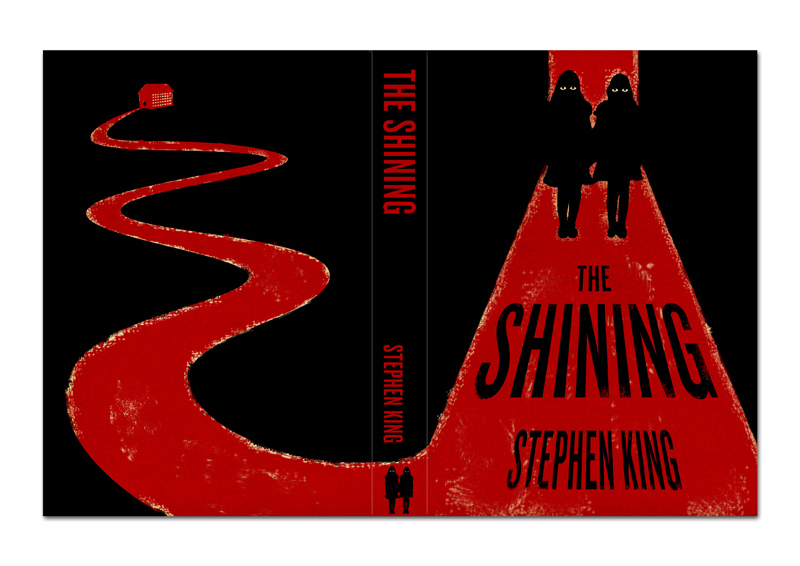
Stephen King’s The Shining: Like Father, Like Son.


Looking for the perfect book to read on Father’s Day? The Shining by Stephen King is a classic: one of the scariest books ever written. One reason for its popularity is the novel was turned into a celebrated movie directed by Stanley Kubrick, starring Jack Nicholson and Shelley Duval in the main roles, back in the 1980s.

Rumor has it that King himself was not entirely happy with the movie adaptation. If you read the book, you will probably understand why. Although the movie is heavily inspired by the book, it takes a lot of detours from the original plot and skips important themes that play an essential subtext.

5802698618_c2fbf5eefe_b

In broad strokes, the novel tells the story of Jack Torrance, a recovering alcoholic with a short temper, who – unable to find a job anywhere else, after beating up a student at the school he used to work as a writing teacher – is hired, with the help of a friend, as the caretaker of the sinister Overlook hotel for the winter months, taking his young wife, Wendy, and their 5-year-old son, Danny, with him.

The hotel is completely empty and isolated. To spice things up, Danny has the gift of precognition, popularly known, among the initiated, as the shining: he can read people’s thoughts, foresee the future, and have glimpses of violent incidents that took place a long time ago. Weird things start happening at the hotel. The family, especially the father and the son, are haunted by ghosts and unusual experiences.

Among the strange ocurrences that contribute to its sense of horror, the novel depicts a topiary – bushes and trees trimmed in the form of a rabbit, two lions and a dog – that seems to come to life occasionally; a dead woman who rises from a bathtub in room 217 (to this day, guests in many real hotels are said to turn down the offer to occupy the room with this number because of the novel); images of a mob murder that happened years before materialize in vivid form in front of the kid; in addition, mufffled sounds of a mask ball from the past are heard continually at night.images-2

Could all this be a metaphor for a darker link between father and son? The symptoms of something terrible lurking inside the boy and ready to blossom?

As the months go by and the winter becomes harsher, the claustrophobic atmosphere of the hotel inevitably starts to unhinge Jack Torrance, whose madness slowly sets in. He becomes a deadly menace to his own family.

(Watch the clip of one of the best scenes of the movie below. Warning: strong language is used)

Stephen King is not only a bestselling and prolific author, but he’s also really talented. His books are not just airport thrillers made out of a schematic formula meant to provide a couple of hours  of entertainement before being thrown out in the trash can at the end of your flight. The Shining, for example, can be read on at least two different levels. On a simpler, more straightforward level, we have the chilling mystery tale of a family stranded by heavy snow and lack of telecommunications, living alone in a more than 50-year-old luxurious hotel up in the mountains of Colorado.

An even more disturbing way of interpreting The Shining, however, is to read it as a vigorous metaphor for alcoholism, its genetic origins and terrible consequences: the story would consist of hyperbolic images translating the symptoms of that powerful disease that can be handed down from father to son to grandson, causing extreme anxiety, cravings, hallucinations, madness, violence, and, ultimately, death.

As backstory, the reader learns that Jack’s own father was an alcoholic. He would come home from his job as a nurse, smelling of booze and abusing his wife and kids. Despite being very fond of his father, Jack’s love wears out, as he witnesses a vicious beating his Dad administers to his Mom, for no reason at all.

Danny and Jack, for their turn, are quite close too. As a matter of fact, the bond between father and son is so strong that Wendy sometimes feels left out of their peculiar masculine world, and, as a result, even gets a bit jealous.

In an alternative interpretation of the novel, therefore, the closeness between father and son, Jack’s increasing madness at the hotel and Danny’s precognition gift can be easily understood as the addictive genetic inheritance handed down to the next generation, the beginning of what will become for Danny a full-blown disease in the future.

untitled

Steven King himself was an alcoholic at the time he wrote the novel and the theme in The Shining reflects his own worries and unhappiness about the problem. Writing, after all, has always been a potent way of purging one’s own demons.

Whatever layer of the story you choose, rest assured it will scare the living daylights out of you, which is why the book is such a great thriller in all respects.The book sustains a very oppressive atmosphere, making it rather dark. Perhaps you should put off the experience until Halloween rather than reading it now, on Father’s Day! The tension in the story grows progressively unbearable, culminating in a gruesome climactic sequence. Not to be missed.

Jorge Sette.

What Does Bob Dylan Mean Today?


Bob Dylan’s poetry has been enchanting generations for more than half a century now. His songs remain as relevant and powerful as they used to be for the counterculture youth of the 1960s.

To this day, those songs continue to inspire, constantly featuring in contemporary movies and TV series, as a way to contextualize and illuminate universal themes and feelings. A Shelter from the Storm, for example, was recently used in the soundtrack of Danny Boyle’s biopic Steve Jobs as an effective tool to highlight the turbulent relationship between the Apple co-founder and his daughter Lisa; the poignant Don’t Think Twice, It’s All Right, marked the end of season one of the iconic TV series Mad Men, when Don Draper, its unstable protagonist, hits rock bottom, arriving at his suburban home at the end of the day to find out that Betty, his wife, has finally left and taken their kids away.

9485872031_d15878ded8_b

On October 13 Bob Dylan was awarded one of the most important literary prizes in the world: the Nobel. To celebrate the recognition of one of the greatest poets of the XX century, let’s listen to his landmark anti-war hymn, BLOWIN’ IN THE WING (see You Tube video clip below), and reflect on its relevance for today’s audiences. With your study group, family or friends, discuss the questions below. You can share some of your answers with us in the comments section.

How do the 1960s in general compare to the 2010s? Point out some similarities and differences.

 What does the song Blowin’ in the Wind originally refer to? What could it refer to now?

 How would you rephrase the verse “how many roads must a man walk down before we call him a man”?

 What do we turn our heads to and pretend not to see today?

 What does the metaphor to look up and really see the sky mean?

 Enjoy!

Jorge Sette


Philip Roth on Love (The Dying Animal)


“The only obsession everyone wants: ‘love.’ People think that in falling in love they make themselves whole? The Platonic union of souls? I think otherwise. I think you’re whole before you begin. And the love fractures you. You’re whole, and then you’re cracked open. ”


philip-roth_wide-e08158b825c8ee12ea3f56b15636ea3f4a320417

Almodóvar’s Julieta


The critics are right: Almódovar is not the same. Julieta, his latest movie, is nothing like Women on the Verge of a Nervous Breakdown, which catapulted the Spanish director to international fame almost thirty years ago.

Julieta is more mature, serious and, in many respects, a lot better, reflecting the evolution and progressive refinement of a seasoned maestro. Of course, some fans will miss the raw humor and shock value of his earlier movies, which celebrated la movida madrileña, the cultural movement of the late 70s and early 80s that stood in direct opposition to the values and life style of Franco’s dictatorial years. In those days of la movida, it was necessary to burn the cultural bra to make a point. Those times are over, though. Besides, for more nostalgic viewers, quite a few of his movies of that era are available on Netflix, at your fingertip.

original

 Julieta, on the other hand, belongs to the 2010s. It is allowed – strike that; required is the precise word – to be simpler and more contained. Nevertheless, it has kept the director’s inimitable voice and style: the bright colors, the Madrid touch, and the inscrutable strong women are still there. And even Rossy the Palma, one of the muses of his early years as a filmmaker, makes a comeback; her wondrous nose, uneven eyes and twisted mouth working their magic, in the role of a modern-day Cassandra.

Rossy de Palma La Ley del Deseo

Rossy de Palma in the 1980s.

I find it unbelievable that many critics will say that Almodóvar has never mastered the skills to tell a story. His narrative powers are weak, some say. Obviously, these critics abide by only one model of storytelling: the commercial cinema of Hollywood. Although I respect the claim that some narrative elements and archetypes make themselves present one way or another in every story ever told, they should be rearranged in as many different ways as creative directors can come up with. Almodóvar’s storylines do follow a structure – although an idiosyncratic one. Digression plays a big part in his method.

Without the digression, Julieta would be a simple tale about guilt. It’s the digressions that allow Almodóvar to present the viewer with unique images (an elk running in slow motion alongside a moving train at night; the bluest sea shown though the open windows of a living room in Galicia; the Swiss Alps shot in all their glory); intriguing metaphors: references to Homer’s Odyssey and the power of the sea to entice men like Ulisses and Xoan, pulling them from the safety of their houses and the comfort of their families; and one of the most original transitions between youth and old age in movie history: actress Adrian Ugarte is replaced by Emma Suárez at the sudden removal of a red tower.

23cp_outtakes_pedr_1495105g

Pedro Almodóvar

Julieta is a delight to the eyes. You could just sit back for hours watching these beautiful women move around in fashionable clothes, stepping in and out of fascinating Madrid buildings, walking along its narrow cobblestone streets or just sitting in close-up against the backdrop of stunningly decorated apartments.

With the help of great actors and a stunning musical store by Alberto Iglesias, Almodóvar turns the straightforward story of a family marked by tragedy into a Hitchockian thriller – with echoes of Vertigo. Viewers will be met by twists and little surprises at every turn, relishing the journey. Almodóvar has developed the fearlessness of those who have nothing more to prove. He shoots his movies out of sheer pleasure. Who can blame him?

Au revoir

Jorge.


Maracanã Explodes under the Protective Arms of Christ, the Redeemer


Rio Olympic Games’ Opening Ceremony took place on the warm evening of August 5th at the Maracanã stadium, an iconic sporting venue, known all over the world. It was a jaw-dropping festival of creativity, lights, dance and music, extremely well-orchestrated by movie directors Fernando Meirelles (City of God) and Andrucha Waddington (Me You Them), and produced by Daniela Thomas (Foreign Land).

Maracanã_Stadium_in_Rio_de_Janeiro

Due to the serious political-economic crisis Brazil is going through at the moment – plagued by the worst recession in its history and having a president on the verge of impeachment – Brazilians have been deeply divided over the convenience and benefits of hosting the most important sporting event in the world. Many foreigners have also been quick at pointing out problems with the organization of the Games, believing the event is doomed.

Contrary to all expectations, however, the stunningly beautiful and energetic Opening Ceremony came as pleasant surprise, boosting Brazilians’ morale and making them proud of their country. It also signaled that the first Olympic Games in South America may run more smoothly than predicted, after all.

Flickr-christ-the-redeemer-pvcg

Among the highlights of the evening, we would list:

  • An emotional rendition of the national anthem by composer Paulinho da Viola, which brought tears to the audience’s eyes.
  • A powerful delivery by actresses Fernanda Montenegro and Judi Dench of poet Carlos Drummond de Andrade’s poem A Flor e a Náusea – used as a way to mark the importance of keeping the world sustainable and green.
  • As a follow-up, the world witnessed the implementation of an impressive initiative: all athletes contributed seeds of the native flora to the plantation of what will become the Radical Forest – let’s remember that the exuberant present-day Floresta da Tijuca (Tijuca Forest) was also man-made, the result of a similar initiative undertaken by Dom Pedro II, the enlightened emperor of Brazil during the second half of the XIX century.
  • The lighting of the Olympic Torch was conducted by long-distance runner Vanderlei de Lima, offering the audience an unforgettable spectacle, as the cauldron on fire was raised against the backdrop of a revolving metal structure which reflected its light, simulating a radiating sun.

The gods must have been pleased.

Au revoir

Jorge Sette


Famous Greek Quotes


“A man who takes no interest in politics has no business here at all.”


Unknown

Pericles (495 – 429 BCE)

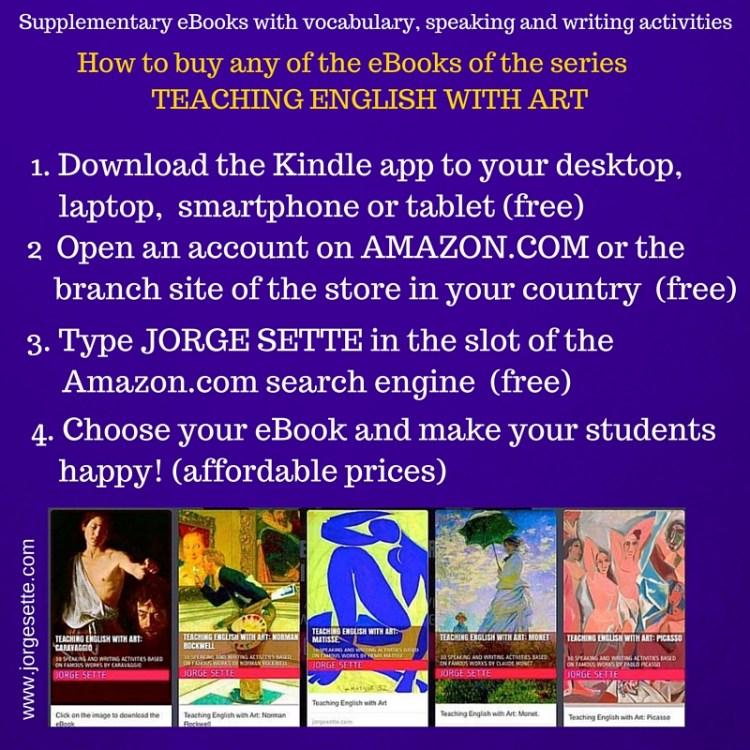
How to Buy Any of the eBooks of the series TEACHING ENGLISH WITH ART


To buy any of the eBooks of the series TEACHING ENGLISH WITH ART, please follow the steps below. Click on the image to be directed to the KINDLE STORE.

Click on the image above to be directed to the KINDLE STORE.

Click on the image above to be directed to the KINDLE STORE.