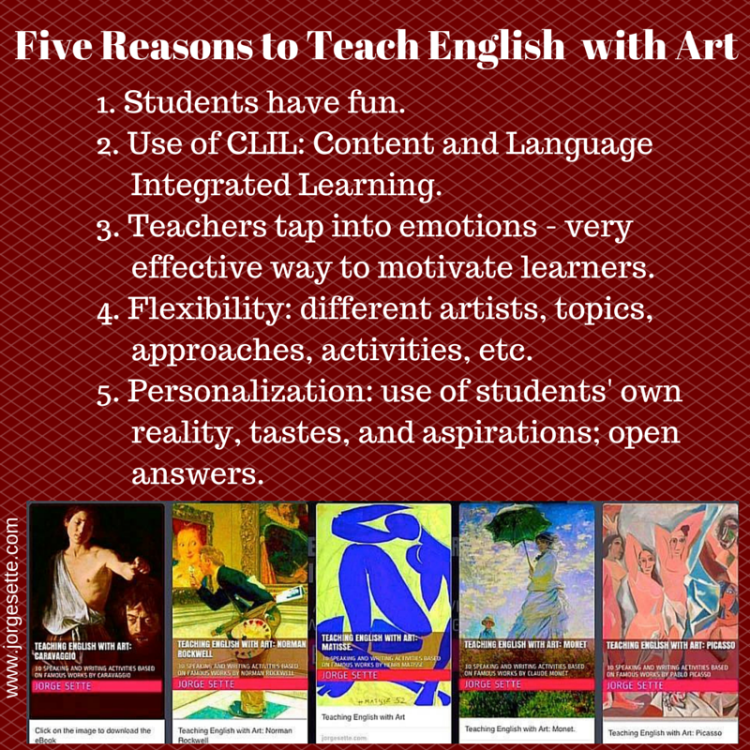
To read the full article, click on the image above.
To read the full article, click on the image above.
Teaching English with Art: the ENGLISH LANGUAGE LEARNING materials you have been waiting for:
Click on the image below to know more about TEACHING ENGLISH WTH ART and buy your eBooks:

Teaching English with Art

Acrobat on a ball, Picasso
For more info about the series TEACHING ENGLISH WITH ART: Click on the link below to go to AMAZON.COM and get your ebooks: http://wp.me/p4gEKJ-1lS
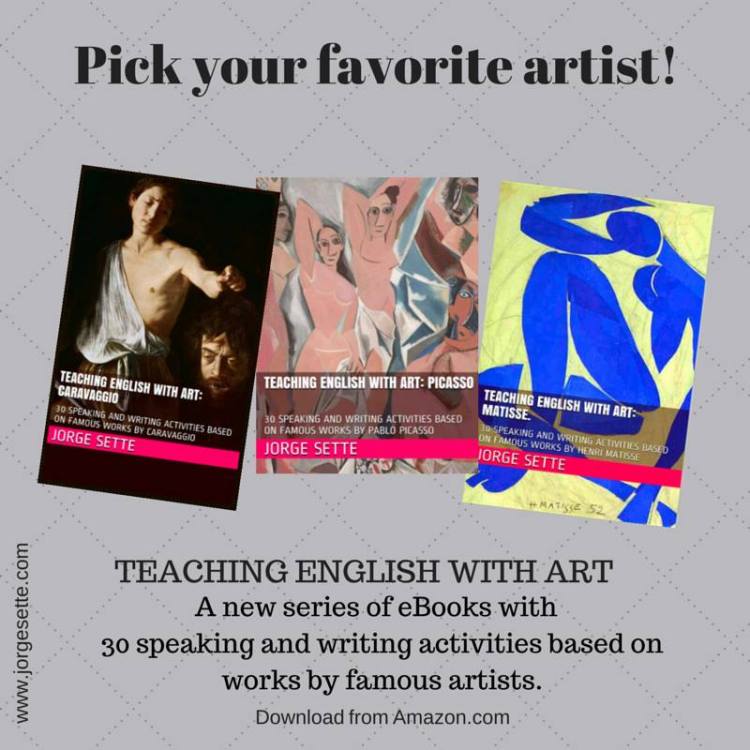
Click on the image above to access the KINDLE STORE. Teaching English with Art: Matisse, Picasso, Caravaggio, Monet, Norman Rockwell
Au revoir Jorge Sette
Teaching English with Art: the ENGLISH LANGUAGE LEARNING materials you have been waiting for:
TEACHING ENGLISH WITH ART: MATISSE. Click here for more info: http://wp.me/p4gEKJ-1kP
TEACHING ENGLISH WITH ART: PICASSO. Click here for more info: http://wp.me/p4gEKJ-1lA
#matisse #picasso #fauvism #cubism #moma #tate #teachingenglish #language #learningenglish
Ideal for online lessons!!
If you are having any of the following problems, we can help you…
a. Are your students often bored during the English class? b. Don’t they know what to say when you set up speaking activities? c. Do you spend the weekend correcting writing assignments that don’t seem to help them improve? d. Is it hard to personalize productive skills and link the English lesson to the other subjects in the school curriculum? e. The students know nothing about Art and high culture in general.
Click on each of the pictures below to get your copy from the KINDLE STORE:
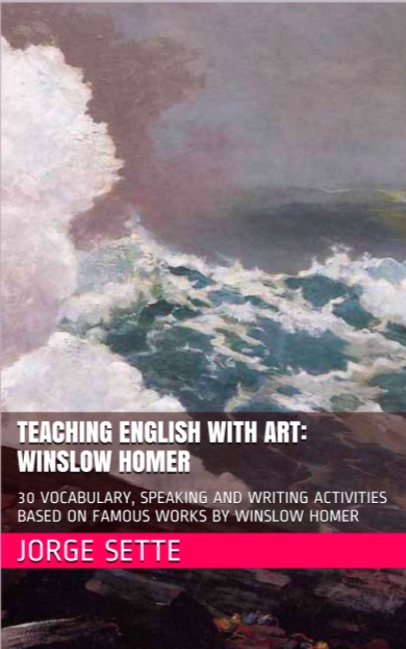
Click on the image above to go to Amazon.com
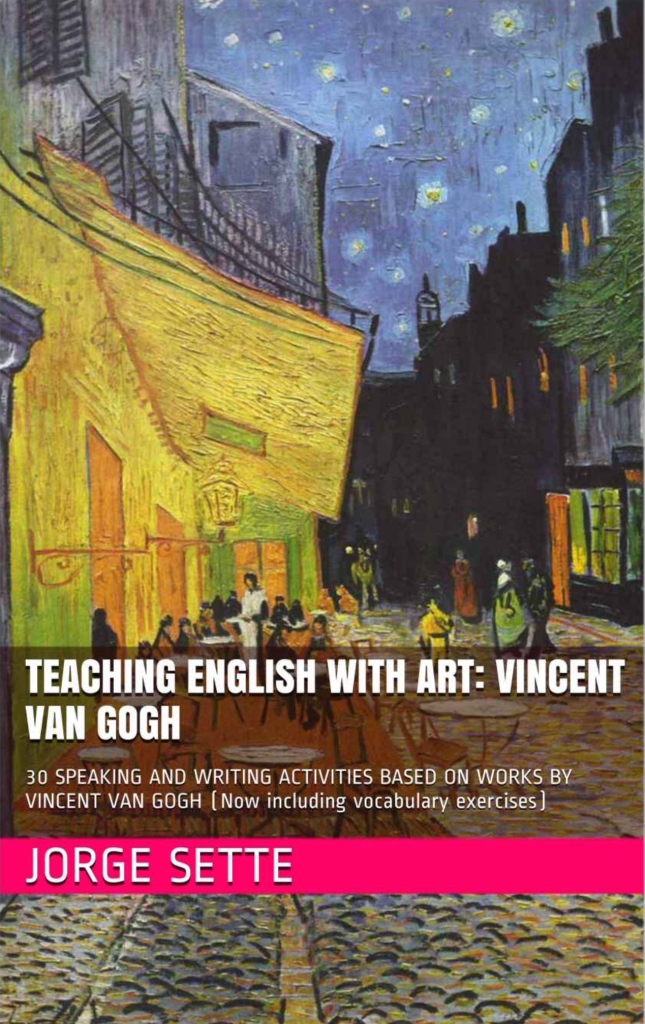
Click on the image above to get your copy from the KINDLE STORE.
Click on the picture above to get your copy.
Click on the image above to download the eBook.
Click on the image to download the ebook.

Click on the image to download the eBook.
Click on the image to download the eBook
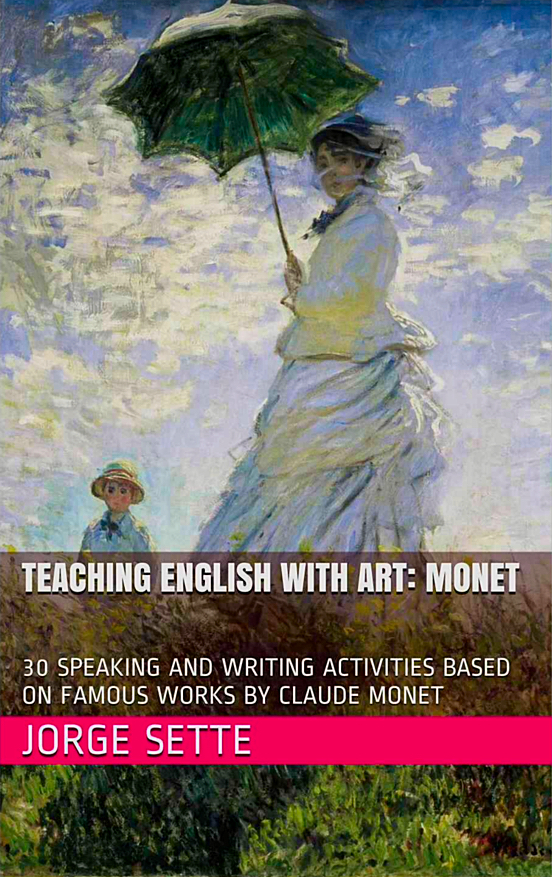
Click on the image to download the eBook.
Teaching English with Art is the series for you! This eBook series is a wonderful supplement to any coursebook or extra materials your students may already be using in the English class. Each volume contains 30 speaking and writing activities for classroom use based on some of the most striking works by famous artists: for now we have MATISSE, PICASSO, CARAVAGGIO, MONET, NORMAN ROCKWELL, WINSLOW HOMER, a special three-in-one volume of MONET + PICASSO + MATISSE (90 activities), and we’ve just launched VAN GOGH.
IMPORTANT NOTE:
PERSONALIZATION: if you wish to change the cover of any of the ebooks, add your school logo, negotiate a special price for a determined number of students, or make other suggestions of customization, do not hesitate to talk to us. We are VERY FLEXIBLE. Make your ebook UNIQUE!
The objective of these eBooks is to expose the students to high art while having them practice English, fulfilling, therefore, one of the tenets of effective language acquisition: providing a realistic context for the language to be learned and practiced as a means to an end. Your students will love to practice their English discussing and doing writing tasks based on the works of these great artists. The activities are highly personalized, so the students can express their own opinions and feelings. This is a proven way to make language acquisition fun and effective by creating in the classroom an atmosphere of interest, motivation and personalization. Each activity is clearly correlated to the COMMON EUROPEAN FRAMEWORK OF REFERENCE (CEFR), and the level is stated next to it. Ideally both you and your students should purchase the material. For heads up activities, project the images on a white wall. Chose your favorite artist and click on the corresponding image below to go to AMAZON.COM and get your e-book:
If you need more instructions on how to purchase the eBooks, please click here: http://wp.me/p4gEKJ-1Cz
Jorge Sette.
Click on the image below to download your book FROM AMAZON.COM
You will never have bored students again.

Teaching English with Art: Picasso
For other eBooks of the series TEACHING ENGLISH WITH ART, please click here:
Check out the video clip on our eBooks below:
Au revoir
Jorge Sette
Pioneered by Pablo Picasso and Georges Braque, Cubism is one of the most revolutionary and seminal art movements of the 20th century. It has its origins in the post-impressionist paintings of Paul Cezanne, and aims at depicting reality in a non-naturalistic way, being considered the seed of the abstract paintings developed later on. Cubism in its more innovative and radical form lasted from 1907 to 1914, when the First World War broke out.
The end of the 19th century and the early decades of the 20th century were marked by great technological innovations that cried for an art form that could express these fast changes and new times. Traditional art, based on realistic works, which had been perfecting the use of perspective since the Renaissance, could not compete with the innovations of photography and film. They would be a mere replication of these more accurate methods of showing reality.

Portrait of Fernande by Picasso, Pablo, 1909
In an attempt to grasp the essence of the times, Picasso started to move towards more simplified depictions of objects and the human form, trying to represent simultaneously the different angles from which they could be seen, not only from a unique perspective. He started to flatten his images, making use of geometric shapes (such as cubes, hence the name of the movement) and deconstructing reality by slashing the image into different planes, producing, thus, an effect which had a more intellectual than sensorial impact on the viewer.
The iconic painting Les Demoiselles d’Avignon is considered the first Cubist work of art. Primitive art, such as African masks and Iberian sculptures, played an influential role in the development of Cubism. This first phase of the movement is usually known as analytic cubism, characterized by the use of dark, almost monochromatic color hues, and growing to a point where the deconstruction of reality became so radical that the viewer could hardly identify the object or person depicted. The second phase, synthetic cubism, was a lot more energetic and colorful, including the technique of collage, where real-life two-dimensional materials, such as colored paper, newspapers or even hair ribbons, were glued to the painting.

Bottle, Guitar, and Pipe by Picasso, Pablo. 1912
It’s hard to pinpoint when Cubism really finished, although we usually place it in the historical period between 1907-1914. It actually did not end, but transformed itself and evolved into other styles in the following decades.
Even today we can identify strong influences of Cubism in architecture, design and, of course, the arts in general.
NOTE: If you teach languages, you might want to check out our series of eBooks TEACHING ENGLISH WITH ENGLISH available from AMAZON.COM: http://wp.me/p4gEKJ-1lS

Teaching English with art
Au revoir
Jorge Sette
 Jorge Sette "Linguagem"