Interviewing Homer Simpson – One of The Most Popular Dads in Pop Culture


For months, I tried to get an exclusive interview with Homer Simpson for Father’s Day. His PR representative kept turning me down but I didn’t give up. Then I had a lucky break. As Lisa, his daughter, was browsing through my blog Linguagem, she came across the article Stephen King’s The Shining: Like Father, Like Son (https://wp.me/p4gEKJ-1IL) and got interested. The PR rep had neglected to inform Mr. Simpson as to where the interview would be published. Lisa convinced her Dad how important it could be for his career to talk to Linguagem. Consequently, Homer immediately granted me an interview. He couldn’t have been more apologetic about his employee’s gaffe. Needless to say, she got fired.

15CE0A9C-6CE3-45A5-A863-E9660ACEF2A2

The next day I flew to Springfield and, after a wonderful dinner with the entire family, I spoke to Homer. Below, you will find a summary of the insightful conversation we had about his life and the importance of fatherhood:

Linguagem: Mr. Simpson, how do you plan to celebrate Father’s Day with your family? Are you going anywhere fancy?

HS: What’s the point of going out? We’re just gonna wind up back here anyway.

Linguagem: I see. How do you feel about life in general?

HS: I’ve learned that life is one crushing defeat after another…

Linguagem: Do you follow any particular philosophy on how to educate your kids? Can you give us an example of how you discipline them when they are out of line?

HS: Now Bart, since you broke Grandpa’s teeth, he gets to break yours.

244D29D3-B0BB-430A-968E-160A9C9E6F2E_4_5005_c

Linguagem: And what about when your boy reach puberty?

HS: …I told my wife how to go about teaching Bart how to become a man: The code of the schoolyard, Marge! The rules that teach a boy to be a man. Let’s see. Don’t tattle. Always make fun of those different from you. Never say anything, unless you’re sure everyone feels exactly the same way you do.

Linguagem: Hmmm. As a Dad, what are your hopes for your children?

HS: I believe that children are our future. Unless we stop them now.

Linguagem: Are you a religious man? Do you thank God for the great life and wonderful family you have?

HS: I’m normally not a praying man, but if you’re up there, please save me, Superman. But I remember saying on one particular occasion: Dear Lord, the gods have been good to me. As an offering, I present these milk and cookies. If you wish me to eat them instead, please give me no sign whatsoever…thy will be done.

7372A5E7-D016-4DAA-B55A-E43D92824867

Linguagem: What would you do if there were some kind of emergency with your kids?

HS: Operator! Give me the number for 911!

Linguagem: What is the best advice you could give to kids who didn’t accomplish what they had wanted to?

HS: Kids, you tried your best and you failed miserably. The lesson is, never try.

Linguagem: Do you consider yourself a good role model for your children?

HS: I think the saddest day of my life was when I realized I could beat my dad at most things, and Bart experienced that at the age of four.

1BCAB971-0E11-4B2A-B354-32B053C1D648

Note: all Homer’s answers are actual quotes from the very successful and funny TV show. Homer may sometimes sound harsh, but he is a loving father and adored by his dedicated wife. Happy Father’s Day to all.

Jorge Sette


Fascinating Facts about Three of Velázquez’s Most Famous Paintings


If you are a fan of the works of Diego Velázquez, considered by many the painter of painters, I’m sure you’ll enjoy the information I gathered for this article:

1. Volcan’s Forge (1630)

FA110550-90D7-4B95-A4AC-CB908DD8022D

This is one of the uncommissioned paintings produced by Velázquez right after his first trip to Italy, where he stayed from 1629 to 1631. The painting shows the moment, narrated in Ovid’s Metamorphoses, when Apollo, the god of light, shows up at Vulcan’s forge, to tell him that his wife, Venus, the goddess of love, is having an affair with Mars, the god of War. Apollo is identified by the crown of laurel on his head and the orange toga he is wearing. Vulcan, the man on his right, looks horrified and even dangerous. He seems to be working on an armor for Mars himself.

Velázquez had become heavily influenced by Italian art during his trip. This is noticeable in this work by the choice of subject matter – mythology – and by the study of the male nude. However, Velázquez, being the great artist that he was, could not help but add a personal touch to the painting: as we can see, although the bodies replicate in their perfection and athleticism the idealization of the Greek-Roman statuary, the men’s faces look common, contemporary and even ugly. The exaggerated expressions of surprise and shock are a characteristic of the Baroque movement, which did not refrain from showing emotion. There is also an almost comic element to the painting, as it does not seem to treat Mythology with the respect it inspired in other painters. Apollo looks rather full of himself, which you can tell from his posture and body language, such as the curved back and the raised finger.

It’s also worth pointing out that the painting suggests a tri-dimensional perspective: the figure in the background, for example, looks blurred, as if we were actually seeing him from a greater distance. Some of the figures in the painting are displayed in front of others, a technique used to create the illusion of depth. In addition to that, the work suggests a combination of genre painting – the representation of the daily work in a regular forge – with the mythological theme. This kind of combination was rather unusual at the time.

Moreover, some critics claim the painting had the objective of enticing prospective patrons: the artist was perhaps trying to show off his draftsmanship, demonstrating how he could depict the male nude in different positions, in a balanced composition.

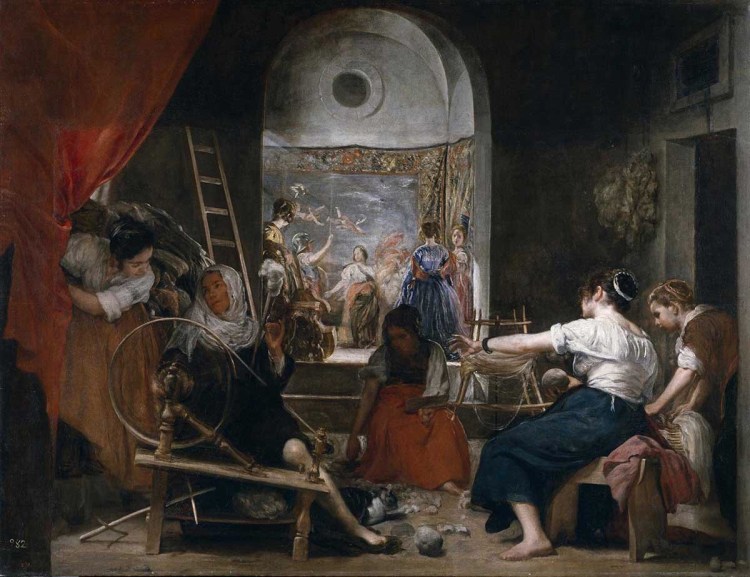
2. The Spinners (Las Hilanderas, 1657)

425796C9-8CD5-40F6-AC63-8B00D3079DCD

Critics understand this painting as the representation of the fable of Arachne, as told by Ovid in the Metamorphoses. In the story, Arachne was a shepherd’s daughter who developed an extraordinary skill as a weaver. When asked who had taught her how to weave so well, she said she had learned it on her own. This insulted Athena, the Greek goddess of wisdom and the crafts, who showed up as an old woman to give Arachne a chance to apologize and acknowledge that her skill could only have come from the goddess. Arachne refused to do so, which made Athena furious. She reverted to her natural form and set up a contest with Arachne to prove who could weave better.

The story unfolds in two stages in Velázquez’s painting. In the foreground, we see the contest itself, as it takes place. Athena would be the older woman on the left. The fact that she is the goddess is betrayed by the youth and the skin glow of her exposed leg. Her ability is demonstrated not only by the relaxed attitude in which she operates the spinning wheel but also by the speed of the instrument, whose stokes we can hardly see.

Arachne, on the other hand, is seen working furiously on the right, with her back to the viewer. Arachne’s skillful work is also indicated by the speed of her performance – notice that her left hand moves so fast it seems to have 6 fingers! They are assisted by three other women in their work.

The conclusion of the story can be seen in the background of the painting. Arachne’s final work – represented here by a copy of Titian’s The Abduction of Europe – beats Athena’s. Athena, the woman wearing a helmet in the painting, is so angry that she rips Arachne’s work to threads. The goddess is seen here at the moment when she is casting the curse that will turn Arachne into a spider, so she will spend the rest of her life spinning webs. The obvious lesson is humans must not compete with the gods.

Just like in the previous painting we analyzed, Velázquez’s work in Las Hilanderas is a clever combination of genre and mythological themes. The women in the foreground look just like her contemporaries at a weaving workshop. It’s in the background that we have a more explicit reference to the myth, marked both by the presence of Athena is his Greek clothes and by the replication of the mythological work of Titian.

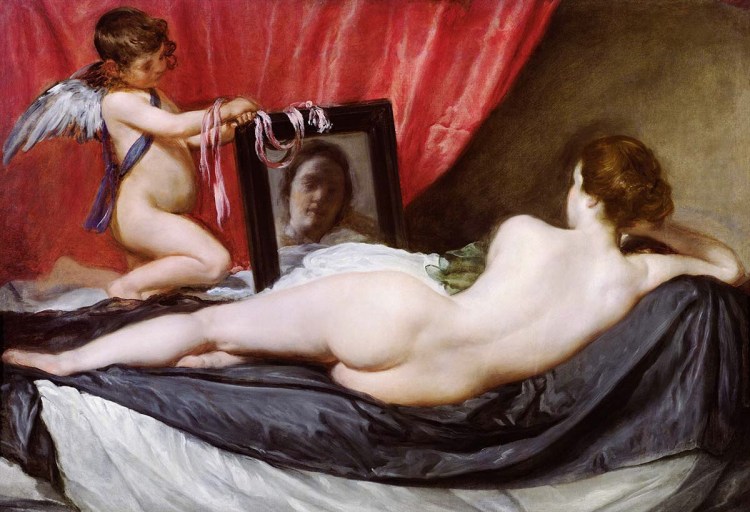
3. The Toilet of Venus (The Rokeby Venus, 1647-1651)

429E0754-931F-4E26-BE9F-7C1C11E582D6

This is the only nude study of a woman painted by Velázquez to reach our days. He seems to have painted three, but two of them are lost. This kind of risqué painting was the object of careful surveillance by the Catholic Church during those harsh times of the Spanish Inquisition. Artists who dared to break the rule faced the threat of excommunication.

This painting, which is sometimes called The Rokeby Venus due to the fact that it was in the Morrit Collection at Rokeby Park, shows the goddess who personifies love and beauty lying with the back to the viewer and looking into a mirror held by her son, the god Cupid. The blurred image in the mirror is explained by the fact that ideal beauty cannot be represented.

However, contrary the trend of the times, Venus looks slimmer than the more voluptuous women usually depicted by other painters. She is also a brunette, while most other representations of Venus show her as a blond. These details all seem to indicate a wish to depict just a beautiful Spanish woman of Velázquez’s own days. Besides, the painting does not show any of the other items that characterize the goddess in other paintings, such as myrtle, roses and jewelry. Except for the presence of the winged Cupid holding the mirror, nothing indicates she is the goddess.

It’s interesting to notice how her curvaceous body is echoed by the rounded belly of Cupid and by the folds of the drapery and bed sheets.

Just like in Velázquez’s most famous painting, Las Meninas, which we discussed in a previous blog post (please click here for the post: https://jorgesette.com/2020/03/14/las-meninas-by-velazquez-under-the-magnifying-glass/), the presence of the mirror, and the fact the goddess seems to be looking at us through it, incorporates an element of mystery to the painting. It seems to stimulate a conversation between the work and the viewer, generating a discussion about the dichotomy between art and reality, representation and fact.

This brings us to the end of our blog post. It’s fascinating to discover the facts, the legends and the stories behind famous works of art. If you have further info, opinions or questions about the paintings discussed above, please don’t hesitate to enter your comments in the box below. We would love to share your perspective with our readers.

Jorge Sette


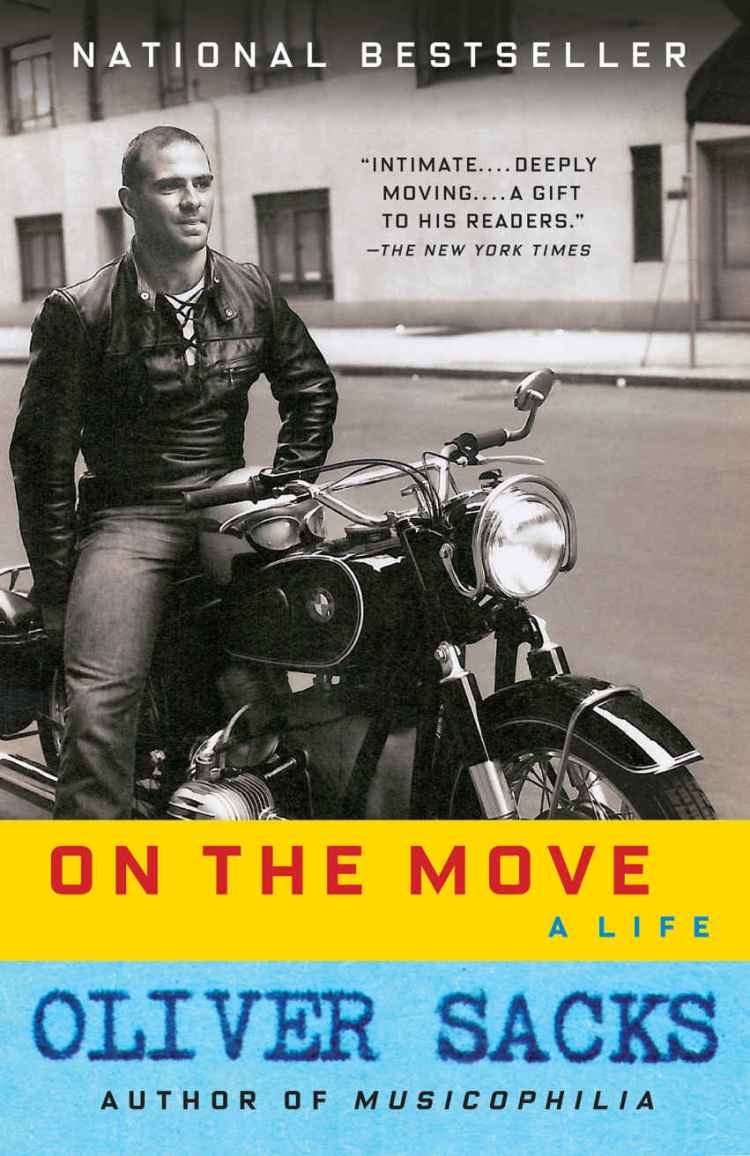
Oliver Sacks – A Review of His Autobiography, On the Move: A Life


Neurologist, researcher, clinician, but especially a great storyteller, Oliver Sacks has millions of fans around the world. His books, which are essentially collections of case studies from his experience looking after patients with brain disorders, can be said to have established a new literary genre.

To me, the appeal of reading Oliver Sacks’ autobiography, On the Move: A Life, was to catch a glimpse of the real man behind the public figure and to learn more about the amazing neurological cases and concepts I’d read about in some of his previous books.

9191BAEE-ABD0-458E-B70D-7223E0731C9A

The autobiography tells us about aspects of his private life that didn’t make their way into his clinical stories. We learn, for example, about his rebel side as a lone motorcycle rider in the 50s and 60s, and about his love of strenuous – and sometimes foolhardy – physical activities, such as extreme weightlifting, swimming in dangerous waters and hiking alone. We also find out about his Jewish family background, his evacuation to a boarding school run by a sadistic headmaster during the second world war, his homosexuality, solitude and 35-year celibacy, and his drug addiction during the 1960s (although he was considered only a weekend “tripper,” having to cope with a challenging job during the week).

What struck me particularly was Sacks’ peripatetic nature, made explicit in the title of the book. It seems he was trying to escape from something, perhaps from himself, due to the fact that he was different – like his patients – but also from his family and the burden of growing up with a schizophrenic older brother. However, being constantly on the move may have been a consequence not only of the restlessness of his soul but also of the strong mental and physical energy he exuded until very late in life.

32C5160E-B0F3-4650-8065-EC850B981CF5

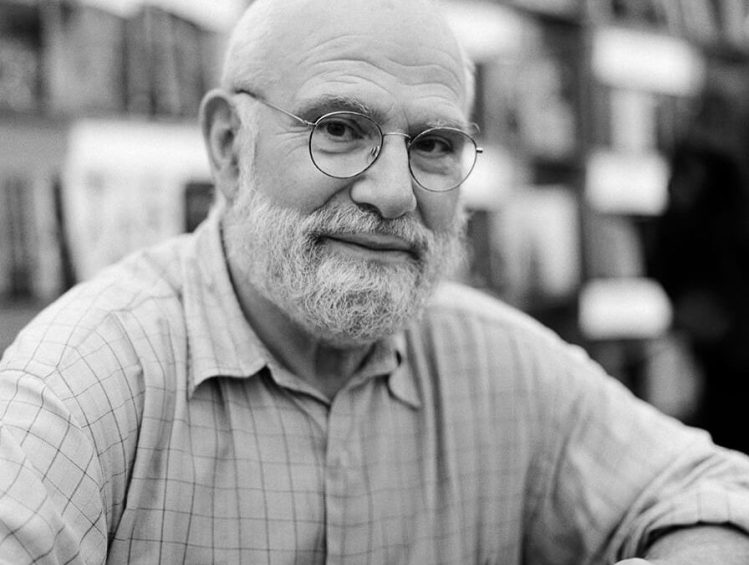
Oliver Sacks

What mainly resonated with me was his account of his obsession with writing. Sacks kept journals, taking notes of his experiences, registering his observations, thoughts and feelings. He always had a notebook on hand, even when he went swimming – which, he claimed, stimulated his mind – and he would sometimes dash out of the water to scribble his thoughts down on the pad lying nearby. He may never use those notes when he was writing his books later on, but putting his thoughts down on paper was a powerful way of clarifying his ideas and reflecting on intriguing points; it was like carrying out a conversation with himself.

Laypeople cannot judge how good a doctor Oliver Sacks was. His track record as a researcher and even as a clinician has been disputed a number of times. Also, his decision to base his stories on the cases of real patients caused controversy, as some people claimed it was unethical. His first book, Migraine, was aimed only at the medical community, but it inevitably appealed to a wider public and generated popular interest. He then gave up trying to make his accounts mere reports on medical facts and purposely imbued his stories with themes, metaphors, and humanistic and philosophical considerations, which took his writing to a whole new level.

Sacks’ case studies never give the reader the impression he’s taking advantage of his patients or exploiting them for commercial purposes. He doesn’t come across as someone who’s treating human misery as a circus show. He genuinely seems to care, and his stories, despite the unthinkable suffering of many of the people involved, are mostly uplifting. He reinforces our belief in the power of humans to come to terms with tragedy and even to overcome it.

Following the publication of Awakenings and A Leg to Stand On, Sacks gained notoriety, but it was the publication of The Man Who Mistook His Wife for a Hat in 1985 that turned him into a public figure and a celebrity recognized worldwide.

One of the most interesting passages in On the Move covers the time Sacks worked as a consultant for the movie Awakenings, based on his book. Although Sacks hadn’t loved the script, which contained some fictitious subplots he wasn’t comfortable with, he decided at one point that the movie was not his, and, therefore, not his responsibility. This realization liberated him, allowing him to adopt a more relaxed attitude and to accept his role in the project.

491FFC43-EF05-4AAC-A2C8-9586BCBD5FA9

Robin Williams and Robert De Niro in Awakenings

In his autobiography, Sacks praises actor Robert De Niro’s extensive and detailed research to play the postencephalitic Leonard L., stating that De Niro would sometimes stay in character for hours or even days after filming. Sacks also comments on how weird it felt to be mirrored by Robin Williams on the many days they spent together as the actor researched the model behind the character he would portray –  based on Sacks himself. I watched the movie again to write this post and found it a bit dated, lacking a drier, less sentimental approach to the subject. It could have benefited from a wittier and more creative script, since it wasn’t supposed to be a faithful replication of real life. I wonder how much better it might turn out if it was remade today, especially as an HBO production. I loved Robin William’s performance – subtle, subdued and contained. As for Robert De Niro’s, I’m afraid he didn’t convince me in the role of a postencephalitic patient.

In summary, reading On the Move: A Life was as fascinating an experience as reading Sacks’ previous books. His language and fluency are remarkable. He writes through examples; he doesn’t explain or define concepts in technical ways. That’s what makes it easy for us to appreciate his stories.

Reading Sacks’ books, I learned a lot about curious brain conditions I never suspected existed. I became familiar with a wealth of new words and concepts: aphasia, amusia, musicophilia, synesthesia, visual cortex, auditory cortex, Tourette’s syndrome and prosopagnosia, to name just a few. In his wonderful book Seeing Voices: A Journey into the World of the Deaf, he made me understand that sign language is just another mode of language, not unlike verbal language in its sophistication and capacity to express all kinds of concepts, both abstract and concrete, through perfectly structured grammar. These kinds of enthralling revelations are the stuff his books are made of. You simply can’t put them down once you get started. On the Move: A Life is equally irresistible.

Sacks found out he had melanoma in his right eye in 2005. When it metastasized to his brain and liver in January 2015, he knew his death was imminent, but he seemed to have already come to terms with it. When he publicly announced his predicament, he added: “I want and hope in the time that remains to deepen my friendships, to say farewell to those I love, to write more, to travel if I have the strength, to achieve new levels of understanding and insight.” On the Move: A Life gave me a sense of a life well lived, packed with adventures, experiences, profound learning and fulfillment. Oliver Sacks died on August 30, 2015.

Jorge Sette

5 Booker Prize Winners that will Rock your World


The Booker Prize or The Man Booker Prize for Fiction – initially called the Booker-McConnell Prize, due to the company which sponsored it – is an English literary prize created in 1968. It is awarded to the best novel of the year. At first, only Commonwealth, Irish, and Zimbabwean writers were eligible, but as of 2013, the eligibility was extended to any novel written in English and published in the UK. Being awarded, or even shortlisted for it, is a great honor, as the prize warrants success and fame for every writer who’s associated with it.

0370F7A4-E9C4-4DBB-BDFE-DECD608E0582


As a voracious reader, I can assure you that, whenever you finish a novel and are left with that familiar void, yearning for another great book to come your way, taking a look at the Booker Prize list of winners or shortlisted books is a great way to begin your search. You will hardly be disappointed.

The list below is my personal choice of great Booker Prize Winners. I’m sure they will stay with you long after you finished reading them, as the language is stunning and the plots are both original and gripping. The books below are listed according to the year they received the prize:

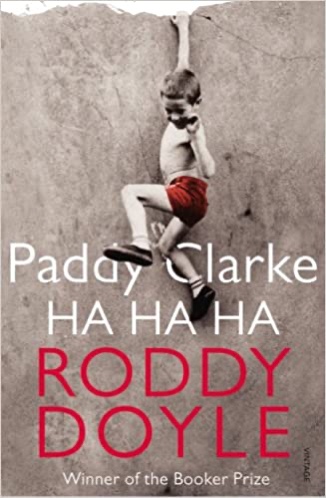
  1. Paddy Clark Ha Ha Ha by Roddy Doyle (winner of the 1993 Booker Prize)

Funny, moving and poignant, this novel is told from the perspective of a 10-year-old Irish boy growing up in the 1960s. As he narrates his experiences – using the logic and language of childhood – we get to know his discoveries, games and adventures with his little brother, the relationship between his parents and the daily routine of his family. Despite the cheerful tone of the book, at some point, readers begin to suspect they are being misled by the unreliable narrative of a child: not everything is going well at home, the truth is his parents are drifting apart and about to break up.

02ABD8EB-5C9A-4D14-9F13-D3ECCA4D753E_4_5005_c

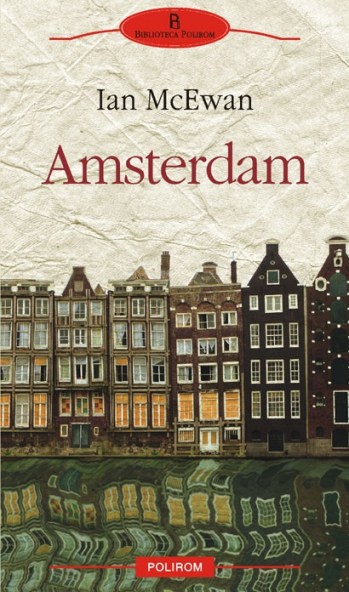
  1. Amsterdam by Ian McEwan (winner of the 1998 Booker Prize)

Three former lovers cross paths at the cremation of their common mistress, Molly Lane, without realizing that the meeting will be a turning point in their lives. Their careers and personal lives will be cleverly manipulated by the woman’s jealous and resentful widower, George, who will set them on a collision course with one another, crafting a spiderweb of blackmails, mutual blames and lies, tabloid stories, debauched cross-dressing photographs, sinister euthanasia doctors and, ultimately, violence and tragedy. Clive Linley, one of the lovers, is a musician who, after attending the cremation, embarks on a depressive behavior, worried that he may get sick and die as young and unexpectedly as Molly. As a consequence, he is having a mental block, which prevents him from finishing up the Millennium symphony he was assigned to compose. Fame and recognition are at stake here and he is frantic (the language used by the author to describe the composer’s creative process and its drawbacks is already a good reason to make you love the book); Molly’s second lover, Vernon Halliday, is a mediocre editor of a serious and conventional newspaper whose circulation and readership are going seriously down. He is suddenly given the chance to resort to dirty and cheap tabloid tactics to try to reverse the process, publishing intimate photographs which are likely to destroy the family life and career plans of the third lover, Julian Garmony, a foreign secretary with aspirations of becoming prime minister.

D0DD3A38-1BB2-4A1A-B890-E64F5B575E87

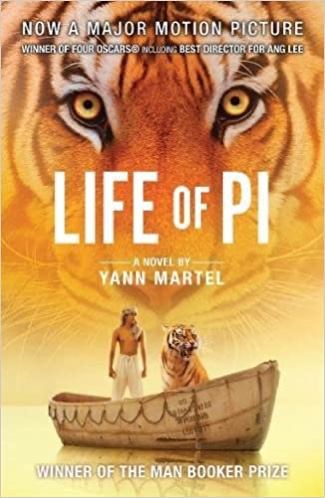
  1. Life of Pi by Yann Martel (winner of the 2002 Booker Prize)

A hymn to religious tolerance, a celebration of life in all its forms, and the recognition of the power of storytelling make Life of Pi an unforgettable novel. The story contrasts myth and reason, religion and science, asking the reader to compare the effectiveness of simply narrating the factual sequence of events of a journey with the alternative of fictionalizing it through the use of allegories. Which version would you choose as the more insightful and helpful way to understand the world? A Canadian writer in search of ideas for his new book is promised the opportunity to hear a story that will make him believe in God. With this aim, he agrees to meet and listen to the life story of an Indian man who spent 227 days adrift in the Pacific Ocean, sharing a lifeboat with none other than a Bengal tiger, after the shipwreck of the Japanese cargo ship which would take his family to Canada. Brutal, scatological, philosophic, funny and poetic, Life of Pi saddens, cheers and inspires the reader, who will certainly come out of the experience loving tales and metaphors even more than when he started the book.

D108C970-DBD2-43C4-A62B-B4A810470BF7_4_5005_c

  1. Wolf Hall by Hilary Mantel (winner of the 2009 Booker Prize)

The first part of this trilogy tells the known story of the marriage of Henry Tudor and Anne Boleyn and all the political, religious and social upheavals involved in making it happen. The novelty is the choice of perspective chosen by the author, who decides to focus the novel on a lesser historical character, whose life details are not very well-known: Thomas Cromwell. Choosing Cromwell – who rises from being the son of a Putney blacksmith to Master Secretary of the kingdom, due to his intelligence and cunning – as the protagonist of the story allows the author to fill in the blanks of history books with her fertile imagination, transporting and placing the reader smack in the middle the exciting events that happened more than 500 years ago.

A21F84FD-CFA8-4B15-9EC7-F13900DF9E9D_4_5005_c

  1. Bring up the Bodies by Hilary Mantel (winner of the 2012 Booker Prize)

This is the second volume of the Cromwell trilogy, and, in my opinion, better written and even more exciting than the first – to me, it sounds like the author finally found the best way to tell the story. Despite all the efforts and machinations of the court to bring Anne Boleyn and Henry Tudor together, causing England to sever links with the Catholic Church, and antagonizing its powerful neighbors in Europe by appointing Henry VIII the head of the Church of England, the queen fails to deliver a male heir and will have to be ousted. Craftily paving the way to Henry’s new marriage to Jane Seymore, Cromwell will become Anne’s main nemesis, ruthlessly plotting the annulment of her marriage and driving her to a thunderous fall, which will bring many others down with her. Terrific reading.

8F6B6A9D-735E-4E32-97EC-FF679A8EAF24_4_5005_c

Have you read any of these books? Share your comments with us. Also, watch this space for further suggestions on the wonderful books out there you may not have heard about.

Au revoir

Jorge Sette

Jorge Amado’s Novels: Marxism, Humor and the Beauty of the African-Brazilian Culture


Jorge Amado (August 10, 2012 – August 6, 2001) was a very prolific Brazilian author, having written more than 30 novels, translated into some 49 languages. Most of his stories are set in the state of Bahia, the region where he was born. His works highlight the brutal economic inequality of the society and the richness of his state’s Afro-Brazilian culture: the empowering traits of the religious cult of Candomblé, the beauty and creativity of its mestizo people, the spicy flavors of the delicious local cuisine, and the rhythms of its music and local dance/martial art (capoeira).

IMG_1233

Salvador, the capital of Bahia, the state Jorge Amado was born in. Photo: April, 2019. Jorge Sette.

Through Amado’s characters, we get to hear the voice of the lower classes, the poor, the fallen and the discriminated against. We also hear the voices of the strong women of Brazil. Despite the fact that his early books were derogatorily characterized as sentimental Marxism, Jorge Amado matured as a writer, as of the late 1950s. With the publication of Gabriela, Clove and Cinammon (1958), his novels became a lot more sophisticated, funny and authentic. Satire became a strong element of his style. The main themes of Jorge Amado’s books, however, remained the same: the lives of the poor people of Bahia, their traditions, the religious syncretism between Catholicism and the African cults, the prejudice and discrimination against the mixed-raced (mestizo) people of Brazil (which, ironically, comprises most of the population!) and open criticism of the hypocritical moral values of the Brazilian upper and middle classes.

Jorge Amado was a member of the Brazilian Academy of Letters from 1961 until his death in 2001. Here’s a list of his most popular works.

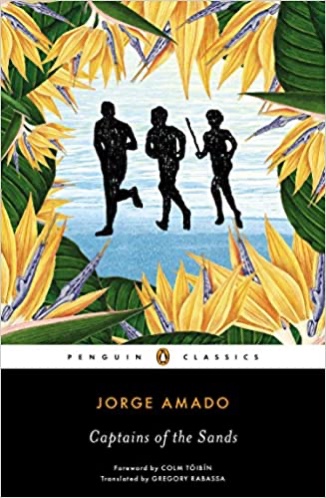
1.  Captains of the Sands (Capitães da Areia, 1937)
6EFE2FA8-3D2D-4AAA-A227-C1C98FEA18C2_4_5005_c

Captains of the Sands, a rather romanticized account of the lives of a gang of abandoned street kids in the city of Salvador (called the city of Bahia in the book), whose crimes terrorize the local population, may sound a bit tame by today’s standards. After all, the level of real juvenile violence experienced in the big cities of Brazil (exposed in books such as City of God by Paulo Lins, for example) surpass by far what we read in this novel, which takes place in the 1930s.

However, the reader can still be moved and relate to the thesis of how the social-economic context deprives these kids of their innocence and childhood and is ultimately responsible for their corruption and lack of choice. Reminiscent of Charles Dickens and Mark Twain, the book focuses on the adventures of the leader of the gang, Pedro Bala (bullet), and five of his closest allies, living off theft and petty crimes, and sleeping in a shack by the sea. We follow their early years as members of the feared gang of the Captains of the Sands and the different paths taken by each of them as they grow older and leave.

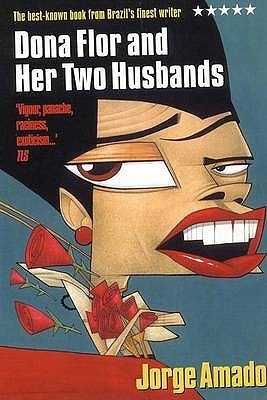
2. Dona Flor and Her Two Husbands (Dona Flor e Seus Dois Maridos, 1966)
FB71F3CD-6CD7-4091-A504-B58F9521AB07_4_5005_c


It’s surely inconceivable for most Latin American males to accept that it may take more than one man – at one given time – to completely satisfy the many facets of a woman’s life. In this widely successful novel (turned into a hugely popular movie in the 1970s), Jorge Amado adopts a very liberal and perhaps feminist point of view in this respect.

Flor, an adorable young woman in the Bahia of the 1920s, is an expert in the local cuisine. Her recipes are so popular that she decides to open a cooking school for girls. Soon afterwards, she meets and falls in love with the irresistible Vadinho, a typical “malandro” (a bohemian ruffian), an incorrigible rogue who spends most nights gambling and drinking in the company of prostitutes. The marriage takes place against her family’s wishes, as the whole conservative society of the time seems to foresee that it’s doomed. The couple is perfectly matched sexually, though. Vadinho fulfills Flor’s every fantasy and surpasses all her expectations in the bedroom. When he suddenly dies, celebrating Carnival, Flor is left inconsolable.

After a year of mourning, the widow finally marries the local pharmacist, a very decent man called Dr. Teodoro, who has nothing of the passion for life that Vadinho did. Teodoro stands for respectability, tender love, a reliable routine and financial safety. For a while, Flor seems happy and grateful for the arrangement, but it does not take long for her typical ardor to flourish again; she deeply misses Vadinho’s passionate lovemaking. After a couple of months living in this torture, her desire for Vadinho becomes so strong, that it brings him back from the dead. Only Flor can see him, when he appears, always naked, at the most unexpected times. He is invisible to everyone else. What will Flor do about this?

3. The War of the Saints (O Sumiço da Santa, 1988)

22235CA3-A806-4A8C-BAFC-CE538AE58A7B_4_5005_c


The holy icon of Saint Barbara (or Yansan, the goddess of thunder and lightning, as she is known in the Afro-Brazilian religion of Candomblé) is taken by boat from her original site, at the Church of Santo Amaro, to be part of a religious art exhibition in Salvador. When the boat docks, the saint miraculously comes to life, smiles, and winks at her fellow passengers and simply walks off through the market quay, raising Cain in the city of Salvador. Her mission is to liberate the young and beautiful Manela from the repressive grip of her aunt and guardian Adalgisa.

The plot, however, is only a pretext for the author to take the reader on an unforgettable and hilarious 48-hour tour of the city of Bahia during the oppressive years of the military dictatorship, introducing us to a series of colorful characters, savory foods and sensual religious rites. Mixing fact and fiction, where references to real musicians, singers, artists and political figures of the time abound, the narrator makes hilarious digressions, discussing, among other things, the nature of his narrative and making self-deprecating comments about his writing in a delicious conversation with the reader. This is undoubtedly one of the most accomplished and subversive books ever written by the author.

4. The Two Deaths of Quincas Wateryell  (A Morte e a Morte de Quincas Berro D’Água, 1959)

24EF29BB-E4A6-4AC3-B2E5-81E7FA5C49DD_4_5005_c


This novella tells the strange and hilarious story of a man who, getting fed up with the tyranny of a bossy and nagging wife and the pettiness of the codes of respectability of the lower bourgeoisie, suddenly decides to say goodbye to all that and start a new life as a drunk vagrant in the streets of Bahia. He leaves his family and dedicates himself to the most unthinkable hedonism: getting drunk every night, having sex with prostitutes and becoming the king of the bohemians of Bahia. He craves total freedom, has a legion of loyal followers and admirers, pledging that his tomb will be the endless sea.

When he suddenly dies, however, and faces the danger of having his corpse go through a respectable and catholic wake and burial, four of his closest friends show up to pay his respects and – in a sequence of scenes filled with humor and poetry – steal the corpse (or the living-dead man – as the reader is never quite sure how dead he really is) to take him for a last night of celebration in the city, before his second and final death.

On a deeper level, the story investigates the creation of popular myths and the distortion of reality prompted by the ingrained custom of gossiping, so typical of Brazil and Bahia, in particular.

Have you ever read any of Jorge Amado’s novels? How do you like his books? Please leave a comment below.

Au revoir

Jorge Sette.


Las Meninas by Velázquez – under the magnifying glass


One of the most controversial paintings in Western Art History is Velázquez’s intriguing The Maids of Honor (Las Meninas). Painted in 1656, it’s considered the Sevillian artist’s masterpiece. Critics and specialists have been debating how best to interpret this work for centuries, and of course, no analysis is conclusive.

5E6049CA-98C5-4A51-A6F2-4B80677E1F38

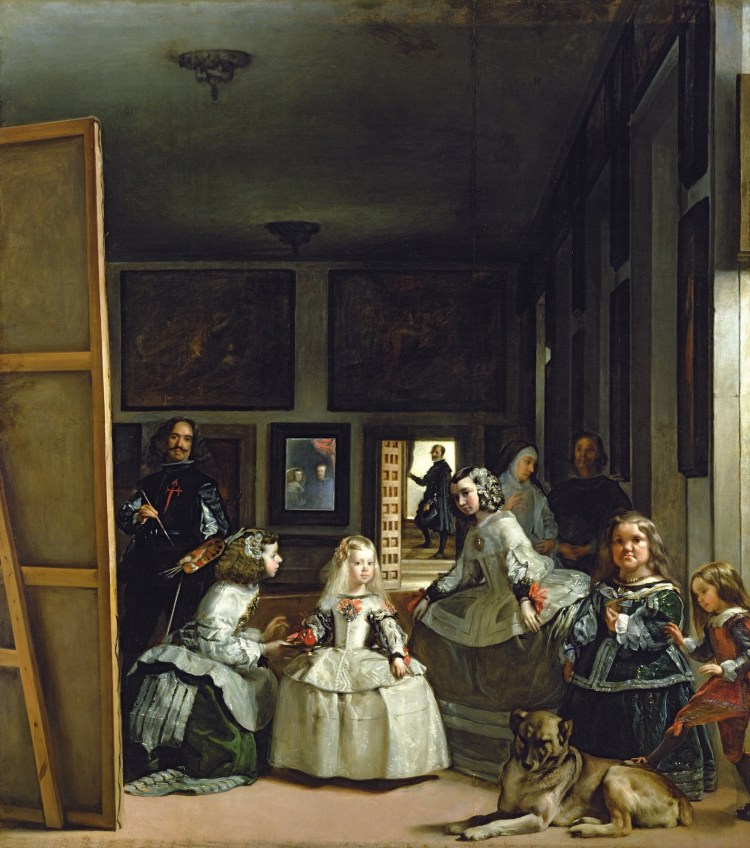
Las Meninas  (The Maids of Honor) by Velázquez, Diego.

The first question seems to be what Velázquez, who’s depicted on the left of the scene, in front of a huge canvas, is painting on it. Is he working on the very painting we see? This seems to be suggested by the palette in his left hand, whose blurred and mixed colors appear to replicate the image in front of us. However, how and why would he include himself in it?

Others, on the other hand, point out that there’s a mirror in the center background, reflecting the images of the king and queen of Spain at the time, Phillip IV and his second wife, Mariana de Austria, who would occupy the same position as the viewer as we look at the painting. This would explain why everyone seems to be gazing outward from the picture. They are actually staring at the royal couple, who would be the subject of Velazquez’s canvas within the painting. Complicated? Wait, it gets even more complex.

A third theory says that Velázquez is painting in front of a mirror (the clue is the way the parting of the hair of the Infanta Margarita, the blond girl in the center foreground, is reversed from what it would look like in reality). This would explain how the artist managed to include himself in the painting. This would also mean that everything we see is also flipped.

More interesting facts about the picture:

The central figure of the scene is the Princess or Infanta Margarita, who was about 5 years old at the time. Who are the other ten people represented in the painting? We can identify all of them historically, except for one. Flanking the Infanta, who’s at the center of the painting, we see the maids of honor. To the right of the Infanta, bowing – possibly due to the arrival of the king and the queen – we see Isabel de Velasco, and to the left, kneeling, as she offers the princess a glass of water or some kind of grease for the princess to dip her fingers in, as she seemed to have had some kind of disease, we have Doña Maria Augustina Sarmiento. On the right, we see the dwarfs Maria Barbola and Nicolas Pertusato, who is playing with the dog. The job of the dwarfs was to entertain the court members.

Behind the dwarfs, obscured by the lack of lighting, we notice Doña Marcela de Ulloa, the princess’s chaperone, and next to her, the only unrecognized figure in the painting, possibly a bodyguard. At the back, going up the stairs and opening the door, the queen’s chamberlain, José Nieto Velázquez, can be identified. The other three people are Velázquez himself and the reflections of the king and the queen in the mirror.

Another question is what kind of painting is this? It does not seem to be a portrait of Princess Margarita, due to its informality. Velázquez was a great portraitist and we have plenty of examples of what a portrait of the higher members of the court of Philip IV should look like: formal, pompous, rigid, authoritarian, exuding power. This depiction of Princess Margarida is nothing like that, resembling more a genre painting, like the bodegones (kitchen and tavern paintings Velázquez produced at the beginning of his career): this could be a snapshot of a regular day in the painter’s studio, known as “el cuarto del prince”.

Ultimately, Las Meninas could be a very personal statement of the artist about his own social status. A self-promoting artwork, to show his intimacy with the higher members of the court. The red cross painted on the left of his chest, which represents the Order of Santiago, seems to indicate this, although some critics guarantee this cross was painted only after the death of the artist, as a way of honoring him for his work under the king.

Now, all this complexity only adds to the attraction of this unique work of art, which not only shows masterful draftsmanship and use of color (the brushstrokes that make up the dresses of the ladies and their decorations seem to anticipate the Impressionist movement in some 250 years), but also to establish the concept of the painter as an intellectual.

If you ever go to Madrid, don’t even think of skipping a visit to The Prado, the museum in which this artwork hangs in all its majesty.

Jorge Sette

Six of Batman’s Most Dangerous Enemies


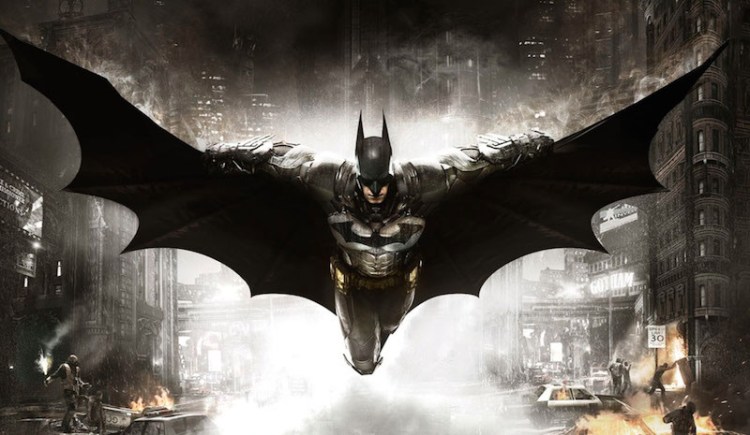
Batman, The Dark Knight, is one of the most iconic graphic novel characters of all time. Created by artist Bob Kane and writer Bill finger in 1939, Batman’s secret identity is Bruce Wayne, an American billionaire whose parents were murdered when he was only a boy. As a consequence, Bruce Wayne swore revenge on all the criminals of the corrupt-ridden Gotham, the fictitious city he lives in.

14298522208_42235e75c3_b-1

This world-famous DC Comics’s superhero has had his adventures turned into a popular TV show in the 1960s and numerous successful movies ever since. Bats, as he’s oftentimes called by some of his friends and foes, is up against a huge gallery of rogues – most of them mentally-disturbed individuals who develop idiosyncratic theme-related personas with corresponding crime styles.

We have selected six of Batman’s most dangerous enemies to discuss in this post. We cover their main personality traits, objectives and modus operandi, highlighting a couple of prominent quotes and naming famous actors who have portrayed them in movies or television.

Joker: one of the Cape Crusader’s scariest villains. A sadistic clown, with a disturbing grin, Joker was responsible for the murder of Jason Todd, Batman’s sidekick Robin, and for crippling Barbara Gordon, Batgirl, who became a paraplegic. In the movies, Joker has been played by great actors such as Heath Ledger, Jack Nicholson and Cesar Romero. Joaquin Phoenix, in the movie Joker, has given one of the most original and dazzling performances of the villain. One of Joker’s quotes: “In my dream, the world had suffered a terrible disaster. A black haze shut out the sun, and the darkness was alive with the moans and screams of wounded people. Suddenly, a small light glowed. A candle flickered into life, symbol of hope for millions. A single tiny candle, shining in the ugly dark. I laughed and blew it out.”

15995631702_f2e7d2c65c_b

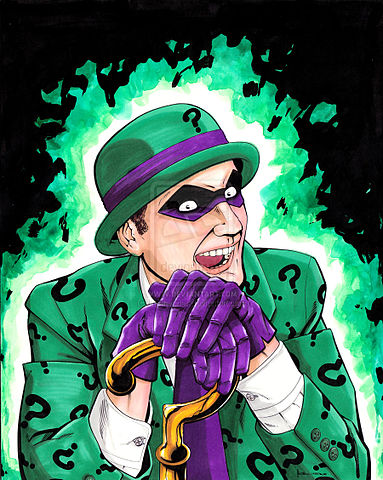
The Riddler: Edward Nigma wants, more than anything else, to prove his intellectual superiority over Batman. He challenges the Bat by throwing in riddles, puzzles and word games as clues to the crimes he’s either planning or is already executing. The Riddler has been played on the big screen by Jim Carrey (Batman Forever, 1995). Two of his riddles:

Q: What is the beginning of eternity, the end of time and space, the beginning of every end and the end of every race?

A: The letter ‘E’

Q: What belongs to you, but is used by others?

A: Your name

the_riddler-1

Two-Face: Harvey Dent was a close friend of Bruce Wayne’s and a former district attorney, defending Gotham City against its criminals. His life changed radically after being assaulted by Gotham City’s infamous mobster Sal Maroni, who cast acid into Dent’s face, disfiguring half of it. The incident heavily affected Harvey Dent’s mental health, causing him to develop an obsession with duality and the number two. Of course, this makes for a very interesting and sophisticated character, always torn between good and evil. Two-Face has the habit of flipping a one-dollar coin, with one of its sides suitably defaced, to make decisions about the conclusion of his crimes: eg. to kill a victim or not. Actor Aaron Eckhart offered a very convincing rendition of the rogue in the 2008 movie The Dark Knight. A quote by this fascinating villain: You have broken into our hideout. You have violated the sanctity of our lair. For this we should crush your bones into POWDER. However, you do pose a very interesting proposition: therefore, heads, we accept, and tails, we blow your damned head off!

harvey_dent_two_face_by_gingerleonie-d4xkpej

Poison-Ivy: Pamela Isley, a student of advanced botanical biochemistry, is an eco-terrorist. Her aim is to protect plants at all costs. She won’t hesitate to kill humans to protect nature, using all her knowledge of poisons and toxins to achieve her goals. Pamela has a love/hate relationship with Batman. Actress Uma Thurman portrayed the hot red-head in the 1997 movie Batman and Robin. A couple of quotes by the villain:

  1. So many people to kill… so little time.
  1. It took God seven days to create paradise. Let’s see if I can do better.

NIKON D700, AF VR Zoom 70-200mm f/2.8G IF-ED f/9, 1/200, ISO , 185mm

Catwoman: Selina Kyle is a lover of felines and their protector. She is sometimes portrayed as a burglar and jewel thief. In most stories, however, she is more of an antihero than a typical villain, as her love/hate relationship with Batman tends to blur the lines. Actress Michele Pfeiffer infused the role of Catwoman with a powerful dose of sensuality in the movie Batman Returns (1992). Julie Newmar (below) played the most popular and beloved Catwoman in seasons 1 and 2 of the 1960s TV show. A quote: Meow!

catwoman_lee_meriwether_1966

The Penguin: Oswald Cobblepot uses his nightclub, the Iceberg Lounge, as a front for his criminal activities. His ultimate goal is financial gain, as it suits a businessman. Always smartly dressed in a tuxedo and top hat, the Penguin makes use of his collection of umbrellas as deadly weapons. The character has been unforgettably portrayed by actor Burgess Meredith (below) in the iconic TV series of the 1960s. One of the man-bird’s quote: [to Catwoman] You’re Beauty and the Beast in one luscious Christmas gift pack.

burgess_meredith_penguin_batman_1967

In the comments section below, please share with us your thoughts on Batman and his rogue gallery.

By Jorge Sette

10 Cool Questions about Peter Carey’s Oscar and Lucinda – A great love story (for your book club)


Oscar and Lucinda is one of those books that grow in the reader’s mind over time. The unforgettable and powerfully written novel by Peter Carey, winner of the 1988 Man Booker Prize, tells the improbable love story between a religiously obsessed English young man and a compulsive Australian heiress.

c7bfa1c130de93e81d6d2be25a84aeee

Oscar has a gambling problem. He loves horse races. Lucinda, on the other hand, adores glassworks and cannot resist a game of cards.

Lucinda purchases the oldest Glass Factory in Sydney. The story takes place in the 19th century and culminates with the couple’s joining forces on the biggest (and strangest) bet of their lives: gambling on the transportation of a glass church across the Outback from Sydney to the remote Bellingen, 400 km up the coast of New South Wales. This is certainly one of the most outlandish and beautiful literary visions I’ve come across as a reader in a long, long time.

In 1997, the novel was made into an acclaimed movie directed by Gillian Armstrong, starring Cate Blanchett and Ralph Fiennes.


Cate_Blanchett_Cannes_2015-1

Cate Blanchett – who plays Lucinda in the movie version.


The questions below are fairly open-ended. They are intended to be incorporated into the list of others you are possibly already using during your book club’s sessions. It helps to have a mediator to conduct the discussions. There are no absolute right or wrong answers, so I would recommend the members of the group be flexible, welcoming and respectful of other people’s opinions and interpretations. Enjoy:

1. Where did Oscar live as a child (country, region, city)? Where did Lucinda live as a child (country, region, city)?

2. Why did Oscar start moving away from his father’s religion to become an Anglican?

3. What did Oscar do for a living? What about Lucinda?

4. Where/When did Oscar and Lucinda first meet? And what was Oscar’s greatest fear at that point?

5. What feelings developed when they decided to play cards for the first time, and how did the storm change the situation?

6. How did Oscar morally reconcile religion and gambling?

7. How does a Glassworks or glass factory reflect Lucinda’s own personality?

8. Would you consider Lucinda a feminist ahead of her time? Give us three examples of her behavior in the story that would justify this idea.

9. What is the passage (or passages) in the novel that will probably linger in the readers’ minds after they’ve finished it?

10. If you were Peter Carey, the author, list three things you would have changed about the novel before it was published. Your answer can be about the characters, the plot, the location, the times or the ending.

Choose a couple of the questions above and answer them in writing in the comments space below, if you wish.

Au revoir

Jorge Sette.


Velázquez – The Iconic Painter of the Spanish Baroque


Considered the painter’s painter, Diego Rodríguez de Silva y Velázquez was born in Seville in 1599, growing up in the old Jewish quarter of that booming city.

Velázquez was an apprentice to Sevillian artist Francisco Pacheco for 5 years. However, it did not take long for the pupil to surpass the master in technique, which did not bother Pacheco at all. He was very proud of the young artist, who would later become his son-in-law. At the age of 19, Velázquez married Pacheco’s daughter, Juana, and had two daughters by her.

XIR221119

Velázquez

In 1623, he was invited to go to Madrid to paint the portrait of King Philip IV. The king liked the painting so much he commanded Velázquez to became his personal painter. From then on, only Velázquez was allowed to paint the king, and all his other portraits were taken out of circulation. Later on, Velázquez rose in the court to also become the king’s curator (being the person in charge of choosing and purchasing the furniture and paintings that would decorate the king’s palaces). Velázquez served the king for over 40 years, while Philip IV was the most powerful man on Earth.

At the beginning of his career, Velázquez soon distanced himself from the usual religious themes most Spanish painters produced at the time, due to the influence and power of the Catholic Church, and the overwhelming surveillance of the Spanish Inquisition. Instead, he started painting bodegones – kitchen and tavern scenes, involving common people – which, despite being considered a low genre of painting in those days, started to attract the attention of rich purchasers and patrons. Among these paintings, we have, for example, Old Woman Frying Eggs, and the breathtaking Water Seller.

0105vela.big

Old Woman Frying Eggs

His art was clearly influenced by Caravaggio in his use of contemporary, common people as models, and also in the use of the dramatic contrasts of light and shadow (chiaroscuro). Another major influence on Velázquez’s work was the art of Flemish baroque painter Peter Paul Rubens, who spent seven months at the court of King Philip IV on a diplomatic mission. Later, after spending time in Italy on two different occasions, he incorporated elements of both the contemporary local art and features of the Renaissance into his technique.

When he began working for King Philip IV, his main assignments consisted of portraits. He painted the members of the royal family in a great number of portraits, but his most famous ones are his own slave and studio assistant Juan de Pareja’s and the stunning portrait of Pope Innocent X. The realism and strength of these works, in which Velázquez managed to capture not only the physical but also the personality traits of his models, astonished his contemporaries and are a source of awe and inspiration to many artists to this day. Since most of Velázquez’s works were made for the king, they remained unseen for many years, hanging from the private walls of the royal family’s many residences.

Image-1

Pope Innocent X

In addition to the bodegones and portraits, he also produced famous mythological scenes (e.g. The Triumph of Baccus; Vulcan’s Forge; The Spinners; The Rokeby Venus), landscapes (e.g. Philip IV Hunting Wild Boar) and historical scenes (e.g. The Surrender of Breda).

XIR974

Vulcan’s Forge

Velázquez’s technique, draftsmanship and use of color have amazed the general public, critics and other painters for centuries. He’s many people’s candidate for the post of best painter ever. His paintings are included in what is called the Spanish Baroque movement of the XVII century, but they stand out as very personal and unique, the work of a genius.

Velázquez struggled his whole life to become part of the nobility he served so faithfully. His Jewish blood, however, was a constant obstacle for him to achieve such recognition. Only at the very end of his life, in 1658, did he become a knight, receiving the insignia of the Military Order of Santiago, the red cross that features on his chest in his most famous painting Las Meninas.

Velázquez died on August 6th, 1660, at the age of 61.

Au revoir

Jorge Sette


For Those Who Enjoyed Netflix’s 13 Reasons Why


The popular Netflix series about teenage angst and issues – including bullying, sexual  orientation problems, drug use and suicide – has prompted many fans to look for similar material in literature. Of course, the series itself was based on the bestselling young-adult novel by Jay Asher, which came out in 2007. Therefore you might as well start there.

two young girls laughing behind another girls back

I would also recommend the following novels, which, in addition to the similarity and relevance of the issues discussed, are – just like the series – carefully crafted, brimming with colorful characters, mystery and suspense.

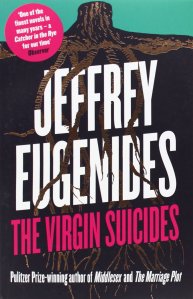
The Virgin Suicides by Jeffrey Eugenides

71mDSeTvYgL

(Originally published in 1993). Aimed at adults. Issues covered: suicide; teenage inadequacy; family problems.

This option is ideal for readers who are looking for more sophisticated and literary material on similar topics. This debut novel by Jeffrey Eugenides is certainly one the darkest (and funniest) I have ever read. The five oversheltered Lisbon sisters were difficult to differentiate: all blond, good-looking and reserved. Ranging from 13 to 17 in age, they were an eternal source of mystery and attraction to the young male kids of the neighborhood of this quiet Detroit suburb – these same boys, decades later, will narrate the sinister events which took place in the 1970s as an interesting choral voice, reminiscent of the format of Greek tragedies. Things get weird when the youngest sister, Cecilia, commits suicide, jumping from her bedroom window. Mr. and Mrs. Lisbon are devastated. The girls become progressively more detached and emotionally removed from their school and community until they stop leaving home altogether. Meanwhile, their house is undergoing a pathetic process of deterioration and decay. It looks terrible and smells bad. One year later, all the sisters will have killed themselves as well. What happened? Who’s to blame? Disturbing. Beautifully written. A masterpiece. The story was made into an acclaimed movie by director Sophia Coppola in 2000.

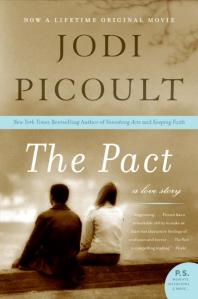
The Pact by Jodi Picoult

the-pact-06-lg

(Originally published in 1998). Aimed at young adults and adults. Issues covered: teenage pregnancy; young love; suicide.

Chris Harte and Emily Gold have known each other since they were born 17 years ago, only a few months apart. Their parents are neighbors and best friends. The kids were inseparable and their friendship blossomed into romantic love, which was exactly what their parents had been hoping for all along. They are about to finish high school, their whole lives ahead of them. Nevertheless, when they are found lying in a pool of blood near the carousel they loved going to at night, it looks like a double suicide took place. Could it have been a sinister pact? But only one bullet was fired and Chris survives, which makes the police suspect foul play.

Undone By Cat Clarke

c72abc874e3394978498e5736ce1cedc

(Originally published in 2013). Aimed at young adult readers. Issues covered: sexual orientation; bullying; suicide.

This time, instead of the infamous tapes of 13 Reasons Why, the protagonist, high-school student Jem Halliday, gets monthly letters from the afterlife with specific instructions for her to follow. The story, which takes place in a small town in England, is narrated in the first person by Jem, who has a huge crush on her best friend and long-time neighbor Kai McBride. Kai, who happens to be gay, is brutally outed when a video showing intimate scenes between him and another boy gets e-mailed anonymously to his colleagues at school, kicking off heavy homophobic bullying. As a result, Kai kills himself. Jem, outraged and angry, sets out on a mission to avenge her beloved friend. But to accomplish that, she needs to become part of the elite gang of popular kids at school.

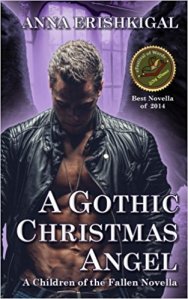
A Gothic Christmas Angel by Anna Erishkigal

51q3eF3zI2L._SX311_BO1,204,203,200_

(Originally published in 2013). Aimed at young adults. Issues covered: relationships; family matters; suicide.

This retelling of Charles Dickens’s classic A Christmas Carol takes place in modern-day Cape Cod, Massachusetts. 18-year-old Cassie works as a barista to help her alcoholic and harping mother. Her father abandoned the family when she was a kid. It’s Christmas Eve. Cassie gets dumped by her cheating boyfriend of five months, and out of despair, deliberately crashes her car into an old beech tree. As she lies slumped over the steering wheel, Cassie has an out-of-body kind of experience, being visited upon by a dark angel, Jeremiel – described in the book as “a smoking hot, really tall Goth Dude”. Can he help her review her life and avoid being sucked by demons into Hell?

Would you have any other suggestions? Please let us know.

Au revoir

Jorge Sette